


Page 79 - JCTR-10-1
P. 79
Adeba et al. | Journal of Clinical and Translational Research 2024; 10(1): 72-77   75
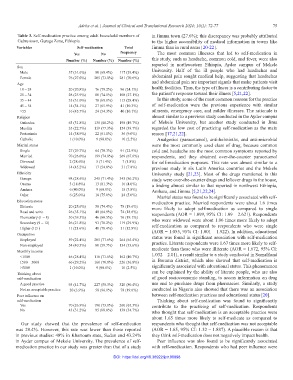
        Table 3. Self-medication practice among adult household members of   in Jimma town (27.6%); this discrepancy was probably attributed
        Gubre town, Gurage Zone, Ethiopia                       to the higher accessibility of medical information in towns like
        Variables                Self‑medication     Total      Jimma than in rural areas [20-22].
                                Yes        No      frequency       The  most common illnesses  that  led  to self-medication  in
                             Number (%)  Number (%)  Number (%)  this study, such as headache, common cold, and fever, were also
        Sex                                                     reported  in  northwestern  Ethiopia,  Ayder  campus  of  Mekele
         Male                 37 (31.6%)  80 (68.4%)  117 (29.4%)  University.  Half  of  the  ill  people  who  had  headaches  and
         Female               76 (27.0%)  205 (73.0%)  281 (70.6%)  abdominal pain sought medical help, suggesting that headaches
        Age                                                     and abdominal pain are important signals that make patients visit
         18 – 24              20 (20.8%)  76 (79.2%)  96 (24.1%)  health facilities. Thus, the type of illness is a contributing factor to
         25 – 34              28 (25.9%)  80 (74.1%)  108 (27.1%)  the patient’s response toward their illness [5,21,22].
         35 – 44              35 (31.0%)  78 (69.0%)  113 (28.4%)  In this study, some of the most common reasons for the practice
         45 – 54              14 (34.1%)  27 (65.9%)  41 (10.3%)  of self-medication were the previous experience  with similar
         >55                  16 (45.7%)  24 (54.3%)  40 (10.1%)  ailments, emergency care, and milder illnesses. The rationale is
        Religion                                                almost similar to a previous study conducted in the Ayder campus
         Orthodox             63 (31.8%)  135 (68.2%)  198 (49.7%)  of  Mekele  University,  but  another  study  conducted  in  Jima
         Muslim               35 (22.7%)  119 (77.3%)  154 (38.7%)  regarded the low cost of practicing self-medication as the main
         Protestants          14 (38.9%)  22 (61.1%)  36 (9.0%)  reason [17,21,22].
         Catholic             1 (10.0%)  9 (90.0%)  10 (2.5%)      Analgesics (paracetamol),  anti-helminths, and anti-microbial
        Marital status                                          were the most commonly used class of drug, because common
         Single               27 (29.7%)  64 (70.3%)  91 (22.9%)  cold and headache are the most common symptoms reported by
         Married              70 (26.0%)  199 (74.0%)  269 (67.6%)  respondents, and they obtained  over-the-counter  paracetamol
         Divorced             2 (28.6%)  5 (71.4%)  7 (1.8%)    for self-medication purposes. This rate was almost similar to a
         Widowed              14 (45.2%)  17 (54.8%)  31 (7.8%)  previous  study  in  six  Latin America  countries  and  the  Mekele
        Ethnicity                                               University  study  [21,23].  Most  of  the  drugs  mentioned  in  this
         Gurage               98 (28.6%)  245 (71.4%)  343 (86.2%)  study were over-the-counter drugs and leftover drugs in the house,
         Oromo                3 (18.8%)  13 (81.3%)  16 (4.0%)  a finding almost similar to that reported in northwest Ethiopia,
         Amhara               6 (40.0%)  9 (60.0%)  15 (3.8%)   Amhara, and Jimma [5,21,22,24].
         Other                6 (25.0%)  18 (75.0%)  24 (5.0%)     Marital status was found to be significantly associated with self-
        Education status                                        medication practice. Married respondents were about 1.6 times
         Illiterate           20 (25.6%)  58 (74.4%)  78 (19.6%)  more likely to adopt self-medication  as compared to single
         Read and write       26 (35.1%)  48 (64.9%)  74 (18.6%)  respondents (AOR = 1.099, 95% CI: 1.09 – 2.621). Respondents
         Elementary (1 – 8)   30 (39.5%)  46 (60.5%)  76 (19.1%)  who were widowed were about 1.06 times more likely to adopt
         Secondary (9 – 12)   26 (21.8%)  93 (78.2%)  119 (29.9%)
         Higher (12+)         11 (21.6%)  40 (78.4%)  51 (12.8%)  self-medication  as compared  to respondents who were single
        Occupation                                              (AOR = 1.055, 95% CI: 1.001 – 1.922). In addition, educational
         Employed             59 (22.4%)  205 (77.6%)  264 (65.4%)  status was found in significant association with self-medication
         Non-employed         54 (40.3%)  80 (59.7%)  134 (33.6%)  practice. Literate respondents were 1.67 times more likely to self-
        Monthly income                                          medicate than those who were illiterate (AOR = 1.672, 95% CI:
         <1500                46 (28.4%)  116 (71.6%)  162 (40.7%)  1.032 – 2.01), a result similar to a study conducted in Somaliland
         1500 – 5000          66 (29.2%)  160 (70.8%)  226 (56.8%)  in  Borama  district,  which  also  showed that  self-medication  is
         >5000                1 (10.0%)  9 (90.0%)  10 (2.5%)   significantly associated with educational status. This phenomenon
        Thinking about                                          can be explained by the ability of literate people, who are also
        self-medication                                         of good socioeconomic standing, to access information on drug
         A good practice      93 (41.7%)  227 (58.3%)  320 (80.4%)  use  and  to  purchase  drugs from  pharmacies. Similarly,  a  study
         Not an acceptable practice  20 (3.9%)  58 (96.1%)  78 (19.6%)  conducted in Nigeria also showed that there was an association

        Peer influence on                                       between self-medication practices and educational status[20].
        self-medication                                            Thinking  about  self-medication  was  found  to  significantly
         Yes                  70 (26.9%)  190 (73.1%)  260 (65.3%)  contribute to the practicing  of self-medication.  Respondents
         No                   43 (31.2%)  95 (68.8%)  138 (34.7%)  who thought that self-medication is an acceptable practice were
                                                                about 1.65  times more  likely  to self-medicate  as compared  to
          Our study showed that  the  prevalence  of self-medication   respondents who thought that self-medication was not acceptable
        was  28.4%.  However,  this  rate  was  lower  than  those  reported   (AOR = 1.65, 95% CI: 1.32 – 1.887). A plausible reason is that
        in previous studies: 48% in Khartoum state, Sudan and 43.24%   they think self-medication does not negatively impact health.
        in Ayder campus of Mekele University. The prevalence of self-  Peer  influence  was  also  found  to  be  significantly  associated
        medication practice in our study was greater than that of a study   with self-medication. Respondents who had peer influence were
                                                 DOI: https://doi.org/10.36922/jctr.00098

