


Page 82 - JCTR-10-2
P. 82
176                       Kikuchi et al. | Journal of Clinical and Translational Research 2024; 10(2): 172-179
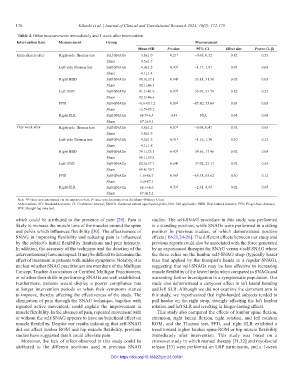
        Table 4. Other measurements immediately and 1 week after intervention
        Intervention time  Measurement       Group                                Measurement
                                                           Mean±SD     P‑value     95% CI      Effect size  Power (1–β)
        Immediately after  Right-side Thomas test  Self-SNAGs  3.8±1.0  0.21 §    −0.68, 0.52    0.82         0.55
                                              Sham          4.5±1.7
                          Left-side Thomas test  Self-SNAGs  4.0±1.5    0.93 §    −1.17, 1.07    0.03         0.05
                                              Sham          4.1±1.4
                          Right HBD           Self-SNAGs   90.9±37.1    0.94 §    −33.81, 31.38  0.05         0.05
                                              Sham         92.1±46.3
                          Left HBD            Self-SNAGs   91.5±41.9    0.97 §    −35.07, 33.79  0.82         0.55
                                              Sham         92.2±46.6
                          FFD                 Self-SNAGs   −8.1±111.2   0.89 §    −85.80, 75.04  0.03         0.05
                                              Sham         −2.7±95.2
                          Right SLR           Self-SNAGs   68.7±6.3     0.43         N/A         0.05         0.05
                                              Sham         67.1±6.1
        One week after    Right-side Thomas test  Self-SNAGs  3.8±1.2   0.87 §    −0.08, 0.47    0.92         0.65
                                              Sham          3.8±1.3
                          Left-side Thomas test  Self-SNAGs  4.2±1.3    0.91 §    −1.16, 1.30    0.30         0.12
                                              Sham          4.1±1.8
                          Right HBD           Self-SNAGs   79.1±33.3    0.43 §    −39.56, 17.46  0.02         0.05
                                              Sham         90.1±39.8
                          Left HBD            Self-SNAGs   82.9±37.7    0.64 §    −37.02, 23.17  0.92         0.65
                                              Sham         89.8±39.7
                          FFD                 Self-SNAGs   1.5±86.7     0.96 §    −69.38, 65.62  0.30         0.12
                                              Sham         3.4±87.1
                          Right SLR           Self-SNAGs   68.1±4.6     0.53 §    −2.61, 4.95    0.02         0.05
                                              Sham         67.0±5.2
        Note:  P-value was determined via the unpaired t-test; P-value was determined via the Mann–Whitney U test.
            §
        Abbreviations: SD: Standard deviation; CI: Confidence interval; SNAGs: Sustained natural apophyseal glides; N/A: Not applicable; HBD: Heel-buttock distance; FFD: Finger-floor distance;
        SLR: Straight leg raise test.
        which could be attributed to the presence of pain [29]. Pain is   studies. The self-SNAG procedure in this study was performed
        likely to increase the muscle tone of the muscles around the spine   in a standing position, while SNAGs were performed in a sitting
        and pelvis which influences flexibility [30]. The effectiveness of   position  in previous studies,  of which demonstrated  positive
        SNAG in improving flexibility and reducing pain is influenced   effects [19-21,24-26]. The different effects between our study and
        by the subject’s initial flexibility limitations and pain intensity.   previous reports could also be associated with the force generated
        In addition, the accuracy of the technique and the duration of the   by an experienced therapist for SNAG versus a self-SNAG where
        intervention may have an impact. It may be difficult to determine the   the force relies on the lumbar self-SNAG strap (typically lesser
        effect of treatment in patients with milder symptoms. Notably, it is   than  that  applied  by  the  therapist’s  hands  in  a  regular  SNAG),
        unclear whether SNAG practitioners are members of the Mulligan   suggesting  that  self-SNAGs  may  be  less  effective  in  increasing
        Concept Teacher Association or Certified Mulligan Practitioners,   muscle flexibility of the lower limbs when compared to SNAGs and
        or whether their skills in performing SNAGs are well established.   warranting further investigation in a symptomatic population. Our
        Furthermore,  patients  would  display  a  poorer  compliance  rate   study also demonstrated a carryover effect in left lateral bending
        at  longer  intervention  periods  or  when  their  symptoms  started   and left SLR. Although we did not examine the dominant arm in
        to improve, thereby affecting the effectiveness of the study. The   this study, we hypothesized that right-handed subjects tended to
        elimination of pain through the SNAG technique, together with   pull harder on the right strap, strongly affecting the left lumbar
        repeated  active  movement,  could  explain  the  improvement  in   rotation and left SLR and resulting in longer-lasting effects.
        muscle flexibility. In the absence of pain, repeated movement with   This study also compared the effects of lumbar spine flexion,
        or without the self-SNAG appears to have no beneficial effect on   extension,  right  lateral  flexion,  right  rotation,  and  left  rotation
        muscle flexibility. Despite our results indicating that self-SNAG   ROM,  and  the  Thomas  test,  FFD,  and  right  SLR  exhibited  a
        did not affect lumbar ROM and hip muscle flexibility, previous   trend toward higher lumbar spine ROM or hip muscle flexibility
        studies have suggested that it could alleviate pain.    immediately  after  intervention.  This  study  was  based  on  a
          Moreover, the lack of effect observed in this study could be   crossover study in which manual therapy [31,32] and myofascial
        attributed  to  the  different  positions  used  in  previous  SNAG   release [33] were performed on LBP participants, and a 1-week
                                                DOI: https://doi.org/10.36922/jctr.23.00091

