


Page 81 - JCTR-10-2
P. 81
Kikuchi et al. | Journal of Clinical and Translational Research 2024; 10(2): 172-179   175
        4. Discussion                                              For  lumbar  spine  ROM  (flexion,  extension,  right  lateral
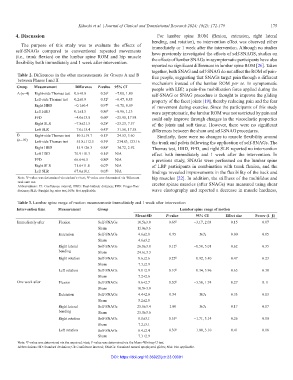
                                                                bending, and rotation), no intervention effect was observed either
          The  purpose  of  this  study  was  to  evaluate  the  effects  of
        self-SNAGs  compared  to  conventional  repeated  movements   immediately or 1 week after the intervention. Although no studies
                                                                have previously investigated the effects of self-SNAGS, studies on
        (i.e.,  trunk  flexion)  on  the  lumbar  spine  ROM  and  hip  muscle   the effects of lumbar SNAGs in asymptomatic participants have also
        flexibility both immediately and 1 week after intervention.
                                                                reported no significant differences in lumbar spine ROM [26]. Taken
                                                                together, both SNAG and self-SNAG do not affect the ROM of pain-
        Table 2. Differences in the other measurements for Groups A and B   free people, suggesting that SNAGs target pain through a different
        between Phases I and II
        Group  Measurement       Difference  P‑value  95% CI    mechanism instead of the lumbar ROM  per se.  In  symptomatic
                                                                people with LBP, a pain-free mobilization force applied during the
        A (n=4)  Right-side Thomas test  0.6±0.8  0.26 †  −7.00, 1.80  self-SNAG or SNAG procedure is thought to improve the gliding
               Left-side Thomas test  0.2±0.9  0.52 †  −0.47, 0.85  property of the facet joints [19], thereby reducing pain and the fear
               Right HBD        −0.1±0.4   0.97 †  −0.71, 0.69  of movement during exercise. Since the participants of this study
               Left HBD         0.1±1.5    0.86 †  −0.96, 1.13  were asymptomatic, the lumbar ROM was not restricted by pain and
               FFD              −4.0±13.8  0.60 †  −25.98, 17.98  could only improve through changes in the viscoelastic properties
               Right SLR        −7.8±21.5  0.28 †  −23.23, 7.57  of  the  joints  and  soft  tissue.  However,  there  were  no  significant
               Left SLR         −7.0±15.4  0.43 †  −31.58, 17.58  differences between the sham and self-SNAG procedures.
        B      Right-side Thomas test  −10.5±19.7  0.13 †  −24.53, 3.60  Similarly, there were no changes to muscle flexibility around
        (n=10)  Left-side Thomas test  −55.8±112.5  0.39 †  −234.83, 123.16  the trunk and pelvis following the application of self-SNAGs. The
               Right HBD        −15.9±26.3  0.88 †  −34.72, 2.92  Thomas test, HBD, FFD, and right SLR reported no intervention
               Left HBD         70.9±10.3  0.14 ‡  N/A          effect  both  immediately  and  1  week  after  the  intervention.  In
               FFD              66.6±6.5   0.80 ‡  N/A          a previous study, SNAGs were performed on the lumbar spine
               Right SLR        71.6±11.8  0.07 ‡  N/A          of LBP participants in combination with trunk flexion, and the
               Left SLR         67.0±10.1  0.05 ‡  N/A          findings revealed improvements in the flexibility of the back and
        Note:  P-value was determined via student’s t-test;  P-value was determined via Wilcoxon   hip muscles [22]. In addition, the stiffness of the multifidus and
            †
                                     ‡
        rank sum test.                                          erector spinae muscles (after SNAGs) was measured using shear
        Abbreviations: CI: Confidence interval; HBD: Heel-buttock distance; FFD: Finger-floor
        distance; SLR: Straight leg raise test; N/A: Not applicable.  wave elastography and reported a decrease in muscle hardness,
        Table 3. Lumbar spine range of motion measurements immediately and 1 week after intervention
        Intervention time  Measurement    Group                             Lumbar spine range of motion
                                                          Mean±SD     P‑value      95% CI      Effect size  Power (1–β)
        Immediately after  Flexion        Self-SNAGs      10.5±3.0      0.66 §    −3.17, 2.03    0.15          0.07
                                          Sham            11.0±3.6
                          Extension       Self-SNAGs       4.6±2.8      0.95        N/A          0.00          0.05
                                          Sham             4.6±3.2
                          Right lateral   Self-SNAGs      26.8±3.8      0.12 §    −0.58, 5.01    0.62          0.35
                          bending         Sham            24.6±3.3
                          Right rotation  Self-SNAGs       8.6±2.6      0.25 §    −0.92, 3.40    0.47          0.23
                                          Sham             7.3±2.9
                          Left rotation   Self-SNAGs       9.0±2.9      0.10 §    −0.34, 3.96    0.65          0.38
                                          Sham             7.2±2.6
        One week after    Flexion         Self-SNAGs       9.6±2.7      0.50 §    −3.50, 1.74    0.27          0.11
                                          Sham            10.5±3.9
                          Extension       Self-SNAGs       4.4±2.0      0.54        N/A          0.33          0.13
                                          Sham             5.2±2.8
                          Right lateral   Self-SNAGs      25.6±3.4      1.00        N/A          0.17          0.07
                          bending         Sham            25.0±3.6
                          Right rotation  Self-SNAGs       8.0±3.1      0.55 §    −1.71, 3.14    0.26          0.10
                                          Sham             7.2±3.1
                          Left rotation   Self-SNAGs       8.4±2.4      0.30 §    −1.00, 3.10    0.41          0.18
                                          Sham             7.3±2.9
        Note:  P-value was determined via the unpaired t-test; P-value was determined via the Mann-Whitney U test.
            §
        Abbreviations: SD: Standard deviation; CI: Confidence interval; SNAGs: Sustained natural apophyseal glides; N/A: Not applicable.
                                                DOI: https://doi.org/10.36922/jctr.23.00091

