


Page 79 - JCTR-10-2
P. 79
Kikuchi et al. | Journal of Clinical and Translational Research 2024; 10(2): 172-179   173
        and the lumbar spine range of motion (ROM) [8]. Nonetheless,   average height: 170.3 ± 4.3 cm; and average weight: 70.5 ± 13.3 kg).
        the causative factors (e.g., physical and functional) of LBP should   Participants were excluded if no consent was provided, if they had
        be considered during the treatment process.             a history of LBP within the past 2 years, or could not perform
          LBP  is  commonly  treated  with  conservative  management,   the self-SNAG exercise. The study was a prospective randomized
        which includes management exercise and manual therapy [14].   double-blinded crossover controlled study investigating the effect
        Among the different forms of manual therapy, mobilization with   of self-SNAGs on lumbar spine ROM in asymptomatic college
        movement  (MWM),  devised  by  New  Zealand  physiotherapist   students.
        Brian Mulligan  [15,16],  could  effectively  reduce  pain  and
        increase  ROM  at  the  affected  joints  of  patients.  A  sustained   2.2. Protocol
        natural  apophyseal  glide  (SNAG)  is  an  MWM  technique  that   Each participant performed a warm-up, consisting of lumbar
        encourages the patient to move in a painful restricted direction.   flexion,  extension,  lateral  bending,  and  rotation  movements
        At the same time, the therapist applies a specific force to the spine   that  were  performed  3  times  in  each  movement  direction.  In
        through the spinous process in a direction parallel to the facet joint   this  crossover  study,  different  exercises  were  performed  in
        plane [17-26]. The applied force could subsequently eliminate pain   Phases  I  and  II.  The  envelope  method  was  used  to  randomly
        during movement, and the pressure on the spinous process should   allocate  participants  to  either  group  A  or  B.  In  Phase  I,
        be adjusted according to the patient’s symptomatic response to the   Group A performed self-SNAG, while Group B performed the
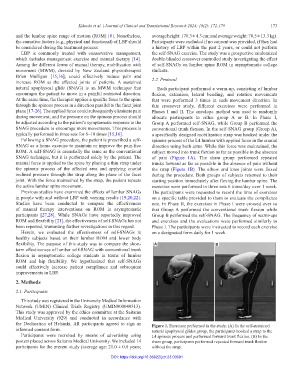
        SNAG procedure to encourage more movements. This process is   conventional trunk flexion. In the self-SNAG group (Group A),
        typically performed in three sets for 6–10 times [15,16].  a specifically designed mobilization strap was hooked under the
          Following a SNAG procedure, the patient is prescribed a self-  spinous process of the L4 lumbar with applied force in the cranial
        SNAG as a home exercise to maintain or improve the pain-free   direction using both arms. While this force was maintained, the
        ROM. A self-SNAG is essentially the same as the conventional   subject moved into trunk flexion as far as possible in the absence
        SNAG technique, but it is performed solely by the patient. The   of  pain  (Figure  1A).  The  sham  group  performed  repeated
        manual force is applied to the spine by placing a thin strap under   trunks forward as far as possible in the absence of pain without
        the  spinous  process  of  the  affected  area  and  applying  cranial   the strap (Figure  1B). The  elbow  and  knee  joints  were  flexed
        inclined pressure through the strap along the plane of the facet   during the procedure. Both groups of subjects returned to their
        joint. With the force maintained by the strap, the patient repeats   starting position immediately after flexing the lumbar spine. The
        the active lumbar spine movement.                       exercises were performed in three sets 6 times/day over 1 week.
          Previous studies have examined the effects of lumbar SNAGs   The participants were requested to record the time of exercises
        in people with and without LBP with varying results [19,20,22].   on a specific table provided to them to evaluate the compliance
        Studies  have  been  conducted  to  compare  the  effectiveness   rate. In Phase II, the exercises in Phase I were crossed over so
        of  manual  therapy  interventions  on  ROM  in  asymptomatic   that  Group A  performed  the  conventional  trunk  flexion  while
        participants  [27,28].  While  SNAGs  have  reportedly  improved   Group B performed the self-SNAG. The frequency of warm-ups
        ROM and flexibility [21], the effectiveness of self-SNAGs has not   and exercises and the evaluations were performed similarly to
        been reported, warranting further investigations in this regard.  Phase I. The participants were instructed to record each exercise
          Herein,  we  evaluated  the  effectiveness  of  self-SNAGs  in   on a designated form daily for 1 week.
        healthy  subjects  based  on  their  lumbar  ROM  and  lower  body
        flexibility. The purpose of this study was to compare the short-  A                B
        term effectiveness of lumbar self-SNAG with conventional trunk
        flexion  in  asymptomatic  college  students  in  terms  of  lumbar
        ROM  and  hip  flexibility.  We  hypothesized  that  self-SNAGs
        could  effectively  increase  patient  compliance  and  subsequent
        improvements in LBP.
        2. Methods

        2.1. Participants
          This study was registered in the University Medical Information
        Network  (UMIN)  Clinical  Trials  Registry  (UMIN000040313).
        This study was approved by the ethics committee at the Saitama
        Medical  University  (929)  and  conducted  in  accordance  with
        the  Declaration  of  Helsinki. All  participants  agreed  to  sign  an   Figure 1. Exercises performed in the study. (A) In the self-sustained
        informed consent form.                                  natural apophyseal glides group, the participants hooked a strap to the
          Participants  were  recruited  by  means  of  advertising  using   L4 spinous process and performed forward trunk flexion. (B) In the
        posters placed across Saitama Medical University. We included 14   sham group, participants performed repeated forward trunk flexion
        participants for the present study (average age: 21.0 ± 0.8 years;   without the strap.
                                                DOI: https://doi.org/10.36922/jctr.23.00091

