


Page 76 - JCTR-10-2
P. 76
170                       Ezenekwe et al. | Journal of Clinical and Translational Research 2024; 10(2): 165-171
          In addition, parathyroid lesions are most often located directly   and performance of different models [14]. Considering the recent
        adjacent  to  the  thyroid,  making  it  difficult  for  radiologists  and   success of other applications of radiomic data in the field, findings
        computers alike to distinguish between the two with a high level   of this study are anticipated to make a meaningful contribution
        of confidence. Thus, our selection and comparison of the thyroid to   to  future  advances  in  parathyroid  adenoma  identification  and
        parathyroid lesions in this study are particularly important. Our data   localization.  Ultimately,  the  ability  to  non-invasively  localize
        suggest that parathyroid lesions are associated with a unique set of   parathyroid  adenomas  preoperatively  could  in  turn  translate  to
        radiomic variables when compared to the thyroid. These distinct,   broader utilization of MIP, resulting in overall improved clinical
        quantifiable differences revealed will be of use in creating a texture   outcomes [1,2].
        signature specific to parathyroid adenomas. This signature could   Several limitations of this study should be acknowledged. The
        utilize dimensional and textural differences between the parathyroid   most prominent shortcoming of this study is that the relatively
        adenoma and surrounding anatomy to create models that predict   small sample size was n=20. In addition, the retrospective nature
        potential lesions and more precisely localize parathyroid adenomas.  of the study and selection bias might influence the generalizability
          Naturally,  the  next  step  in  our  application  of  this  data  is  to   of the results. Further investigation  is needed  to validate  our
        investigate  the  performance  of a  parathyroid  adenoma  texture   findings and warrant application in a clinical setting.
        signature in models differentiating lesions from surrounding neck   5. Conclusion
        anatomy on 4D-CTs. For example, a recent study has had moderate
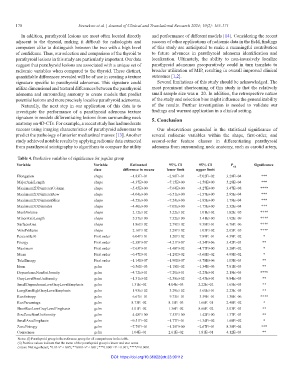
        success using imaging characteristics of parathyroid adenomas to   Our  observations  grounded  in  the  statistical  significance  of
        predict the pathology of anterior mediastinal masses [13]. Another   several  radiomic  variables  within  the  shape,  first-order,  and
        study achieved notable results by applying radiomic data extracted   second-order  feature  classes  in  differentiating  parathyroid
        from parathyroid scintigraphy to algorithms to compare the utility   adenoma from surrounding neck anatomy, such as carotid artery,

        Table 4. Predictive variables of significance for jugular group
        Variable                        Variable       Estimated        95% CI      95% CI       P adj     Significance
                                        class       difference in means   lower limit   upper limit
        Elongation                      shape          −1.83E−01       −2.96E−01   −7.02E−02    3.29E−04      ***
        MajorAxisLength                 shape          −4.37E+00       −7.15E+00   −1.59E+00    5.28E−04      ***
        Maximum2DDiameterColumn         shape          −5.45E+00       −7.64E+00   −3.27E+00    3.47E−08      ****
        Maximum2DDiameterRow            shape          −4.04E+00       −6.51E+00   −1.57E+00    2.95E−04      ***
        Maximum2DDiameterSlice          shape          −4.55E+00       −7.24E+00   −1.85E+00    1.79E−04      ***
        Maximum3DDiameter               shape          −4.40E+00       −7.05E+00   −1.75E+00    2.32E−04      ***
        MeshVolume                      shape          −2.12E+02       −3.22E+02   −1.01E+02    1.82E−05      ****
        MinorAxisLength                 shape          −5.37E+00       −7.32E+00   −3.41E+00    1.92E−09      ****
        SurfaceArea                     shape          −1.86E+02       −2.79E+02   −9.38E+01    6.76E−06      ****
        VoxelVolume                     shape          −2.16E+02       −3.29E+02   −1.03E+02    2.05E−05      ****
        Percentile10                    First order    −6.04E+01       −1.20E+02   −7.89E−01    4.59E−02       *
        Energy                          First order    −2.38E+07       −4.21E+07   −5.54E+06    5.42E−03       **
        Maximum                         First order    −7.63E+01       −1.48E+02   −4.77E+00    3.20E−02       *
        Mean                            First order    −6.47E+01       −1.29E+02   −3.60E−02    4.98E−02       *
        TotalEnergy                     First order    −1.14E+07       −1.90E+07   −3.78E+06    1.05E−03       **
        Idmn                            gclm           −6.56E−03       −1.18E−02   −1.34E−03    7.91E−03       **
        DependenceNonUniformity         gclm           −4.72E+01       −7.20E+01   −2.23E+01    2.19E−05      ****
        GrayLevelNonUniformity          gclm           −1.31E+02       −2.38E+02   −2.43E+01    9.84E−03       **
        SmallDependenceLowGrayLevelEmphasis  gclm       1.31E−02       4.04E−03     2.22E−02    1.65E−03       **
        LongRunHighGrayLevelEmphasis    gclm           −1.93E+02       −3.29E+02   −5.60E+01    2.23E−03       **
        RunEntropy                      gclm           −6.67E−01       −9.75E−01   −3.59E−01    1.38E−06      ****
        RunPercentage                   gclm            8.73E−02       8.15E−03     1.66E−01    2.48E−02       *
        ShortRunLowGrayLevelEmphasis    gclm            5.01E−02       1.36E−02     8.66E−02    3.03E−03       **
        SizeZoneNonUniformity           gclm           −4.48E+00       −7.53E+00   −1.42E+00    1.37E−03       **
        SmallAreaEmphasis               gclm           −9.51E−02       −1.77E−01   −1.34E−02    1.60E−02       *
        ZoneEntropy                     gclm           −7.79E−01       −1.29E+00   −2.67E−01    8.38E−04      ***
        Coarseness                      gclm            1.04E−01       2.61E−02     1.81E−01    4.12E−03       **
        Notes: (i) Parathyroid group is the reference group for all comparisons in the table.
        (ii) Positive values indicate that the mean of the parathyroid group is lower and vice versa.
        (iii) ns: Not significant; *0.01<P < 0.05; **0.001<P < 0.01; ***0.0001<P < 0.001; ****P<0.0001.
                                                DOI: https://doi.org/10.36922/jctr.23.00112

