


Page 80 - JCTR-10-2
P. 80
174                       Kikuchi et al. | Journal of Clinical and Translational Research 2024; 10(2): 172-179
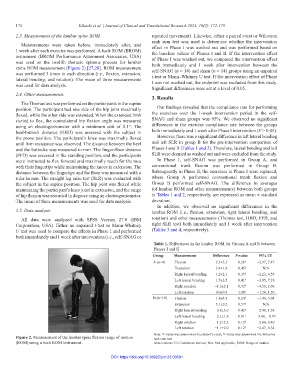
        2.3. Measurement of the lumbar spine ROM                repeated movement). Likewise, either a paired t-test or Wilcoxon
                                                                rank  sum test  was used to  determine  whether  the  intervention
          Measurements  were  taken  before,  immediately  after,  and   effect in Phase I was washed out and was performed based on
        1 week after each exercise was performed. A back ROM (BROM)   the baseline values of Phases I and II. If the intervention effect
        instrument  (BROM  Performance  Attainment  Associates,  USA)   of Phase I was washed out, we compared the intervention effect
        was used on the twelfth thoracic  spinous process for lumbar   both  immediately  and  1  week  after  intervention  between  the
        spine ROM measurement (Figure 2) [27,28]. ROM measurement   self-SNAG (n = 14) and sham (n = 14) groups using an unpaired
        was performed 3 times in each direction (i.e., flexion, extension,   t-test or Mann–Whitney U test. If the intervention effect of Phase
        lateral bending, and rotation). The mean of three measurements   I was not washed out, the endpoint was excluded from this study.
        was used for data analysis.
                                                                Significant differences were set at a level of 0.05.
        2.4. Other measurements
                                                                3. Results
          The Thomas test was performed on the participants in the supine
        position. The participant had one side of the hip joint maximally   Our findings revealed that the compliance rate for performing
        flexed, while the other side was extended. When the extended limb   the  exercises  over  the  1-week  intervention  period  in  the  self-
        started to flex, the contralateral hip flexion angle was measured   SNAG and sham groups was 95%. We observed no significant
        using  an  electrogoniometer  with  a  minimum  unit  of  0.1°.  The   differences in the exercise compliance rate between the groups
        heal-buttock  distance  (HBD)  was  assessed  with  the  subject  in   both immediately and 1 week after Phase I intervention (P > 0.05).
        the prone position. The participant’s knee was maximally flexed   However, there was a significant difference in left lateral bending
        until firm resistance was observed. The distance between the heel   and left SLR in group B for the pre-intervention comparison of
        and the buttocks was measured in mm. The finger-floor distance   Phases I and II (Tables 1 and 2). Therefore, lateral bending and left
        (FFD) was assessed in the standing position, and the participants   SLR were deemed as washed out and were excluded from the study.
        were instructed to flex forward and maximally reach for the toes   In  Phase  I,  self-SNAG  was  performed  in  Group  A,  and
        with their fingertips while maintaining the knees in extension. The   conventional  trunk  flexion  was  performed  in  Group  B.
        distance between the fingertips and the floor was measured with a   Subsequently in Phase II, the exercises in Phase I were replaced,
        ruler in mm. The straight leg raise test (SLR) was evaluated with   where  Group  A  performed  conventional  trunk  flexion  and
        the subject in the supine position. The hip joint was flexed while   Group  B  performed  self-SNAG.  The  difference  in  averages
        maintaining the participant’s knee joint in extension, and the range   (of lumbar ROM and other measurements) between both groups
        of hip flexion was recorded in degrees using an electrogoniometer.   in Tables 1 and 2, respectively, are expressed as mean ± standard
        The mean of three measurements was used for data analysis.  deviation.
                                                                   In  addition,  we  observed  no  significant  differences  in  the
        2.5. Data analysis                                      lumbar ROM (i.e., flexion, extension, right lateral bending, and
          All  data  were  analyzed  with  SPSS  Version  27.0  (IBM   rotation) and other measurements (Thomas test, HBD, FFD, and
        Corporation, USA). Either an unpaired t-test or Mann-Whitney   right SLR test) both immediately and 1 week after intervention
        U test was used to compare the effects in Phase I and performed   (Tables 3 and 4, respectively).
        both immediately and 1 week after intervention (i.e., self-SNAG or
                                                                 Table 1. Differences in the lumbar ROM for Groups A and B between
                                                                 Phases I and II
                                                                 Group    Measurement     Difference  P‑value  95% CI
                                                                 A (n=4)  Flexion          2.3±3.3  0.26 †  −2.97, 7.47
                                                                          Extension        2.4±1.8  0.45 ‡     N/A
                                                                          Right lateral bending  1.2±2.1  0.35 †  −2.23, 4.56
                                                                          Left lateral bending  1.7±3.5  0.41 †  −3.85, 7.18
                                                                          Right rotation   −1.3±2.1  0.32 †  −4.56, 2.06
                                                                          Left rotation    0.0±0.9  1.00 †  −1.50, 1.50
                                                                 B (n=10)  Flexion         1.8±4.5  0.24 †  −1.44, 5.04
                                                                          Extension        3.1±0.2  0.57 ‡     N/A
                                                                          Right lateral bending  −0.8±3.0  0.43 †  −2.98, 1.38
                                                                          Left lateral bending  −2.1±1.8  0.01 †  −3.48, −0.79
                                                                          Right rotation   −1.2±2.2  0.12 †  −2.80, 0.40
                                                                          Left rotation    −1.1±2.0  0.12 †  −2.47, 0.34
                                                                                              ‡
                                                                 Note:  P-value was determined via student’s t-test;  P-value was determined via Wilcoxon
                                                                     †
        Figure 2. Measurement of the lumbar spine flexion range of motion   rank sum test.
        (ROM) using a back ROM instrument.                       Abbreviations: CI: Confidence interval; N/A: Not applicable; ROM: Range of motion.
                                                DOI: https://doi.org/10.36922/jctr.23.00091

