


Page 10 - JCTR-10-4
P. 10
232                       Tyson et al. | Journal of Clinical and Translational Research 2024; 10(4): 229-236
        enrolling interventional studies with corresponding coordinator   It should be noted that this modification of the OPAL tool
        effort tracking from June 1, 2022, to December 1, 2022. Studies   was previously tested by the team comparing 11 interventional
        that had <6 months of coordinator hours logged against it were   protocols [26]. There was a statistically significant difference
        excluded from the study. A total of seven studies were included   between the average standard OPAL score (3.64 ± 0.5) compared
        in  the  data  set.  A  committee  comprised  personnel  from  the   to the adapted OPAL score (7.45 ± 1.64; P < 0.0001). Therefore,
        MSM  Clinical  Trials  Office  then  reviewed  and  graded  each   the  adapted  score  could  differentiate  between  sensitivities
        study protocol using an adapted OPAL tool.             between  protocol  workloads  with  the  same  standard  OPAL
                                                               score.
        2.2. Statistical analysis
                                                               3. Results
          Descriptive  statistics  were  used  to  compare  the  protocol
        characteristics  to  the  adapted  OPAL  score  and  tracked   A total of seven protocols were included in the dataset. Of
        coordinator hours using Student’s t-test to compare averages.   these,  5  (71%)  protocols  were  federally  funded  compared  to
        A univariate analysis was performed using non-parametric tests   2  (29%)  that  were  industry-sponsored;  4  (57%)  studies  were
        for the differences in the continuous variables. Linear regression   behavioral interventions compared to 3 (43%) drug studies. The
        analysis was also performed to assess and quantify the association   range of the adapted OPAL scores was 4.75 – 9.0.
        between the adapted OPAL score and tracked coordinator hours.   There  were  significant  differences  between  sponsor  and
        This study is considered a quality improvement study and was   intervention types when compared to the adapted OPAL score.
        not subject to IRB review or approval.                 Industry-sponsored studies yielded a higher workload estimate

        2.3. Time- and task-tracking application               than federally-sponsored studies (7.25 ± 1.77 vs. 6.45 ± 1.65;
                                                               P < 0.0001). In addition, behavioral interventions (i.e., exercise
          The  research  coordinators  at  MSM  used  a  time-  and   and diet) were estimated at a higher workload assessment than
        task-tracking  application  to  monitor  the  total  time  spent   drug studies (6.88 ± 1.56 vs. 6.42 ± 1.91; P < 0.0001). These
        conducting  study  activities.  The  application  is  accessible   findings are summarized in Table 3.
        through TEAMS, is mobile optimized, and links to the MSM   Although industry-sponsored studies and drug studies had
        CTMS  in  real  time.  Study  activities  are  tracked  in  broad   more coordinator hours tracked against them, there was no
        categories:  recruitment,  communication,  scheduling,  subject   significant relationship between the number of hours tracked
        visits, regulatory/compliance, sponsor visits, sponsor training,   and  the  study  sponsor  type.  Industry-sponsored  studies
        and data entry/query resolution.                       had  an  average  of  181  ±  152.7  h  compared  to  federally
        2.4. Adapted OPAL tool calculation                     sponsored studies with 98 ± 142.6 h tracked (P = 0.06). Drug
                                                               intervention studies had an average of 128.7 ± 141 h tracked
          Research  protocols  were  graded  using  an  adapted  OPAL   compared to behavioral interventions with 116.5 ± 157.6 h
        tool. The base score for the adapted tool is derived from the   tracked (P = 0.06). These findings are summarized below in
        standard OPAL pyramid scale of 1 – 8 (Figure 1). Weighted   Table 4.
        elements  were  then  added  to  the  base  score  to  calculate  the
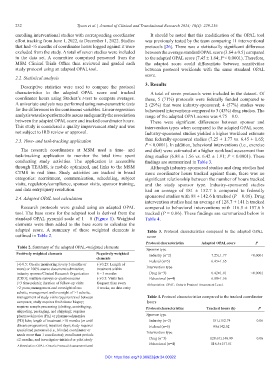
        adapted  score.  A  summary  of  these  weighted  elements  is   Table  3.  Protocol  characteristics  compared  to  the  adapted  OPAL
        outlined in Table 2.                                    score
                                                               Protocol characteristics  Adapted OPAL score   P
        Table 2. Summary of the adapted OPAL-weighted elements  Sponsor type
        Positively weighted elements      Negatively weighted    Industry (n=2)            7.25±1.77        <0.0001
                                          elements               Federal (n=5)             6.45±1.65
        (+) 0.5: On-site monitoring (every 3 months or   (-) 0.25: Length of
        more) or 100% source document submission;   treatment within    Intervention type
        industry sponsor/Clinical Research Organization   0 – 3 months  Drug (n=3)         6.42±1.91        <0.0001
        (CRO); multiple surveys or questionnaires    (-) 0.5: Visits less   Behavioral (n=4)  6.88±1.56
        (>3 time points); duration of follow-up visits   frequent than every    Abbreviation: OPAL: Ontario Protocol Assessment Level.
        >2 years; management and oversight of one   4 weeks; no data entry
        subsite; management and oversight of >1 subsite;
        management of study visits requires travel between      Table 4. Protocol characteristics compared to the tracked coordinator
        campuses; study requires fresh tissue biopsy;           hours
        requires sample processing (clotting, centrifuging,    Protocol characteristics  Tracked hours (h)     P
        aliquoting, packaging, and shipping); requires
        pharmacokinetics (PK) or pharmacodynamics              Sponsor type
        (PD) labs; length of treatment >18 months (or until      Industry (n=2)            181±152.74         0.06
        disease progression); inpatient days; study requires     Federal (n=5)              98±142.62
        specialized personnel (i.e., blinded coordinator or    Intervention type
        needs more than 1 coordinator); enrollment periodc
        ≤2 months; and investigator-initiated or pilot study     Drug (n=3)               128.67±140.99       0.06
                                                                 Behavioral (n=4)          116.5±157.61
        Abbreviation: OPAL: Ontario Protocol Assessment Level
                                              DOI: https://doi.org/10.36922/jctr.24.00022

