


Page 11 - JCTR-10-4
P. 11
Tyson et al. | Journal of Clinical and Translational Research 2024; 10(4): 229-236   233
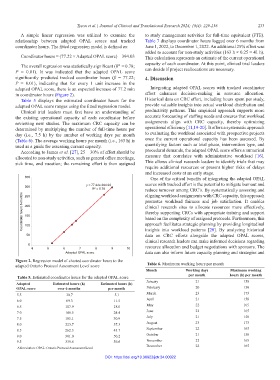
          A  simple  linear  regression  was  utilized  to  examine  the   to study management activities for full-time equivalent (FTE).
        relationship  between  adapted  OPAL  scores  and  tracked   Table 7 displays coordinator hours logged over 6 months from
        coordinator hours. The fitted regression model is defined as:  June 1, 2022, to December 1, 2022. An additional 25% effort was
                                                               added to account for non-study activities (163 h × 0.25 = 41 h).
          Coordinator hours = (77.22 × Adapted OPAL score) – 394.03  This calculation represents an estimate of the current operational

          The overall regression was statistically significant (R   = 0.78;   capacity of each coordinator. At this point, clinical trial leaders
                                                   2
        P  =  0.01).  It  was  indicated  that  the  adapted  OPAL  score   can decide if project reallocations are necessary.
        significantly  predicted  tracked  coordinator  hours  (β  =  77.22;   4. Discussion
        P  =  0.01),  indicating  that  for  every  1  unit  increase  in  the
        adapted OPAL score, there is an expected increase of 77.2 min   Integrating  adapted  OPAL  scores  with  tracked  coordinator
        in coordinator hours (Figure 2).                       effort  enhances  decision-making  in  resource  allocation.
          Table  5  displays  the  estimated  coordinator  hours  for  the   Historical data on CRC effort, including hours spent per study,
        adapted OPAL score ranges using the fitted regression model.  provide valuable insights into actual workload distribution and
          Clinical  trial  leaders  must  first  have  an  understanding  of   productivity  patterns. This  empirical  approach  supports  more
        the  existing  operational  capacity  of  each  coordinator  before   accurate forecasting of staffing needs and ensures that workload
        reviewing  new  studies.  The  maximum  CRC  capacity  can  be   assignments  align  with  CRC  capacity,  thereby  optimizing
        determined by multiplying the number of full-time hours per   operational efficiency [11,19-20]. It offers a systematic approach
        day  (i.e.,  7.5  h)  by  the  number  of  working  days  per  month   to evaluating the workload associated with prospective projects
        (Table 6). The average working hours per month (i.e., 163 h) is   once  the  current  operational  capacity  has  been  assessed.  By
        used as a guide for assessing current capacity.        quantifying factors such as trial phase, intervention type, and
          According to James et al. [27], 25 – 30% of effort should be   procedural demands, the adapted OPAL score offers a numerical
        allocated to non-study activities, such as general office meetings,   measure  that  correlates  with  administrative  workload  [16].
        sick  time,  and  vacation;  the  remaining  effort  is  then  assigned   This allows clinical research leaders to identify trials that may
                                                               require  additional  resources  or  present  higher  risks  of  delays
                                                               and increased costs at an early stage.
            350                                                  One of the critical benefits of integrating the adapted OPAL

            300                       y = 77.22x-394.03        scores with tracked effort is the potential to mitigate burnout and
                                        R² = 0.78              reduce turnover among CRC’s. By systematically assessing and
                                                               aligning workload assignments with CRC capacity, this approach
          Coordinator hours 6-months  200                      promotes  workload  fairness  and  job  satisfaction.  It  enables
            250
                                                               clinical  research  sites  to  allocate  resources  more  effectively,
                                                               thereby supporting CRCs with appropriate training and support
            150
                                                               based on the complexity of assigned protocols. Furthermore, this
            100
                                                               insights  into  workload  patterns  [20].  By  analyzing  historical
                                                               data  on  CRC  efforts  alongside  the  adapted  OPAL  scores,
            50                                                 approach facilitates strategic planning by providing longitudinal
                                                               clinical research leaders can make informed decisions regarding
             0                                                 resource allocation and budget negotiations with sponsors. The
              4      5      6      7      8     9      10
                             Adapted OPAL score                data can also inform future capacity planning and strategies and
        Figure 2. Regression model of charted coordinator hours to the
        adapted Ontario Protocol Assessment Level score         Table 6. Maximum working hours per month
                                                               Month            Working days       Maximum working
        Table 5. Estimated coordinator hours for the adapted OPAL score          per month         hours (h) per month
        Adapted         Estimated hours (h)   Estimated hours (h)   January         21                   158
        OPAL score        over 6 months        per month       February             20                   150
        5.5                  30.7                 5.1          March                23                   173
        6.0                  69.3                11.5          April                21                   158
        6.5                  107.9               18.0          May                  22                   165
        7.0                  146.5               24.4          June                 22                   165
        7.5                  185.1               30.9          July                 21                   158
        8.0                  223.7               37.3          August               23                   173
        8.5                  262.3               43.7          September            22                   165
        9.0                  301.0               50.2          October              21                   158
        9.5                  339.6               56.6          November             22                   165
                                                               December             22                   165
        Abbreviation: OPAL: Ontario Protocol Assessment Level
                                              DOI: https://doi.org/10.36922/jctr.24.00022

