


Page 26 - JCTR-10-4
P. 26
248                       Sari et al. | Journal of Clinical and Translational Research 2024; 10(4): 246-255


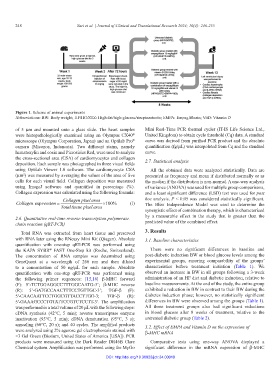
        Figure 1. Scheme of animal experiments
        Abbreviations: BW: Body weight; HF/HG/STZ: High-fat/high-glucose/streptozotocin; EMPA: Empagliflozin; VitD: Vitamin D


        of 5  µm and mounted onto a glass slide.  The heart samples   Mini  Real-Time  PCR  thermal  cycler  (IT-IS  Life  Science  Ltd.,
        were  histopathologically  examined  using  an  Olympus  CX40    United Kingdom) to obtain cycle threshold (Cq) data. A standard
                                                         ®
        microscope (Olympus Corporation, Japan) and an Optilab Pro    curve was derived from purified PCR product and the absolute
                                                         ®
        camera  (Miconos,  Indonesia).  Two  different  stains,  namely   quantification (fg/µL) was interpolated from Cq and the standard
        hematoxylin and eosin and Picrosirius Red, were used to analyze   curve.
        the cross-sectional area (CSA) of cardiomyocytes and collagen
        deposition. Each sample was photographed in three visual fields   2.7. Statistical analysis
        using  Optilab  Viewer  1.0  software.  The  cardiomyocyte  CSA   All  the  obtained data  were  analyzed  statistically. Data  are
        (µm ) was measured by averaging the values of the area of five   presented as frequency and mean if distributed normally or as
           2
        cells  for  each  visual  field.  Collagen  deposition  was  measured   the median if the distribution is non-normal. A one-way analysis
        using  ImageJ  software  and  quantified  in  percentage  (%).   of variance (ANOVA) was used for multiple group comparisons,
        Collagen expression was calculated using the following formula:  and a least significant difference (LSD) test was used for post
                            Collagen pixel area                hoc analysis. P < 0.05 was considered statistically significant.
        Collagen  expression =               × 100%     (I)    The  Bliss  Independence  Model  was  used  to  determine  the
                           Totaltissue pixel area
                                                               synergistic effect of combination therapy, which is characterized
        2.6. Quantitative real-time reverse-transcription polymerase   by  a  measurable  effect  in  the  study  that  is  greater  than  the
        chain reaction (qRT-PCR)                               predicted value of the combined effect.
          Total  RNA  was  extracted  from  heart  tissue  and  preserved   3. Results
        with RNA later using the RNeasy Mini Kit (Qiagen). Absolute   3.1. Baseline characteristics
        quantification  with  one-step  qRT-PCR  was  performed  using
        the  KAPA  SYBR   FAST  One-Step  kit  (Roche,  Switzerland).   There  were  no  significant  differences  in  baseline  and
                      ®
        The  concentration  of  RNA  samples  was  determined  using   post-diabetic induction BW or blood glucose levels among the
        GeneQuant  at  a  wavelength  of  260  nm  and  then  diluted   experimental  groups,  ensuring  comparability  of  the  groups’
        to  a  concentration  of  50  ng/µL for each sample.  Absolute   characteristics  before treatment initiation  (Table  1). We
        quantification  with  one-step  qRT-PCR  was  performed  using   observed an increase in BW in all groups following a 3-week
        the following primer sequences:  [15,16]  β-MHC forward   administration of an HF diet and diabetic induction, relative to
        (F):  5’-TCTGGAGGCCTTTGGCAATG-3’;  β-MHC  reverse      baseline measurements. At the end of the study, the entire group
        (R):   5’-GATGCCAACTTTCCTGTTGC-3’;     TGF-β   (F):    exhibited a reduction in BW in contrast to their BW during the
        5′-CAACAATTCCTGGCGTTACCTTGG-3;        TGF-β    (R):    diabetes induction phase; however, no statistically significant
        5′-GAAAGCCCTGTATTCCGTCTCCTT-3′.  The  amplification    differences in BW were observed among the groups (Table 1).
        was performed in a total volume of 20 µL with the following steps:   All  three  treatment  groups  also  had  significant  reductions
        cDNA  synthesis  (42°C,  5  min);  reverse  transcriptase  enzyme   in  blood  glucose  after  8  weeks  of  treatment,  relative  to  the
        inactivation  (95°C,  5  min);  cDNA  denaturation  (95°C,  3  s);   untreated diabetic group (Table 2).
        annealing (60°C, 20 s); and 40 cycles. The amplified products   3.2. Effect of EMPA and Vitamin D on the expression of
        were analyzed using 2% agarose gel electrophoresis stained with   β-MHC mRNA
        ×3 Gel Green (Biotium, United States of America [USA]). PCR
        products were measured using the Dark Reader DR46B Clare   Comparative  tests  using  one-way  ANOVA  displayed  a
        Chemical system. Amplification was performed using the MyGo   significant  difference  in  the  mRNA  expression  of  β-MHC

                                               DOI: http://doi.org/10.36922/jctr.24.00010

