


Page 27 - JCTR-10-4
P. 27
Sari et al. | Journal of Clinical and Translational Research 2024; 10(4): 246-255   249
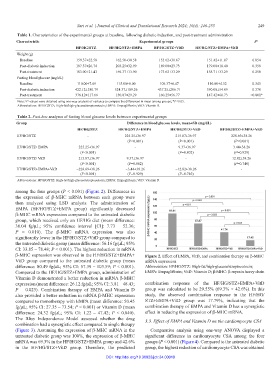
        Table 1. Characteristics of the experimental groups at baseline, following diabetic induction, and post-treatment administration
        Characteristic                                      Experimental groups                              P a
                                 HF/HG/STZ     HF/HG/STZ+EMPA     HF/HG/STZ+VitD    HF/HG/STZ+EMPA+VitD
        Weight (g)
         Baseline                159.37±22.58     162.50±30.58       155.62±31.67        151.42±11.07       0.854
         Post-diabetic induction  187.37±26.74    203.25±32.99       189.00±23.73        179.00±18.40       0.358
         Post-treatment          183.00±21.43     169.37±13.90       173.62±33.29        158.71±33.29       0.250
        Fasting blood glucose (mg/dL)
         Baseline                 110.00±7.69      115.00±8.00       109.37±6.47         110.00±4.32        0.343
         Post-diabetic induction  422.12±180.79   524.37±109.26     437.25±206.71        390.00±54.09       0.370
         Post-treatment          376.12±117.66    150.87±29.29       160.25±56.77        147.42±60.73       <0.001*
        Note:  P-values were obtained using one-way analysis of variance to compare the differences in mean among groups; *P<0.05.
            a
        Abbreviations: HF/HG/STZ: High-fat/high-glucose/streptozotocin; EMPA: Empagliflozin; VitD: Vitamin D.
        Table 2. Post-hoc analyses of fasting blood glucose levels between experimental groups
        Group                                          Difference in blood glucose levels, mean±SD (mg/dL)
                                  HF/HG/STZ        HF/HG/STZ+EMPA         HF/HG/STZ+VitD      HF/HG/STZ+EMPA+VitD
        HF/HG/STZ                     -               225.25±36.97          215.87±36.97           228.69±38.26
                                                       (P<0.001)             (P<0.001)               (P<0.001)
        HF/HG/STZ+EMPA            −225.25±36.97           -                 −9.37±36.97             3.44±38.26
                                   (P<0.001)                                 (P=0.802)               (P=0.929)
        HF/HG/STZ+VitD            −215.87±36.97        9.37±36.97               -                   12.82±38.26
                                   (P<0.001)           (P=0.802)                                     (P=0.740)
        HF/HG/STZ+EMPA+VitD       −228.69±38.26       −3.44±38.26           −12.82±38.26                -
                                   (P<0.001)           (P=0.929)             (P=0.740)
        Abbreviations: HF/HG/STZ: High-fat/high-glucose/streptozotocin; EMPA: Empagliflozin; VitD: Vitamin D.

        among the four groups (P < 0.001) (Figure 2). Differences in
        the expression of  β-MHC  mRNA  between  each  group  were
        then  analyzed  using LSD analysis.  The  administration  of
        EMPA  (HF/HG/STZ+EMPA  group)  significantly  decreased
        β-MHC mRNA expression compared to the untreated diabetic
        group, which received only an HF/HG diet (mean difference:
        30.04  fg/µL;  95%  confidence  interval  [CI]:  7.73  –  52.36;
        P  =  0.010).  The  β-MHC  mRNA  expression  was  also
        significantly lower in the HF/HG/STZ+VitD group compared to
        the untreated diabetic group (mean difference: 56.16 fg/µL; 95%
        CI: 33.85 – 78.48; P < 0.001). The highest reduction in mRNA
        β-MHC expression was observed in the HF/HG/STZ+EMPA+   Figure 2. Effect of EMPA, VitD, and combination therapy on β-MHC
        VitD group compared  to the untreated  diabetic  group (mean   mRNA expression
        difference: 80.49 fg/µL; 95% CI: 57.39 – 103.59; P < 0.001).   Abbreviation: HF/HG/STZ: High-fat/high-glucose/streptozotocin;
        Compared to the HF/HG/STZ+EMPA group, administration of   EMPA: Empagliflozin; VitD: Vitamin D; β-MHC: β-myosin heavy chain
        Vitamin D demonstrated a better reduction in mRNA β-MHC
        expression (mean difference: 26.12 fg/µL; 95% CI: 3.81 – 48.43;   combination  response  of  the  HF/HG/STZ+EMPA+VitD
        P  =  0.023).  Combination  therapy  of  EMPA  and  Vitamin  D   group was calculated to be 29.55% (69.3% × 42.6%). In this
        also provided a better reduction in mRNA β-MHC expression   study,  the  observed  combination  response  in  the  HF/HG/
        compared to monotherapy with EMPA (mean difference: 50.45   STZ+EMPA+VitD  group  was  17.79%,  indicating  that  the
        fg/µL; 95% CI: 27.35 – 73.54; P < 0.001) or Vitamin D (mean   combination therapy of EMPA and Vitamin D has a synergistic
        difference:  24.32  fg/µL;  95%  CI:  1.22  –  47.42;  P  <  0.040).   effect in reducing the expression of β-MHC mRNA.
        The  Bliss  Independence  Model  assessed  whether  the  drug   3.3. Effect of EMPA and Vitamin D on the cardiomyocyte CSA
        combination had a synergistic effect compared to single therapy
        (Figure 3). Assuming the expression of β-MHC mRNA in the   Comparative  analysis  using  one-way  ANOVA  displayed  a
        untreated diabetic group was 100%, the expression of β-MHC   significant  difference  in  cardiomyocyte  CSA  among  the  four
        mRNA was 69.3% in the HF/HG/STZ+EMPA group and 42.6%   groups (P < 0.001) (Figure 4). Compared to the untreated diabetic
        in  the  HF/HG/STZ+VitD  group.  Therefore,  the  predicted   group, the highest reduction of cardiomyocyte CSA was obtained

                                               DOI: http://doi.org/10.36922/jctr.24.00010

