


Page 42 - JCTR-10-4
P. 42
264                       Biberstein et al. | Journal of Clinical and Translational Research 2024; 10(4): 263-268
        is now accepted that both implant and surgical factors impact
        fixation  [5,7-9].  More  specifically,  these  include  component
        malalignment, improper bone surface preparation, and drying,
        poor  cement  technique  including  mixing  and  handling,
        potentially high-viscosity cements, and smaller cement mantles,
        as well as other intraoperative surgical technique errors. These
        problems can all detrimentally affect the cement structure and
        strength at the implant-cement interface, potentially increasing
        the risk of component  debonding and, subsequently, aseptic
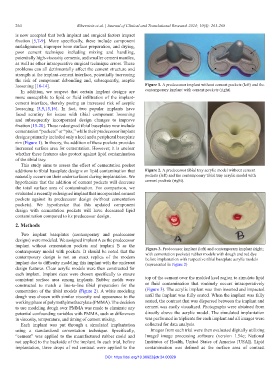
        loosening [10-14].                                     Figure 1. A predecessor implant without cement pockets (left) and the
          In addition, we suspect that  certain  implant  designs are   contemporary implant with cement pockets (right).
        more  susceptible  to  lipid  or  fluid  infiltration  of  the  implant-
        cement interface, thereby posing an increased risk of aseptic
        loosening  [5,9,15,16]. In fact, two popular implants have
        faced scrutiny for issues with tibial  component loosening
        and  subsequently  incorporated  design  changes  to  improve
        fixation [15-20]. These redesigned tibial baseplates now include
        cementation “pockets” or “pits,” while their predecessor implant
        designs primarily included only a keel and a peripheral baseplate
        rim (Figure 1). In theory, the addition of these pockets provides
        increased surface area for cementation. However, it is unclear
        whether these features also protect against lipid contamination
        of the tibial tray.
          This study aims to assess the effect of cementation pocket
        additions to tibial baseplate designs on lipid contamination that   Figure 2. A predecessor tibial tray acrylic model without cement
        naturally occurs on their undersurfaces during implantation. We   pockets (left) and the contemporary tibial tray acrylic model with
        hypothesize that the addition of cement pockets will decrease   cement pockets (right).
        the total surface area of contamination.  For  comparison, we
        evaluated a recently redesigned implant that incorporated cement
        pockets against  its predecessor design (without cementation
        pockets).  We  hypothesize  that  this  updated  component
        design with cementation  pockets will have decreased lipid
        contamination compared to its predecessor design.

        2. Methods
          Two implant baseplates (contemporary and predecessor
        designs) were modeled. We assigned implant A as the predecessor
        implant  without cementation  pockets  and  implant  B  as  the   Figure 3. Predecessor implant (left) and contemporary implant (right;
        contemporary model with pockets. It should be noted that the   with cementation pockets) rubber models with dough and red dye
        contemporary  design  is  not  an  exact  replica  of  the  modern   before implantation with respective tibial baseplate acrylic models
        implant due to difficulty modeling this implant with the undercut   (represented in Figure 2)
        design features. Clear acrylic models were then constructed for
        each  implant.  Implant  sizes  were  chosen  specifically  to  ensure
        consistent surface area among implants. Rubber molds were   top of the cement over the molded keel region to simulate lipid
        constructed to match a line-to-line tibial preparation for the   or  fluid  contamination  that  routinely  occurs  intraoperatively
        cementation of  the tibial models (Figure  2). A  white modeling   (Figure 3). The acrylic implant was then inserted and impacted
        dough was chosen with similar viscosity and appearance to the   until the implant was fully seated. When the implant was fully
        working phase of polymethylmethacrylate (PMMA). The decision   seated, the contrast that was dispersed between the implant and
        to use modeling dough over PMMA was made to eliminate any   cement was easily visualized. Photographs were obtained from
        potential confounding variables with PMMA, such as differences   directly above the acrylic model. The simulated implantation
        in viscosity, temperature, and timing of cement mixing.  was performed in triplicate for each implant and all images were
          Each  implant  was put  through  a  simulated  implantation   collected for data analysis.
        using  a  standardized  cementation  technique.  Specifically,   Images from each trial were then evaluated digitally utilizing
        “cement”  was applied  to  the  manufactured  rubber  mold  and   ImageJ  image  processing  software  (version  1.54e;  National
        not applied to the backside of the implant. In each trial, before   Institutes of Health, United States of America [USA]).  Lipid
        implantation,  three  drops of  red  contrast  were  applied  to  the   contamination  was  defined  as  the  surface  area  of  contrast

                                              DOI: https://doi.org/10.36922/jctr.24.00029

