


Page 39 - JCTR-10-5
P. 39
Marshall et al. | Journal of Clinical and Translational Research 2024; 10(5): 296-306   301
        Table 2. Effect size estimates at post-operative days 4, 7, 14, 21, and 42
        Outcome        Time              ICG                    DCG             Hedges’ g effect sizec   Between‑group mean
                       point     n      Mean      SD     n     Mean      SD        (95% CI)       difference (95% CI) d
                                      difference a           difference b
        Swelling (%)    Day 4    14     27.20    10.65  16     30.27     12.17  0.26 (−0.44 to 0.96)  −3.08 (−11.69 to 5.53)
                        Day 7    11     22.20    10.71  16     21.71     8.98   −0.05 (−0.79 to 0.70)  0.49 (−7.34 to 8.32)
                        Day 14   13     16.50    12.65  16     18.53     10.72  0.17 (−0.54 to 0.88)  −2.03 (−10.93 to 6.87)
                        Day 21   11     17.03    10.84  16     14.55     7.60   −0.27 (−1.01 to 0.48)  2.48 (−4.81 to 9.77)
                        Day 42   11     18.84    11.46  15     18.26     9.27   −0.06 (−0.81 to 0.70)  0.58 (−7.81 to 8.97)
        Quadriceps      Day 21   11     −0.41     0.34  16     −0.46     0.39   0.13 (−0.61 to 0.88)  0.05 (−0.25 to 0.35)
        strength (Nm/kg)  Day 42  11    −0.21     0.30  15     −0.24     0.40   0.07 (−0.68 to 0.83)  0.03 (−0.27 to 0.32)
        Quadriceps      Day 21   11     12.23    12.16  15     −3.24     23.20  0.77 (−0.01 to 1.56)  15.47 (0.91 to 30.03)
        activation (%)  Day 42   11     16.86    13.08  13      7.20     12.99  0.72 (−0.09 to 1.52)  9.66 (−1.42 to 20.73)
        WOMAC pain      Day 14   10     −1.60     4.55  16      0.13     3.40   0.43 (−0.34 to 1.21)  −1.73 (−4.95 to 1.50)
                        Day 21   11     −2.73     4.17  16     −0.63     3.16   0.57 (−0.19 to 1.33)  −2.10 (−5.01 to 0.80)
                        Day 42   11     −3.64     4.18  16     −2.06     3.21   0.42 (−0.33 to 1.17)  −1.57 (−4.50 to 1.35)
        Note:  mean difference=ICG post-operative day x – ICG baseline;  mean difference=DCG post-operative day x – DCG baseline;  for clarity, effect sizes have been standardized so
                                               b
            a
                                                                                    c
        that positive values favor ICG and negative values favor DCG;  between-group mean difference = (ICG mean difference) – (DCG mean difference). Abbreviations: ICG: Immediate
                                             d
        compression garment; DCG: Delayed compression garment; SD: Standard deviation; CI: Confidence interval; WOMAC: Western Ontario and McMaster universities osteoarthritis index.
                                                               satisfaction  [3] and early  emergency department  visits  [4,5].
                                                               Dissatisfaction  after  TKA  is  between  8%  and  19%,  with
                                                               actual rates possibly higher than reported in the literature [54].
                                                               In  addition,  in  the  first  90  days  after  TKA,  the  incidence  of
                                                               emergency  department  visits  is  between  10.8%  and  13.8%,
                                                               with  swelling  of  the  surgical  limb  being  one  of  the  most
                                                               common reasons for seeking medical care [4,5]. It remains to
                                                               be determined whether minimizing swelling in the early post-
                                                               operative period can impact (i) long-term residual swelling and
                                                               satisfaction,  and (ii) the incidence  of emergency department
                                                               visits and healthcare costs following TKA.
                                                                 Nonetheless, the study had several limitations. The primary
                                                               aim of this study was to assess the feasibility of ICG among
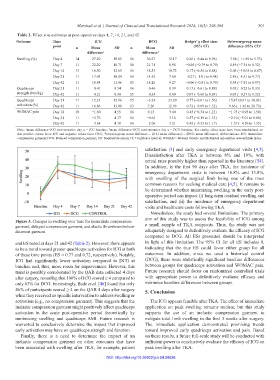
        Figure 3. Changes in swelling over time for immediate compression
        garment, delayed compression garment, and elastic thromboembolism-  a small sample of  TKA recipients.  Thus, the study was not
        deterrent garment                                      adequately designed to definitively evaluate the efficacy of ICG
                                                               compared  to  DCG.  All  ESs  presented  should  be  interpreted
        and ES noted at days 21 and 42 (Table 2). However, there appears   in light of this limitation. The 95% CI for all ES includes 0,
        to be a trend toward greater quadriceps activation for ICG at both   indicating  that  the  true  ES  could  favor  either  group  for  all
        of these time points (ES = 0.77 and 0.72, respectively). Notably,   outcomes.  In addition,  since  we used a historical  control
        ICG  had  significantly  lower  activation  compared  to  DCG  at   (DCG), there were statistically significant baseline differences
        baseline and, thus, more room for improvement. However, this   between groups for quadriceps activation and WOMAC pain.
        trend is possibly corroborated by the QAB data collected 4 days   Future  research  should  focus  on  randomized  controlled  trials
        after surgery, revealing that 100% of ICG scored ≥ 4 compared to   with  appropriate  power  to  definitively  evaluate  efficacy  and
        only 63% for DCG. Interestingly, Bade et al. [46] found that only   minimize baseline differences between groups.
        46% of participants scored ≥ 4 on the QAB 4 days after surgery   5. Conclusion
        when they received no specific intervention to address swelling or
        activation (e.g., no compression garment). This suggests that the   The ICG appears feasible after TKA. The effect of immediate
        inelastic compression garment might positively affect quadriceps   application  on peak  swelling  remains  unclear, but  this  study
        activation in  the  acute  post-operative period theoretically  by   supports the use of an inelastic  compression garment to
        minimizing  swelling  and  quadriceps  AMI.  Future  research  is   mitigate total limb swelling in the first 3 weeks after surgery.
        warranted to conclusively determine the impact that improved   The immediate application  demonstrated promising trends
        early activation may have on quadriceps strength and function.  toward improved early quadriceps activation and pain. Based
          Finally, there  is a  need  to  determine  the  impact  of an   on these results, a future full-scale study will be conducted with
        inelastic  compression garment  on other  outcomes  that  have   sufficient power to conclusively evaluate the efficacy of ICG on
        been associated with swelling after TKA, for example, patient   peak swelling after TKA.

                                               DOI: http://doi.org/10.36922/jctr.24.00026

