


Page 36 - JCTR-10-5
P. 36
298 Marshall et al. | Journal of Clinical and Translational Research 2024; 10(5): 296-306
2.2.2. Timing of initial garment donning accuracy of reporting. Average daily wear time was calculated
by dividing the sum of the hours the garment was worn each
The DCG group did not don the garment until 3 – 4 days day by the total number of possible days during the intervention
after surgery. The ICG group donned the garment immediately period, that is, 21 days. Adherence to the prescribed daily wear
after surgery in the operating room, assisted by an orthopedic time of 12 h was calculated from 0 to 100% by dividing the total
physician assistant, a surgical assistant, or a professional research number of days the garment was worn for at least 12 h by the
assistant. Approximately 2 h later, a research assistant assessed total number of possible days during the intervention period.
the participant to ensure proper garment application and to answer Both were then reported as the mean, standard deviation (SD),
any participant questions. The participant was instructed to leave and the 95% confidence interval (CI).
the garment on until the following evening (i.e., bedtime of post-
operative day 1) and then to wear it for 12 waking hours per day. 2.3.3. Satisfaction
2.2.3. Rehabilitation Satisfaction with the garment was measured on completion
of the intervention period using a five-point Likert survey,
Participants in both groups were instructed in a home exercise including completely dissatisfied (1), somewhat dissatisfied (2),
program designed to promote frequent pumping of calf and thigh neither dissatisfied nor satisfied (3), somewhat satisfied (4), and
musculature to aid in (i) venous and lymphatic return and (ii) knee completely satisfied (5). It was then reported as median and range.
range of motion (ROM). Participants were asked to perform
ankle pumps for 1 min, a minimum of 5 times daily. In addition, 2.3.4. Swelling
they were asked to perform 10 repetitions of a knee flexion The swelling was measured at days 4, 7, 14, 21, and 42 days after
exercise, a minimum of 5 times daily. The knee flexion exercise surgery by a single frequency bioelectrical impedance assessment
was chosen by the participant from one of the following, with (SF-BIA) using an RJL Systems Quantum® (USA) device, as
the option to choose a different exercise at any time: heel slides, further described in the study by Carmichael et al. [36] SF-BIA
floor scrubs, or stair stretch (Table S1). These exercises were is a reliable and responsive measure of total limb swelling after
performed with the garment in place, but the participant could TKA [44]. The device delivers a 2.5 µA alternating current at a
loosen select straps around the knee joint to allow more ROM, if frequency of 50 kHz. The level of impedance met by the current
necessary. Finally, all participants also received standard-of-care will fluctuate with the presence of swelling in the lower extremity.
outpatient rehabilitation separate from this study. Lower levels of impedance represent greater levels of swelling.
2.3. Outcome measures Using a ratio of the impedance of the involved limb to the
uninvolved limb accounts for body composition, fluid shifts, and
Feasibility of ICG was assessed by safety, average daily wear hydration status, allows any changes in impedance between time
time of the garment, adherence to the prescribed garment wear points to be attributed to changes in limb swelling. Therefore,
time of 12 h/day, and participant satisfaction with the garment. swelling values at each time point are presented as the percent
To investigate initial efficacy, ICG and DCG were both tested difference between limbs and calculated as:
at baseline (1 – 2 weeks preoperatively) and postoperatively on
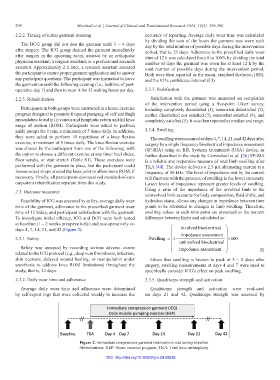
days 4, 7, 14, 21, and 42 (Figure 2). involved bioelectrical
impedance assessment
2.3.1. Safety Swelling = 1− uninvolved bioelectrical × 100
Safety was assessed by recording serious adverse events impedance assessment (I)
related to the ICG protocol (e.g., deep vein thrombosis, infection,
skin necrosis, delayed wound healing, or manipulation under Given that swelling is known to peak at 3 – 8 days after
anesthesia to address knee ROM limitations) throughout the surgery, swelling measurements at days 4 and 7 were used to
study, that is, 42 days. specifically consider ICG’s effect on peak swelling.
2.3.2. Daily wear time and adherence 2.3.5. Quadriceps strength and activation
Average daily wear time and adherence were determined Quadriceps strength and activation were evaluated
by self-report logs that were collected weekly to increase the on days 21 and 42. Quadriceps strength was assessed by
Figure 2. Immediate compression garment intervention and testing timeline
Abbreviations: HEP: Home exercise program; TKA: Total knee arthroplasty
DOI: http://doi.org/10.36922/jctr.24.00026

