


Page 31 - JCTR-10-5
P. 31
Omrani et al.| Journal of Clinical and Translational Research 2024; 10(5): 291-295   293
        against diphtheria and tetanus, respectively. In contrast, results   lymphocytes decreased by 0.01% after 6  months following
        indicated that the mean IgG antibody level against hepatitis B   chemotherapy cessation. The relationship between the levels
        increased by 7.09 units compared to the immediate time after   of WBCs, neutrophils, and lymphocytes within the age group
        cessation of therapy (Table 3).                        was  not  significant  (p  >  0.05).  Changes  in  WBC  number
          Our raw data analyses revealed that 6  months after   were significant (p = 0.001), but neutrophil (p = 0.516) and
        chemotherapy  cessation,  one  patient  had  the  highest  changes   lymphocyte  (p  =  0.262)  levels  did  not  change  significantly
        in IgG antibody levels  against  diphtheria  (from 0.05 to 71),   after 6 months compared to the immediate period following
        two patients  had  the  highest  changes  in  IgG antibody  levels   chemotherapy cessation (Table  4).  Six  months  following
        against tetanus (from 0.35 to 22.9; from 0.27 to >5), and four   chemotherapy cessation, all patients enrolled in the analysis
        patients had the highest changes in IgG antibody levels against   responded well to the treatment.
        hepatitis B (from 12 to 6; from 14 to 9.35; from 1 to >200;   4. Discussion
        from 15 to 10).
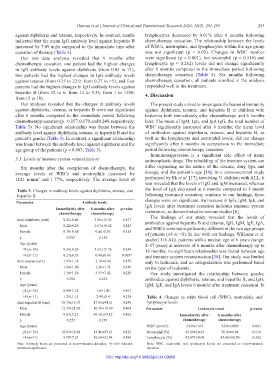
          Our analyses revealed  that  the  changes  in  antibody  levels   The present study aimed to investigate the humoral immunity
        against diphtheria, tetanus, or hepatitis B were not significant   against  diphtheria,  tetanus,  and hepatitis  B in  children  with
        after 6  months compared to the immediate  period following   leukemia both immediately after chemotherapy and 6 months
        chemotherapy cessation (p = 0.157, 0.179, and 0.249, respectively;   later. The mean of IgM, IgE, and IgA IgG, the total number of
        Table  3).  No  significant  relationship  was  found  between  the   WBC  significantly  increased  after  6  months;  the  mean  level
        antibody level against diphtheria, tetanus, or hepatitis B and the   of antibodies against diphtheria, tetanus, and hepatitis B, as
        patient’s gender (Table 3). In contrast, a significant relationship   well as the lymphocyte and neutrophil levels, did not change
        was found between the antibody level against diphtheria and the   significantly  after  6  months  in  comparison  to  the  immediate
        age group of the patients (p = 0.003; Table 3).        period following chemotherapy cessation.
                                                                 Immunosuppression  is  a  significant  side  effect  of  many
        3.3. Levels of immune system-related factors           antineoplastic drugs. The rebuilding of the immune system can

          Six  months  after  the  completion  of  chemotherapy,  the   differ depending on the nature of the disease, drug type and
        average  levels  of  WBCs  and  neutrophils  increased  by   dosage,  and  the  patient’s  age [16].  In  a  cross-sectional study
        1121  n/mm   and  1.77%,  respectively.  The  average  level  of   performed by Ek et al. [17], involving 31 children with ALL, it
                 3
                                                               was revealed that the levels of IgG and IgM increased, whereas
        Table 3. Changes in antibody levels against diphtheria, tetanus, and   the level of IgA decreased at 6 months compared to 1 month
        hepatitis B                                            following treatment cessation; contrary to our findings, these
        Parameter                   Antibody levels            changes were not significant. An increase in IgG, IgM, IgE, and
                         Immediately after   6 months after   p‑value  IgA levels after treatment cessation indicates immune system
                          chemotherapy  chemotherapy           restoration, as demonstrated in various studies [8].
        Anti-diphtheria (unit)  0.25±0.46  3.68±15.43  0.157     The  findings  of  our  study  revealed  that  the  levels  of
         Male               0.22±0.28    6.67±19.62  0.123     antibodies against hepatitis B and tetanus, IgG, IgM, IgE, IgA,
                                                               and WBCs were not significantly different in the two age groups
         Female             0.30±0.68     0.44±0.83  0.358     of patients (≤8 or >8). In line with our findings, Williams et al.
         p                   0.383         0.138               studied 116 ALL patients with a median age of 6 years (range:
         Age (years)                                           2–17 years) at intervals of 6 months after chemotherapy up to
           ≤8 (n=10)        0.24±0.26    3.65±15.76  0.244     18 months; no significant relationship was found between age
           >8 (n=11)        0.27±0.35     0.98±0.43  0.003*    and immune system reconstruction [18]. Our study was limited
        Anti-tetanus (unit)  1.15±1.18    2.18±4.94  0.179     only to leukemia, and no categorization was performed based
         Male               1.04±1.08     1.26±1.71  0.349     on the type of leukemia.
         Female             1.34±1.38     3.37±7.42  0.229       Our study investigated  the  relationship  between  gender,
         p                   0.306         0.234               antibodies against diphtheria, tetanus, and hepatitis B, and IgG,
         Age (years)                                           IgM, IgE, and IgA levels 6 months after treatment cessation. In
           ≤8 (n=10)        0.98±1.32     1.6±1.43   0.163
           >8 (n=11)        1.29±1.15     2.98±8.4   0.258      Table  4.  Changes  in  white  blood  cell  (WBC),  neutrophils,  and
        Anti-hepatitis B (unit)  10.76±16.75  17.85±44.61  0.249  lymphocyte levels
         Male              12.37±21.09   10.39±19.99  0.404    Parameter             Leukocyte count       p‑value
         Female             8.13±5.21    30.10±69.12  0.192                   Immediately after   6 months after
         p                   0.252         0.239                               chemotherapy   chemotherapy
         Age (years)                                           WBC (n/mm )      5439±1619      6560±2089    0.001
                                                                        3
           ≤8 (n=10)       10.87±18.88   13.46±43.61  0.432    Neutrophil (%)   49.19±14.93    50.96±8.84   0.516
           >8 (n=11)        9.97±7.23    16.64±23.54  0.189    Lymphocyte (%)   42.07±14.08    42.08±10.50  0.262
        Note: Antibody  levels  are  presented  as  mean±standard  deviation.  *p<0.05  indicates   Note:  WBC,  neutrophil,  and  lymphocyte  levels  are  presented  as  mean±standard
        statistical significance.                               deviation.
                                               DOI: http://doi.org/10.36922/jctr.24.00050

