


Page 26 - JCTR-10-5
P. 26
288                       Cirrincione | Journal of Clinical and Translational Research 2024; 10(5): 283-290


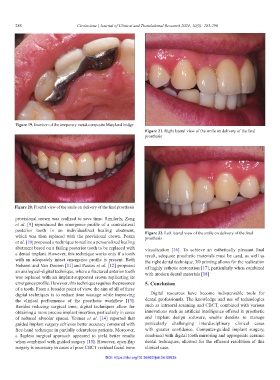
        Figure 19. Insertion of the temporary metal-composite Maryland bridge
                                                               Figure 21. Right lateral view of the smile on delivery of the final
                                                               prosthesis


       Figure 20. Frontal view of the smile on delivery of the final prosthesis

        provisional crown was realized to save time. Similarly, Zeng
        et al. [9] reproduced the emergence profile of a contralateral
        posterior  tooth  in  an  individualized  healing  abutment,   Figure 22. Left lateral view of the smile on delivery of the final
        which  was  then  replaced  with  the  provisional  crown.  Pozza   prosthesis
        et al. [10]proposed a technique to realize a personalized healing

        abutment based on a failing posterior tooth to be replaced with   visualization  [16].  To  achieve  an  esthetically  pleasant  final
        a dental implant. However, this technique works only if a tooth   result, adequate prosthetic materials must be used, as well as
        with  an  adequately  intact  emergence  profile  is  present.  Both   the right dental technique. 3D printing allows for the realization
        Noharet and Van Dooren [11] and Passos et al. [12] proposed   of highly esthetic restoration [17], particularly when combined

        an analogical-digital technique, where a fractured anterior tooth   with modern dental materials [18].
        was replaced with an implant-supported crown replicating its
        emergence profile. However, this technique requires the presence   5. Conclusion
        of a tooth. From a broader point of view, the aim of all of these
        digital techniques is to reduce time wastage while improving   Digital  resources  have  become  indispensable  tools  for
        the  clinical  performance  of  the  prosthetic  workflow  [13].   dental  professionals. The  knowledge  and  use  of  technologies
        Besides  reducing  surgical  time,  digital  techniques  allow  for   such as intraoral scanning and CBCT, combined with various
        obtaining a more precise implant insertion, particularly in cases   innovations such as artificial intelligence offered in prosthetic
        of reduced  alveolar  spaces.  Younes  et  al. [14] reported  that   and  implant  design  software,  enable  dentists  to  manage
        guided implant surgery achieves better accuracy compared with   particularly  challenging  interdisciplinary  clinical  cases
        free-hand technique in partially edentulous patients. Moreover,   with  greater  confidence.  Computer-guided  implant  surgery,
        a  flapless  surgical  approach  appeared  to  yield  better  results   combined with digital tooth mirroring and appropriate ceramic
        when combined with guided surgery [15]. However, open-flap   dental  techniques,  allowed  for  the  efficient  resolution  of  this
        surgery is necessary in cases of poor CBCT residual facial bone   clinical case.

                                               DOI: https://doi.org/10.36922/jctr.24.00035

