


Page 23 - JCTR-10-5
P. 23
Cirrincione | Journal of Clinical and Translational Research 2024; 10(5): 283-290   285


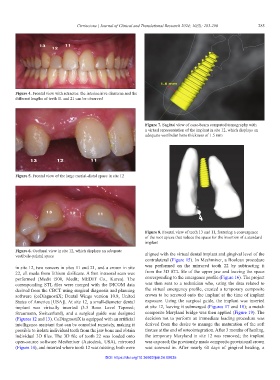
        Figure 4. Frontal view with retractor: the interincisive diastema and the
        different lengths of teeth 11 and 21 can be observed


                                                               Figure 7. Sagittal view of cone-beam computed tomography with
                                                               a virtual representation of the implant in site 12, which displays an
                                                               adequate vestibular bone thickness of 1.5 mm


        Figure 5. Frontal view of the large mesial-distal space in site 12


                                                               Figure 8. Frontal view of teeth 13 and 11, featuring a convergence
                                                               of the root apices that reduce the space for the insertion of a standard
                                                               implant
        Figure 6. Occlusal view in site 12, which displays an adequate
        vestibule-palatal space                                aligned with the virtual dental implant and gingival level of the
                                                               contralateral (Figure 15). In Meshmixer, a Boolean procedure
        in site 12, two veneers in sites 11 and 21, and a crown in site   was  performed  on  the  mirrored  tooth  22  by  subtracting  it
        22, all made from lithium disilicate. A first intraoral scan was   from the 3D STL file of the upper jaw and leaving the space
        performed  (Medit  i500,  Medit;  MEDIT  Co.,  Korea).  The   corresponding to the emergence profile (Figure 16). The project
        corresponding  STL  files  were  merged  with  the  DICOM  data   was  then  sent  to  a  technician  who,  using  the  data  related  to
        derived from the CBCT using surgical diagnosis and planning   the virtual emergency profile, created a temporary composite
        software  (coDiagnostiX;  Dental  Wings  version  10.8,  United   crown to be screwed onto the implant at the time of implant
        States of America [USA]). At site 12, a small-diameter dental   exposure.  Using  the  surgical  guide,  the  implant  was  inserted
        implant  was  virtually  inserted  (3.3  Bone  Level  Tapered;   at site 12, leaving it submerged (Figures 17 and 18); a metal-
        Straumann,  Switzerland),  and  a  surgical  guide  was  designed   composite Maryland bridge was then applied (Figure 19). The
        (Figures 12 and 13). CoDiagnostiX is equipped with an artificial   decision not to perform an immediate loading procedure was
        intelligence assistant that can be consulted remotely, making it   derived from the desire to manage the maturation of the soft
        possible to isolate individual teeth from the jaw bone and obtain   tissues at the end of osteointegration. After 3 months of healing,
        individual 3D files. The 3D file of tooth 22 was loaded onto   the temporary Maryland in site 12 was removed; the implant
        open-source software Meshmixer (Autodesk, USA), mirrored   was exposed; the previously made composite provisional crown
        (Figure 14), and inserted where tooth 12 was missing; both were   was  screwed  in. After  nearly  60  days  of  gingival  healing,  a

                                               DOI: https://doi.org/10.36922/jctr.24.00035

