


Page 22 - JCTR-10-5
P. 22
284                       Cirrincione | Journal of Clinical and Translational Research 2024; 10(5): 283-290
        and  symmetrically  pleasing  boosts  confidence  in  social
        interactions  and enhances attractiveness  [1]. Dentistry has
        adapted  and  improved  its  techniques  to  meet  these  new
        requirements,  strengthening  the  relationship  between  various
        dental disciplines, such as prosthetics, orthodontics, and
        implantology.  This  interdisciplinary  connection  has  been
        facilitated by the impressive development of digital techniques
        in recent years. This includes the ability to easily manipulate
        patient  impressions obtained  with intraoral  scanners, such as
        standard tessellation language (STL) files, and to combine them
        with  3D  visualization  of  the  bone  from  digital  imaging  and
        communications in medicine (DICOM) files generated by cone-
        beam  computed  tomography  (CBCT)  [2]. Therefore,  dentists
        now have the opportunity to create a “virtual patient” on their
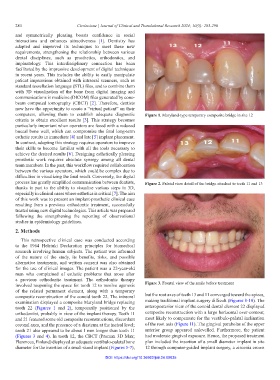
        computers,  allowing  them  to  establish  adequate  diagnostic   Figure 1. Maryland-type temporary composite bridge in site 12
        criteria to  obtain  excellent results  [3]. This  strategy  becomes
        particularly important when operators are faced with a reduced
        buccal bone wall, which can compromise the final long-term
        esthetic results in immediate [4] and late [5] implant placement.
        In contrast, adopting this strategy requires operators to improve
        their skills to become familiar with all the tools necessary to
        achieve the desired results [6]. Designing esthetically pleasing
        prosthetic  work  requires  absolute  synergy  among  all  dental
        team members. In the past, this workflow required collaboration
        between the various operators, which could be complex due to
        difficulties in visualizing the final result. Conversely, the digital
        process has greatly simplified communication between dentists,   Figure 2. Palatal view detail of the bridge attached to teeth 11 and 13
        thanks in part to the ability to visualize various steps in 3D,
        especially in clinical cases where esthetics is critical [7]. The aim
        of this work was to present an implant-prosthetic clinical case
        resulting  from  a  previous  orthodontic  treatment,  successfully
        treated using new digital technologies. This article was prepared
        following  the  strengthening  the  reporting  of  observational
        studies in epidemiology guidelines.
        2. Methods

          This  retrospective  clinical  case  was  conducted  according
        to  the  1964  Helsinki  Declaration  principles  for  biomedical
        research involving human subjects. The patient was informed
        of  the  nature  of  the  study,  its  benefits,  risks,  and  possible
        alternative treatments, and written consent was also obtained
        for the use of clinical images. The patient was a 22-year-old
        man  who complained  of esthetic  problems  that  arose  after
        a previous orthodontic  treatment.  The orthodontic  therapy
        involved reopening the space for tooth 12 to resolve agenesis   Figure 3. Frontal view of the smile before treatment
        of  the  related  permanent  element,  along  with  a  temporary
        composite reconstruction of the conoid tooth 22. The intraoral   but the root axes of teeth 13 and 11 converged toward the apices,
        examination displayed a composite Maryland bridge replacing   making traditional implant surgery difficult (Figures 8-10). The
        tooth  22  (Figures  1  and  2),  temporarily  positioned  by  the   anteroposterior view of the conoid dental element 22 displayed
        orthodontist, probably in view of the implant therapy. Teeth 11   composite reconstruction with a large horizontal over-contour,
        and 21 featured some old composite reconstructions, discordant   most likely to compensate for the vestibulo-palatal inclination
        coronal axes, and the presence of a diastema at the incisal level;   of the root axis (Figure 11). The gingival parabolas of the upper
        tooth 21 also appeared to be about 1 mm longer than tooth 11   anterior  group  appeared  unlevelled.  Furthermore,  the  patient
        (Figures 3 and 4). In tooth 12, the CBCT (Promax 3D Max;   had moderate gingival exposure. Hence, the proposed treatment
        Planmeca, Finland) displayed an adequate vestibulo-palatal bone   plan included the insertion of a small diameter implant in site
        diameter for the insertion of a small-sized implant (Figures 5-7),   12 through computer-guided implant surgery, a zirconia crown

                                               DOI: https://doi.org/10.36922/jctr.24.00035

