


Page 25 - JCTR-10-5
P. 25
Cirrincione | Journal of Clinical and Translational Research 2024; 10(5): 283-290   287


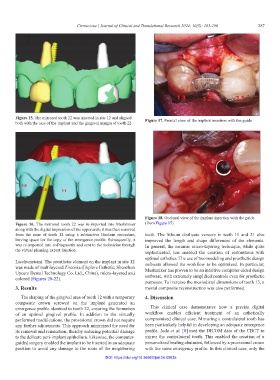
        Figure 15. The mirrored tooth 22 was inserted in site 12 and aligned
        both with the axis of the implant and the gingival margin of tooth 22  Figure 17. Frontal view of the implant insertion with the guide


                                                               Figure 18. Occlusal view of the implant insertion with the guide
        Figure  16.  The  mirrored  tooth  22  was  re-imported  into  Meshmixer   (from Figure 17)
        along with the digital impression of the upper arch; it was then removed
        from  the  zone  of  tooth  12  using  a  subtractive  Boolean  procedure,   teeth.  The  lithium  disilicate  veneers  in  teeth  11  and  21  also
        leaving space for the copy of the emergence profile. Subsequently, it   improved  the  length  and  shape  differences  of  the  elements.
        was re-imported into coDiagnostix and sent to the technician through   In general, the ceramic micro-layering technique, while quite
        the virtual planning export function.
                                                               sophisticated,  has enabled the creation  of restorations with
                                                               optimal esthetics. The use of two modeling and prosthetic design
        Liechtenstein). The prosthetic element on the implant in site 12   software allowed the workflow to be optimized. In particular,
        was made of multilayered Zirconia (Explore Esthetic; Shenzhen   Meshmixer has proven to be an intuitive computer-aided design
        Upcera Dental Technology Co. Ltd., China), micro-layered and   software, with extremely simplified controls even for prosthetic
        colored (Figures 20-22).
                                                               purposes. To increase the mesiodistal dimensions of tooth 13, a
        3. Results                                             mesial composite reconstruction was also performed.
          The shaping of the gingival area of tooth 12 with a temporary   4. Discussion
        composite  crown  screwed  on  the  implant  generated  an
        emergence profile identical to tooth 22, ensuring the formation   This  clinical  case  demonstrates  how  a  precise  digital
        of  an  optimal  gingival  profile.  In  addition  to  the  virtually   workflow  enables  efficient  treatment  of  an  esthetically
        performed modifications, the provisional crown did not require   compromised clinical case. Mirroring a contralateral tooth has
        any further adjustments. This approach minimized the need for   been particularly helpful in developing an adequate emergence
        its removal and reinsertion, thereby reducing potential damage   profile. Joda et al. [8] used the DICOM data of the CBCT to

        to the delicate peri-implant epithelium. Likewise, the computer-  mirror  the  contralateral  tooth. This enabled  the  creation  of a
        guided surgery enabled the implant to be inserted in an adequate   personalized healing abutment, followed by a provisional crown
        position to avoid any damage to the roots of the neighboring   with the same emergency profile. In this clinical case, only the
                                               DOI: https://doi.org/10.36922/jctr.24.00035

