


Page 30 - JCTR-10-5
P. 30
292                       Omrani et al.| Journal of Clinical and Translational Research 2024; 10(5): 291-295
        lymphoid organs, and the BM [5,6]. In addition, immune system   Data were analyzed using Statistical Package for Social Sciences
        dysfunction is an inevitable side effect of chemotherapy, which   (SPSS) V19 software (SPSS Inc., USA). The Kolmogorov–Smirnov
        is used in the treatment of leukemia.                  test evaluated the normal distribution of continuous variables.
          Chemotherapy uses potent cytotoxic and immune-suppressing   Parametric data are expressed as mean ± standard deviation. The
        agents to eliminate cancerous cells, but these drugs also affect   Chi-square  test  and  Spearman  correlation  were  used  to  analyze
        normal BM cells, leading to a reduction in blood cells [7] and   data. For all analyses, a p < 0.05 is considered significant.
        defects  in  the  humoral  immune  system.  The  abnormality  in
        the immune system after chemotherapy in leukemia  patients   3. Results
        lasts for a general period of 6–12  months after stopping the   3.1. Total IgA, IgE, IgG, and IgM
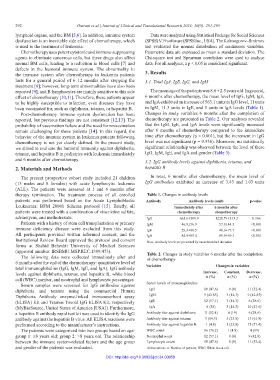
        treatment [8]; however, long-term abnormalities have also been
        reported [9], and B lymphocytes are mainly sensitive to this side   The mean age of the patients was 8.6 ± 2.5 years old. In general,
        effect of chemotherapy [10,11]. Therefore, these patients appear   6 months after chemotherapy, the mean level of IgG, IgM, IgE,
        to be highly susceptible to infection, even diseases they have   and IgA exhibited an increase of 563.1 units in IgG level, 11 units
        been vaccinated for, such as diphtheria, tetanus, or hepatitis B.  in IgM, 11.3 units in IgE, and 5 units in IgA levels (Table 1).
          Post-chemotherapy  immune  system  dysfunction  has  been   Changes in study variables 6 months after the completion of
        reported, but previous findings are not consistent [12,13]. The   chemotherapy are presented in Table 2. Our analyses revealed
        probability of vaccination failure and the need for revaccination   that the IgM, IgE, and IgA levels were significantly increased
        remain challenging for these patients [14]. In this regard, the   after  6  months  of  chemotherapy  compared  to  the  immediate
        behavior of the immune system in leukemia patients following   time after chemotherapy (p = 0.001), but the increment in IgG
        chemotherapy is not yet clearly defined. In the present study,   level was not significant (p = 0.336). Moreover, no statistically
        we aimed to evaluate the humoral immunity against diphtheria,   significant relationship was observed between the level of these
        tetanus, and hepatitis B in pediatrics with leukemia immediately   IgG, IgM, IgE, and IgA and gender (Table 3).
        and 6 months after chemotherapy.                       3.2. IgG antibody levels against diphtheria, tetanus, and
        2. Materials and Methods                               hepatitis B
          The present prospective cohort study included 21 children   In total, 6  months after chemotherapy, the mean level of
        (13  males and 8  females)  with acute  lymphocytic  leukemia   IgG antibodies exhibited  an increase of 3.43 and 1.03 units
        (ALL).  The patients were assessed at 1 and 6  months after
        therapy  termination.  The  treatment  process of all  enrolled   Table 1. Changes in antibody levels
        patients  was performed based on the  Acute Lymphoblastic   Antibody     Antibody levels (unit)    p‑value
        Leukaemia:  BFM  20001  Schema protocol [15].  Briefly,  all       Immediately after   6 months after
        patients were treated with a combination of vincristine sulfate,    chemotherapy    chemotherapy
        adriamycin, and methotrexate.                          IgG           665.6±509.9     1228.7±1815.2  0.366
          Patients with a history of stem cell transplantation or primary   IgM  46.9±56.9    57.9±44.3     <0.001
        immune  deficiency  disease  were  excluded  from  this  study.   IgE  29.3±80.5      40.6±77.7     <0.001
        All  participants provided  written  informed  consent,  and  the   IgA  84.9±85.4    89.9±69.3     <0.001
        Institutional Review Board approved the protocol and consent   Note: Antibody levels are presented by mean±standard deviation.
        forms  at  Shahid  Beheshti  University  of  Medical  Sciences
        (approval number: IRSBMU.MSP.REC.1399.473).             Table 2. Changes in study variables 6 months after the completion
          The following  data were collected immediately after and   of chemotherapy
        6 months after the end of the chemotherapy: quantitative level of   Variables        Changes in variables
        total immunoglobulins (IgG, IgM, IgE, and IgA), IgG antibody
        levels against diphtheria, tetanus, and hepatitis B, white blood               Increase,   Constant,   Decrease,
                                                                                                  n (%)
                                                                                         n (%)
                                                                                                           n (%)
        cell (WBC) number, and neutrophil and lymphocyte percentages.
          Serum  samples  were  screened  for  IgG  antibodies  against   Serum levels of immunoglobulins
        diphtheria  and  tetanus  using  the  commercial  Human   IgG                   10 (47.6)  0 (0)  11 (52.4)
        Diphtheria  Antibody  enzyme-linked  immunosorbent  assay   IgM                 9 (42.85)  3 (14.3)  9 (42.85)
        (ELISA) Kit and Tetanus Toxoid IgG ELISA Kit, respectively   IgE                12 (57.1)  3 (14.3)  6 (28.6)
        (MyBioSource, United States of America [USA]). Furthermore,   IgA                8 (38)  3 (14.3)  10 (47.6)
        a hepatitis B antibody rapid test kit was used to identify the IgG   Antibody titer against diphtheria  11 (52.4)  4 (19)  6 (28.6)
        antibody against the hepatitis B virus. All ELISA reactions were   Antibody titer against tetanus  3 (14.3)  5 (23.8)  13 (61.9)
        performed according to the manufacturer’s instructions.  Antibody titer against hepatitis B  1 (4.8)  5 (23.8)  15 (71.4)
          The patients were categorized into two groups based on age:   WBC count       16 (76.2)  1 (4.8)  4 (19)
        group 1: ≤8 years old; group 2: >8 years old. The relationship   Neutrophil count  12 (57.1)  0 (0)  9 (42.8)
        between the immune system-related factors and the age group   Lymphocyte count  10 (47.6)  0 (0)  11 (52.4)
        and gender of the patients was evaluated.               Abbreviations: n: Number of patients; WBC: White blood cell.

                                               DOI: http://doi.org/10.36922/jctr.24.00050

