


Page 35 - JCTR-10-5
P. 35
Marshall et al. | Journal of Clinical and Translational Research 2024; 10(5): 296-306   297
          Quadriceps strength loss after TKA is also significant, with   the same inclusion and exclusion criteria. Participants between
        patients  experiencing  up  to  a  60%  loss  in  the  1   month after   the ages of 50 and 85 years, who were undergoing a primary
                                               st
        surgery  [8-10].  Pre-operative  quadriceps  strength  levels  are   unilateral  TKA  secondary  to  end-stage  osteoarthritis,  were
        typically not regained for 6 months [9,10], and, perhaps most   consecutively recruited. They were excluded if they had any of
        concerning, strength may never reach the levels of aged-matched   the following: (i) discharge to a location other than home after
        peers  without  any  history  of  knee pathology  [11-15].  Early   surgery;  (ii)  history  of  heart  failure,  lymphatic  insufficiency,
        quadriceps strength loss after TKA is thought to be predominately   hepatic  disease,  pre-existing  pitting  edema,  varicose  vein
        due  to  the  inability  to  fully  activate  the  quadriceps  muscle   ligation, or any other condition associated with chronic swelling
        voluntarily, also known as arthrogenic muscle inhibition   of either lower extremity; (iii) uncontrolled diabetes; (iv) body
        (AMI)  [8,16,17].  AMI  accounts  for  65%  of  the  variance  in   mass index (BMI) >40 kg/m ; (v) no caregiver or the inability to
                                                                                     2
        acute  quadriceps  strength  loss  after  TKA  and  is  thought  to   touch toes, which may affect donning/doffing the compression
        impede  the  effectiveness  of  voluntary  strengthening  during   garment;  or  (vi)  any  ongoing  neurologic,  cardiac,  or  other
        rehabilitation [8,17]. This could explain why even high-intensity,   unstable orthopedic conditions that limit the function or ability
        progressive resistance  protocols after surgery  have  failed to   to participate  in outcome  measures testing.  ICG participants
        mitigate  quadriceps  strength  loss  [18,19]. The  mechanisms   were recruited from April 2021 to July 2022 by two orthopedic
        underlying AMI are not fully understood, but joint pain [8,16,20]   surgeons from one institution in the Denver metro area.
        and swelling [21-24] have been implicated. Pain and swelling
        may reduce the excitability of the quadriceps by affecting the   2.2. Interventions
        afferent discharge of the joint sensory receptors [21].
          Researchers and clinicians alike have attempted to   2.2.1. Inelastic compression garment
        mitigate swelling after  TKA with little success.  The use   Both ICG and DCG cohorts were measured with the inelastic
        of  cryotherapy  has  mixed  findings,  which  may  be  due  to   compression garment 1 – 2 weeks before surgery as part of their
        variations in study methodology  [25-29].  Similarly,  the  effect   baseline testing session. The garment (CircAid Juxtafit upper
        of kinesiotape  [29-33], manual lymphatic drainage  [33-36],   leg and knee garment combined with a lower leg garment; Medi
        or a combination of both [37] has been inconclusive.  The   USA, United States of America [USA]) has adjustable straps
        use  of  elastic  compression  bandages,  including  modified
        Robert  Jones  bandages,  has  also  proven  ineffective  after   that  enable  quick  and  precise  setting  of  various  compression
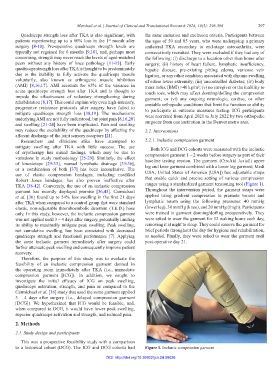
        TKA [38-42]. Conversely, the use of an inelastic compression   ranges using a standardized garment tensioning tool (Figure 1).
        garment has recently displayed promise  [36,43]. Carmichael   Throughout the intervention  period, the garment  straps were
        et al.  [36]  found  up  to  54%  less  swelling  in  the  first  21  days   applied using gradient  compression to promote venous and
        after TKA when compared to a control group that wore standard   lymphatic  return  using  the  following  pressures:  40  mmHg
        elastic, non-adjustable thromboembolic deterrent (T.E.D.) hose   (lower leg), 30 mmHg (knee), and 20 mmHg (thigh). Participants
        only. In this study, however, the inelastic compression garment   were trained in garment donning/doffing preoperatively. They
        was not applied until 3 – 4 days after surgery, potentially limiting   were asked to wear the garment for 12 waking hours each day,
        its ability to maximally mitigate peak swelling. Peak swelling,   removing it at night to sleep. They could remove the garment for
        not cumulative swelling, has been associated with decreased   brief periods throughout the day for hygiene and rehabilitation,
        quadriceps  strength  and  functional  performance  [7]. Applying   as needed. Finally, they were asked to wear the garment until
        the same inelastic garment immediately after surgery could   post-operative day 21.
        further attenuate peak swelling and consequently improve patient
        recovery.
          Therefore,  the purpose of this study was to evaluate  the
        feasibility  of an inelastic  compression garment  donned  in
        the operating room immediately after  TKA (i.e., immediate
        compression garment [ICG]).  In addition, we sought to
        investigate  the  initial  efficacy  of  ICG  on  peak  swelling,
        quadriceps  activation,  strength,  and  pain  as  compared  to  the
        Carmichael et al. [36] study that used the same garment applied
        3 – 4  days after surgery (i.e., delayed compression garment
        [DCG]).  We  hypothesized  that  ICG  would  be  feasible,  and,
        when compared to DCG, it would have lower peak swelling,
        superior quadriceps activation and strength, and reduced pain.
        2. Methods

        2.1. Study design and participants
          This was a prospective feasibility study with a comparison
        to a historical cohort (DCG). The ICG and DCG cohorts had   Figure 1. Inelastic compression garment

                                               DOI: http://doi.org/10.36922/jctr.24.00026

