


Page 20 - JCTR-10-6
P. 20
330                       Barreto et al. | Journal of Clinical and Translational Research 2024; 10(6): 325-333


                                A               B                C               D


                                E                F               G               H


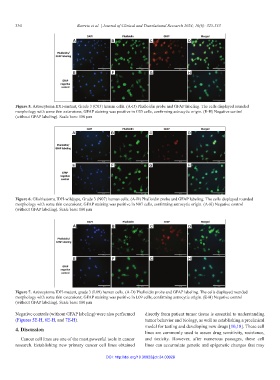
        Figure 5. Astrocytoma IDH-mutant, Grade 3 (C03) human cells. (A-D) Phalloidin probe and GFAP labeling. The cells displayed rounded
        morphology with some thin extensions; GFAP staining was positive in C03 cells, confirming astrocytic origin. (E-H) Negative control
        (without GFAP labeling). Scale bars: 100 µm


                                A               B                C               D


                                E               F                G               H


        Figure 6. Glioblastoma IDH-wildtype, Grade 3 (N07) human cells. (A-D) Phalloidin probe and GFAP labeling. The cells displayed rounded
        morphology with some thin extensions; GFAP staining was positive in N07 cells, confirming astrocytic origin. (A-H) Negative control
        (without GFAP labeling). Scale bars: 100 µm


                                A                B               C               D


                                E                F               G               H


        Figure 7. Astrocytoma IDH-mutant, grade 3 (L09) human cells. (A-D) Phalloidin probe and GFAP labeling. The cells displayed rounded
        morphology with some thin extensions; GFAP staining was positive in L09 cells, confirming astrocytic origin. (E-H) Negative control
        (without GFAP labeling). Scale bars: 100 µm
        Negative controls (without GFAP labeling) were also performed   directly from patient tumor tissue is essential to understanding
        (Figures 5E-H, 6E-H, and 7E-H).                        tumor behavior and biology, as well as establishing a preclinical
        4. Discussion                                          model for testing and developing new drugs [10,18]. These cell
                                                               lines are commonly used to assess drug sensitivity, resistance,
          Cancer cell lines are one of the most powerful tools in cancer   and  toxicity.  However,  after  numerous  passages,  these  cell
        research. Establishing new primary cancer cell lines obtained   lines can accumulate genetic and epigenetic changes that may

                                               DOI: http://doi.org/10.36922/jctr.24.00028

