


Page 35 - JCTR-10-6
P. 35
Musawi et al. | Journal of Clinical and Translational Research 2024; 10(6): 343-347   345
        steps for LAP II pattern preparation. They were taught how to   total BOT-2 score or total BOT-2 subtest scores. Analyses were
        prepare a flat pulpal floor, produce a proper outline form, achieve   performed using SAS version 9.4 (SAS Inc., USA). A P < 0.05
        a proper cavity wall angulation outline for the preparation, reach   was considered statistically significant.
        the ideal pulpal depth and smoothness, and use a perio probe to
        measure the height of the walls.                       3. Results
          Students then practiced preparing a specific LAP II pattern   A total of 42 dental students (22 males and 20 females) from
        under  direct  faculty  supervision.  This  practice  exercise  was   the  D1  class  of  2017  participated  in  this  study;  one  female
        designed for students to familiarize  themselves  with the   student was excluded due to her inability to perform some of
        handpiece and LAP II preparation. The supervising faculty did   the BOT-2 tasks required for the study. The mean age of the
        not provide feedback on the preparation quality but did provide   students  was  24  years  old.  Using  the  general  linear  model,
        feedback about the proper use of the simulation unit, handpiece,   which is a mixture of both regression and analysis of variance, a
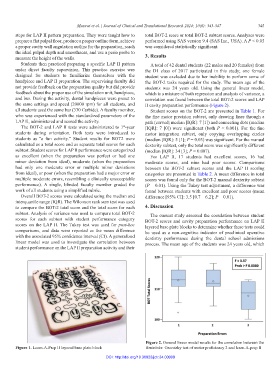
        and bur. During the activity, dental handpieces were preset to   correlation was found between the total BOT-2 scores and LAP
        the same settings and speed (20000 rpm) for all students, and   II cavity preparation performance (Figure 2).
        all students used the same bur (330 Carbide). A faculty member,   Student scores on the BOT-2 are presented in Table 1. For
        who was experienced with the standardized parameters of the   the fine motor precision subtest, only drawing lines through a
        LAP II, administered and scored the activity.          path (curved; median [IQR]: 7 [1]) and connecting dots (median
          The BOT-2 and LAP II tests were administered to 1 -year   [IQR]: 7 [0]) were significant (both P < 0.001). For the fine
                                                     st
        students during orientation.  Both tests were introduced to   motor  integration  subtest, only  copying  overlapping  circles
        students  as  “a  fun  activity.”  Student  results  for  BOT2  were   (median [IQR]: 5 [1]; P = 0.03) was significant. For the manual
        calculated as a total score and as separate total scores for each   dexterity subtest, only the total score was significantly different
        subtest. Student scores for LAP II performance were categorized   (median [IQR]: 34 [3]; P = 0.007).
        as  excellent  (when  the  preparation  was  perfect  or  had  one   For  LAP  II,  17  students  had  excellent  scores,  16  had
        minor deviation from ideal), moderate (when the preparation   moderate  scores,  and  nine  had  poor  scores.  Comparisons
        had only one moderate error or multiple  minor deviations   between  the  BOT-2  subtest  scores  and  the  LAP  II  scoring
        from ideal), or poor (when the preparation had a major error or   categories are presented in Table 2. A mean difference in total
        multiple moderate errors, resembling a clinically unacceptable   scores was found only for the BOT-2 manual dexterity subtest
        performance).  A  single,  blinded  faculty  member  graded  the   (P = 0.01). Using the Tukey test adjustment, a difference was
        work of all students using a simplified rubric.        found between students with excellent and poor scores (mean
          Overall BOT-2 scores were calculated using the median and   difference [95% CI]: 3.5 [0.7 – 6.2]; P = 0.01).
        interquartile range (IQR). The Wilcoxon rank sum test was used
        to compare the BOT-2 total score and the total score for each   4. Discussion
        subtest. Analysis of variance was used to compare total BOT-2   The current study assessed the correlation between student
        scores for each subtest with student performance category   BOT-2 scores and cavity preparation performance on LAP II
        scores  on  the  LAP  II. The Tukey  test  was  used  for  post-hoc   layered base plate blocks to determine whether these tests could
        comparisons,  and data  were  reported  as the  mean  difference   be  used  as  a  non-cognitive  indicator  of  preclinical  operative
        with the associated 95% confidence interval (CI). A generalized   dentistry performance during the dental school admissions
        linear  model  was used to investigate  the  correlation  between   process. The mean age of the students was 24 years old, which
        student performance on the LAP II preparation activity and their


                                                               Figure 2. General linear model results for the correlation between the
        Figure 1. Learn-A-Prep II layered base plate block     Bruininks–Oseretsky test of motor proficiency 2 and learn-A-prep II
                                               DOI: http://doi.org/10.36922/jctr.24.00009

