


Page 30 - JCTR-10-6
P. 30
340                       Cordeiro et al.ǀ Journal of Clinical and Translational Research 2024; 10(6): 334-342
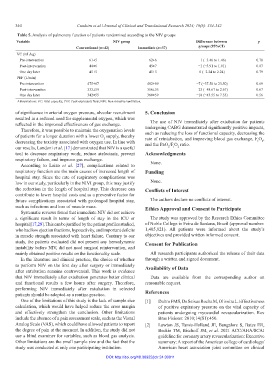
        Table 5. Analysis of pulmonary function of patients randomized according to the NIV groups
        Variable                                 NIV group                          Difference between         p
                                 Conventional (n=42)        Immediate (n=37)         groups (95%CI)
        VC (mL/kg)
         Pre-intervention              61±5                     62±6                 −1 (−3.46 to 1.46)       0.78
         Post-intervention             44±6                     45±7                 −1 (−3.91 to 1.91)       0.87
         One day later                 45±5                     45±5                  0 (−2.24 to 2.24)       0.79
        PEF (L/min)
         Pre-intervention             475±67                    482±69               −7 (−37.50 to 23.50)     0.69
         Post-intervention            333±59                    356±55               −23 (−48.67 to 2.67)     0.67
         One day later                342±55                    360±59               −18 (−43.55 to 7.55)     0.56
        Abbreviations: VC: Vital capacity; PEF: Peak expiratory flow; NIV: Non-invasive ventilation.

        of significance in arterial oxygen pressure, alveolar recruitment   5. Conclusion
        resulted in a reduced need for supplemental oxygen, which was
        reflected in the improved effectiveness of gas exchange.  The  use of NIV immediately  after  extubation  for patients
          Therefore, it was possible to maintain the oxygenation levels   undergoing CABG demonstrated significantly positive impacts,
        of patients for a longer duration with a lower O  supply, thereby   such as reducing the loss of functional capacity, decreasing the
                                                               rate of reintubation, and improving blood gas exchange, F O ,
                                             2
        decreasing the toxicity associated with oxygen use. In line with   and the PaO /F O  ratio.            I  2
        our results, Landoni et al. [17] demonstrated that NIV is a useful   2  I  2
        tool  to decrease  respiratory  work, reduce  atelectasis,  prevent   Acknowledgments
        respiratory failure, and improve gas exchange.
          According  to Laizo  et  al. [27], complications  related  to   None.
        respiratory function are the main causes of increased length of   Funding
        hospital stay. Since the rate of respiratory complications was
        low in our study, particularly in the NIVI group, this may justify   None.
        the reduction in the length of hospital stay. This decrease can   Conflicts of Interest
        contribute to lower hospital costs and as a preventive factor for
        future  complications  associated with  prolonged  hospital  stay,   The authors declare no conflicts of interest.
        such as infections and loss of muscle mass.            Ethics Approval and Consent to Participate
          Systematic reviews found that immediate NIV did not achieve
        a  significant  result  in  terms  of  length  of  stay  in  the  ICU  or   The study was approved by the Research Ethics Committee
        hospital [17,28]. This can be justified by the patient profiles studied,   of Noble College in Feira de Santana, Brazil (approval number:
        who had low ejection fractions, hypoactivity, and important deficits   1,405,821).  All  patients  were  informed  about  the  study’s
        in muscle strength associated with heart failure. Contrary to our   objectives and provided written informed consent.
        study, the patients evaluated did not present any hemodynamic   Consent for Publication
        instability before NIV, did not need surgical reintervention, and
        mainly obtained positive results on the functionality scale.  All research participants authorized the release of their data
          In the literature and clinical practice, the choice of whether   through a written and signed document.
        to perform NIV on the first day after surgery or immediately   Availability of Data
        after extubation remains controversial. This work is evidence
        that NIV immediately after extubation generates better clinical   Data  are  available  from the  corresponding  author  on
        and functional  results a few hours after  surgery.  Therefore,   reasonable request.
        performing  NIV  immediately  after  extubation  in  selected
        patients should be adopted as a routine practice.      References
          One of the limitations of this study is the lack of sample size   [1]   Daltro FMS, De Seixas Rocha M, Oliveira L. Effectiveness
        calculation, which would have helped reduce the error margin   of positive expiratory pressure on the vital capacity of
        and effectively strengthen the conclusion. Other limitations   patients  undergoing myocardial  revascularization.  Rev
        include the absence of a pain assessment scale, such as the Visual   Bras Fisioter. 2010;14(S1):450.
        Analog Scale (VAS), which could have allowed patients to report   [2]   Lawton JS, Tamis-Holland JE, Bangalore S, Bates ER,
        the degree of pain at the moment. In addition, the study did not   Beckie TM, Bischoff JM, et al. 2021 ACC/AHA/SCAI
        use a blind examiner for variables, such as blood gas analysis.   guideline for coronary artery revascularization: Executive
        Other limitations are the small sample size and the fact that the   summary: A report of the American college of cardiology/
        study was conducted at only one participating institution.  American heart association joint committee on clinical

                                               DOI: http://doi.org/10.36922/jctr.24.00011

