


Page 29 - JCTR-10-6
P. 29
Cordeiro et al.ǀ Journal of Clinical and Translational Research 2024; 10(6): 334-342   339
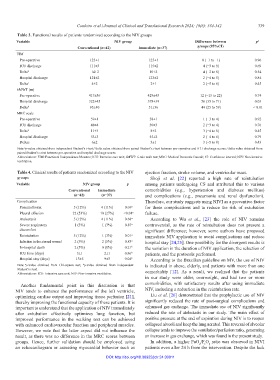
        Table 3. Functional results of patients randomized according to the NIV groups
        Variable                                  NIV group                         Difference between        p a
                                  Conventional (n=42)       Immediate (n=37)         groups (95%CI)
        FIM
         Pre-operative                 125±1                    125±1                  0 (−1 to −1)          0.96
         ICU discharge                 111±3                    115±2                  4 (−3 to 9)           0.69
         Delta b                        14±2                     10±2                  4 (−2 to 8)           0.54
         Hospital discharge            121±2                    123±2                  2 (−4 to 5)           0.84
         Delta c                        4±2                      2±1                   2 (−5 to 6)           0.45
        6MWT (m)
         Pre-operative                 417±36                   429±43                12 (−15 to 22)         0.74
         Hospital discharge            322±45                   378±39                 56 (35 to 71)         0.03
         Delta b                       95±40                    51±36                  44 (25 to 59)         < 0.01
        MRC scale
         Pre-operative                  59±1                     58±1                  1 (−3 to 4)           0.92
         ICU discharge                  48±4                     50±3                  2 (−3 to 4)           0.76
         Delta b                        11±3                     8±2                   3 (−4 to 8)           0.45
         Hospital discharge             53±3                     55±2                  2 (−4 to 6)           0.79
         Deltac                         6±2                      3±1                   3 (−5 to 8)           0.43
                                         b
                                                                                                  c
        Note: p-value obtained from independent Student’s t-test;  delta value obtained from paired Student’s t-test between pre-operative and ICU discharge scores;  delta value obtained from
            a
        paired Student’s t-test between pre-operative and hospital discharge scores.
        Abbreviations: FIM: Functional Independence Measure; ICU: Intensive care unit; 6MWT: 6-min walk test; MRC: Medical Research Council; CI: Confidence interval; NIV: Non-invasive
        ventilation.
        Table 4. Clinical results of patients randomized according to the NIV   ejection fraction, stroke volume, and ventricular mass.
        groups                                                   Shoji  et al. [22] reported  a high rate of reintubation
        Variable                    NIV group          p       among patients undergoing CS and attributed  this to various
                              Conventional   Immediate         comorbidities  (e.g., hypertension and diabetes  mellitus)
                                 (n=42)     (n=37)             and complications (e.g., pneumonia  and renal  dysfunction).
        Complication                                           Therefore, our study suggests using NIVI as a preventive factor
         Pneumothorax           5 (12%)     4 (11%)   0.69 a   for these complications  and to reduce the risk of extubation
         Pleural effusion       22 (53%)    10 (27%)  <0.01 a  failure.
         Atelectasis            5 (12%)     4 (11%)   0.68 a     According  to Wu  et al., [23] the role of NIV remains
         Severe respiratory      1 (3%)     1 (3%)    0.87 a   controversial,  as the rate of reintubation  does not present a
         discomfort                                            significant  difference;  however,  some  authors  have  proposed
         Reintubation           5 (12%)     1 (3%)    0.01 a   immediate NIV application to avoid complications and reduce
         Infection in the sternal wound  2 (5%)  2 (5%)  0.83 a  hospital stay [24,25]. One possibility for the divergent results is
         In-hospital death       2 (5%)     0 (0%)    0.21 b   the variation in the duration of NIV application, the selection of
         ICU time (days)          3±1        2±1      0.86 b   patients, and the protocols performed.
         Hospital stay (days)    13±5        9±3      0.04 b     According to the Brazilian guideline on MV, the use of NIV
        Note: p-value  obtained from  Chi-square  test;  p-value  obtained  from  independent   is indicated in obese, elderly, and patients with more than one
            a
                                    b
        Student’s t-test.
        Abbreviations: ICU: Intensive care unit; NIV: Non-invasive ventilation.  comorbidity  [12].  As a result,  we realized  that the  patients
                                                               in our study were older, overweight, and had two or more
          Another  fundamental  point  in  this  discussion  is  that   comorbidities,  with satisfactory results after  using immediate
        NIV tends to enhance  the  performance  of the  left  ventricle,   NIV, including a reduction in the reintubation rate.
        optimizing cardiac output and improving tissue perfusion [21],   Liu et al. [26] demonstrated that the prophylactic use of NIV
        thereby improving the functional capacity of these patients. It is   significantly  reduced  the  rate  of  post-surgical  complications  and
        important to understand that the application of NIV immediately   enhanced gas exchange. The immediate use of NIV significantly
        after  extubation  effectively  optimizes  lung function,  but   reduced the rate of atelectasis in our study.  The main effect of
        improved performance  in the walking test can be achieved   positive pressure at the end of expiration during NIV is to reopen
        with enhanced cardiovascular function and peripheral muscles.   collapsed alveoli and keep the lung aerated. This reversal of alveolar
        However, we note that the latter aspect did not influence the   collapse tends to improve the ventilation/perfusion ratio, generating
        result, as there was no difference in the MRC scores between   an increase in gas exchange, which was found in the present study.
        groups. Hence,  further  validation should be employed  using   In addition, a higher PaO /F O  ratio was observed in NIVI
                                                                                        I
                                                                                          2
                                                                                      2
        an echocardiogram or assessing myocardial behavior such as   patients even after 24 h from the intervention. Despite the lack
                                               DOI: http://doi.org/10.36922/jctr.24.00011

