


Page 27 - JCTR-10-6
P. 27
Cordeiro et al.ǀ Journal of Clinical and Translational Research 2024; 10(6): 334-342   337
        with  a  difference  of  56  m  between  the  groups.  This  sample   Significant  differences  were  observed  in  F O   and  the
                                                                                                         2
                                                                                                       I
        allowed for a statistical power of 10% (alpha = 5%).   PaO /F O  ratio.  Post-intervention,  the  F O  in the  NIVC and
                                                                                                I
                                                                                                  2
                                                                      2
                                                                  2
                                                                    I
                                                               NIVI groups were 0.43 ± 0.07 and 0.30 ± 0.10, respectively
        2.8. Statistical analysis
                                                               (p = 0.01). One day later, the F O  for the NIVC group was 0.40
                                                                                       I
                                                                                         2
          Data analysis was conducted using the Statistical Package for   ± 0.09, compared to 0.30 ± 0.05 in the NIVI group (p = 0.04).
        the Social Sciences (SPSS) version 20.0 (IBM, USA). Normality   The PaO /F O  ratio in the NIVI group was significantly higher
                                                                          2
                                                                        I
                                                                      2
        was assessed using the Shapiro–Wilk test. Categorical variables   at 75 (95% confidence interval [CI]: 45 – 91) immediately after
        were analyzed using the Chi-square test, while continuous data   NIV and 69 (95%CI: 33 to 82) one day later. Additional values
        were expressed as the mean ± standard deviation. To evaluate   are presented in Table 2.
        oxygenation,  functional  capacity,  and  length  of  stay  –  both   Table 3 displays the functional outcomes between the studied
        intra- and intergroup – paired Student’s t-test and independent   groups at various time points during the research. The FIM and
        t-test were employed, respectively. Pulmonary complications   MRC scores did not display statistically significant variation when
        and mortality were assessed using the Chi-square test. A p-value   comparing the groups at pre-operative assessment and hospital
        of < 0.05 was considered statistically significant.    discharge.  However,  a  significant  reduction  was  noted  when
                                                               analyzing pre-operative scores compared to ICU discharge. The
        3. Results                                             NIVI group demonstrated better performance on 6MWT, with a
          During the study period, 101 patients were admitted for CS.   mean distance loss of 51 ± 36 m, compared to the NIVC group,
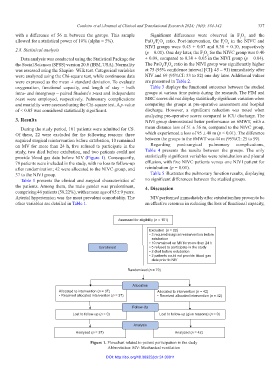
        Of  these,  22  were  excluded  for  the  following  reasons:  three   which experienced a loss of 95 ± 40 m (p < 0.01). The difference
        required surgical reintervention before extubation, 10 remained   between the groups in the 6MWT was 44 m (95%CI: 25 to 59).
        on MV for more than 24 h, five refused to participate in the   Regarding  post-surgical  pulmonary  complications,
        study, two died before extubation, and two patients could not   Table  4  presents the results between the groups.  The only
        provide blood gas data before NIV (Figure 1). Consequently,   statistically significant variables were reintubation and pleural
        79 patients were included in the study, with no loss to follow-up   effusion, with five NIVC patients versus one NIVI patient for
        after randomization; 42 were allocated to the NIVC group, and   reintubation (p = 0.01).
        37 to the NIVI group.                                    Table 5 illustrates the pulmonary function results, displaying
          Table 1 presents the clinical and surgical characteristics of   no significant differences between the studied groups.
        the patients. Among them, the male gender was predominant,   4. Discussion
        comprising 46 patients (58.22%), with a mean age of 65 ± 9 years.
        Arterial hypertension was the most prevalent comorbidity. The   NIV performed immediately after extubation has proven to be
        other variables are detailed in Table 1.               an effective resource in reducing the loss of functional capacity,


                                                   Assessed for eligibility (n = 101)
                                                                 Excluded  (n = 22)
                                                                 • 3 required surgical reintervention before
                                                                   extubation
                                                                 • 10 remained on MV for more than 24 h
                                           Enrollment            • 5 refused to participate in the study
                                                                 • 2 died before extubation
                                                                 • 2 patients could not provide blood gas
                                                                   data prior to NIV

                                                       Randomized (n = 79)


                                                         Allocation
                          Allocated to intervention (n = 37)        Allocated to intervention (n = 42)
                          • Received allocated intervention (n = 37)  • Received allocated intervention (n = 42)

                                                         Follow-Up
                                Lost to follow-up (n = 0)            Lost to follow-up (give reasons) (n = 0)

                                                          Analysis
                                 Analyzed (n = 37)                         Analyzed (n = 42)
                                       Figure 1. Flowchart related to patient participation in the study
                                               Abbreviation: MV: Mechanical ventilation
                                               DOI: http://doi.org/10.36922/jctr.24.00011

