


Page 28 - JCTR-10-6
P. 28
338                       Cordeiro et al.ǀ Journal of Clinical and Translational Research 2024; 10(6): 334-342
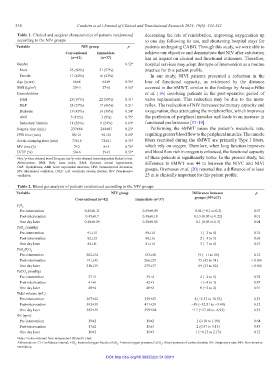
        Table 1. Clinical and surgical characteristics of patients randomized   decreasing the rate of reintubation, improving oxygenation up
        according to the NIV groups                            to one day following its use, and shortening hospital stays for
        Variable                    NIV group          p       patients undergoing CABG. Through this study, we were able to
                             Conventional   Immediate          achieve our objective and demonstrate that NIV after extubation
                               (n=42)       (n=37)             has an impact on clinical and functional outcomes. Therefore,
        Gender                                        0.52 a   hospital services may adopt this type of intervention as a routine
         Male                  25 (60%)    21 (57%)            practice for this patient profile.
         Female                17 (40%)    16 (43%)              In our study, NIVI patients presented a reduction in the
        Age (years)             66±8         64±9     0.36 b   loss of  functional  capacity,  as  evidenced  by  the  distance
        BMI (kg/m²)             25±3         27±4     0.14 b   covered in the 6MWT, similar to the findings by Araújo-Filho
        Comorbidities                                          et al. [16] involving patients  in the post-operative  period of
         SAH                   28 (67%)    22 (59%)   0.31 a   valve replacement.  This reduction  may be due to the meta-
         DLP                   24 (57%)    17 (46%)   0.21 a   reflex. The realization of NIV increases pulmonary capacity and
         Diabetes              19 (45%)    14 (38%)   0.54 a   oxygenation, thus attenuating the metaboreflex, which improves
         AMI                   5 (12%)      3 (8%)    0.75 a   the perfusion of peripheral muscles and leads to an increase in
         Sedentary lifestyle   11 (26%)     9 (24%)   0.69 a   functional performance [17-19].
        Surgery time (min)     237±88       244±87    0.23 b     Performing the 6MWT raises the patient’s metabolic rate,
        CPB time (min)          88±21       92±25     0.18 b   requiring greater blood flow to the peripheral muscles. The muscle
        Aortic clamping time (min)  77±18   72±21     0.35 b   fibers  recruited  during  the  6MWT  are  primarily Type I  fibers,
        MV time (h)             7±2          8±3      0.76 b   which rely on oxygen. Therefore, when lung function improves
        LVEF (%)                58±6         59±5     0.59 b   and blood flow rich in oxygen is enhanced, the functional capacity
            a
        Note: p-value obtained from Chi-square test;  p-value obtained from independent Student’s t-test.  of these patients is significantly better. In the present study, the
                               b
        Abbreviations: BMI: Body mass index; SAH: Systemic arterial hypertension;    difference  in  6MWT  was  44  m  between  the  NIVC  and  NIVI
        DLP: Dyslipidemia;  AMI:  Acute myocardial infarction; CPB: Extracorporeal circulation;   groups. Gremeaux et al. [20] reported that a difference of at least
        MV:  Mechanical  ventilation;  LVEF:  Left  ventricular  ejection  fraction;  NIV:  Non-invasive
        ventilation.                                           25 m is clinically important for this patient profile.
        Table 2. Blood gas analysis of patients randomized according to the NIV groups
        Variable                                NIV group                          Difference between         p
                                 Conventional (n=42)       Immediate (n=37)         groups (95%CI)
        F O 2
         I
         Pre-intervention            0.45±0.11                0.49±0.09             0.04 (−0.1 to 0.2)       0.67
         Post-intervention           0.43±0.7                 0.30±0.10             0.13 (0.05 to 0.22)      0.01
         One day later               0.40±0.09                0.30±0.05             0.1 (0.03 to 0.3)        0.04
        PaO  (mmHg)
           2
         Pre-intervention             91±15                    90±14                  1 (−3 to 4)            0.76
         Post-intervention            82±12                    80±16                  2 (−4 to 5)            0.68
         One day later                84±11                    81±14                  3 (−7 to 8)            0.67
        PaO /F O
           2  I  2
         Pre-intervention             202±34                  183±48                 19 (−11 to 28)          0.12
         Post-intervention            191±45                  266±29                 75 (45 to 91)          < 0.001
         One day later                210±39                  279±37                 69 (33 to 82)          < 0.001
        PaCO  (mmHg)
            2
         Pre-intervention              37±5                    39±4                   2 (−4 to 5)            0.78
         Post-intervention             41±6                    42±3                   1 (−4 to 3)            0.87
         One day later                 40±4                    40±2                   0 (−2 to 2)            0.91
        Tidal volume (mL)
         Pre-intervention             367±22                  359±25                8 (−2.53 to 18.53)       0.53
         Post-intervention            392±31                  411±29              −19 (−32.51 to −5.49)      0.32
         One day later                382±21                  399±24               −17 (−27.08 to -6.92)     0.39
        RR (rpm)
         Pre-intervention              19±2                    18±2                  1 (0.10 to 1.90)        0.64
         Post-intervention             17±2                    15±3                  2 (0.87 to 3.13)        0.43
         One day later                 16±2                    15±3                 1 (−0.13 to 2.13)        0.72
        Note:P-value obtained from independent Student’s t-test.

        Abbreviations: CI: Confidence interval; FIO : Inspired oxygen fraction; PaO : Arterial oxygen pressure; PaCO : Blood pressure of carbon dioxide; RR: Respiratory rate; NIV: Non-invasive
                                                   2
                                 2
                                                                      2
        ventilation.
                                               DOI: http://doi.org/10.36922/jctr.24.00011

