


Page 84 - JCTR-11-1
P. 84
Journal of Clinical and
            Translational Research                                                    Meropenem-induced cholestasis


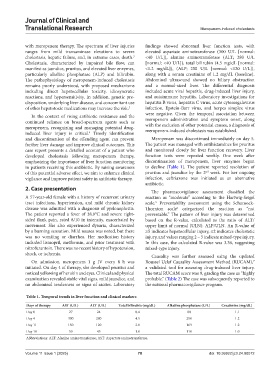
            with meropenem therapy. The spectrum of liver injuries   findings showed abnormal liver function tests, with
            ranges from mild transaminase elevations to severe   elevated aspartate aminotransferase (300 U/L [normal:
            cholestasis, hepatic failure, and, in extreme cases, death.    <40 U/L]), alanine aminotransferase (ALT; 280 U/L
                                                          3
            Cholestasis, characterized by impaired bile flow, can   [normal: <40  U/L]), total bilirubin (4.5  mg/dL [normal:
            manifest as jaundice, pruritus, and elevated liver enzymes,   <1.2  mg/dL]), (ALP; 250 U/L [normal: <120 U/L]),
            particularly alkaline phosphatase (ALP) and bilirubin.   along with a serum creatinine of 1.2  mg/dL (baseline).
            The pathophysiology of meropenem-induced cholestasis   Abdominal ultrasound showed no biliary obstruction
            remains poorly understood, with proposed mechanisms   and a normal-sized liver. The differential diagnosis
            including direct hepatocellular toxicity, idiosyncratic   included  acute  viral hepatitis, drug-induced  liver injury,
            reactions, and hypersensitivity. In addition, genetic pre-  and autoimmune hepatitis. Laboratory investigations for
            disposition, underlying liver disease, and concomitant use   hepatitis B virus, hepatitis C virus, acute cytomegalovirus
            of other hepatotoxic medications may increase the risk. 3  infection, Epstein-Barr virus, and herpes simplex virus
                                                               were negative. Given the temporal association between
              In the context of rising antibiotic resistance and the
            continued reliance on broad-spectrum agents such as   meropenem administration and symptom onset, along
            meropenem,  recognizing  and  managing  potential  drug-  with the exclusion of other potential causes, a diagnosis of
                                                               meropenem-induced cholestasis was established.
                                       4
            induced liver injury is critical.  Timely identification
            and discontinuation of the offending agent can prevent   Meropenam was discontinued immediately on day 5.
            further liver damage and improve clinical outcomes. This   The patient was managed with antihistamines for pruritus
            case report presents a detailed account of a patient who   and monitored closely for liver function recovery. Liver
            developed cholestasis following meropenem therapy,   function tests were repeated weekly. One week after
            emphasizing the importance of liver function monitoring   discontinuation of meropenem, liver enzymes began
            in patients receiving this antibiotic. By raising awareness   to decline (Table 1). The patient reported resolution of
                                                                                        nd
            of this potential adverse effect, we aim to enhance clinical   pruritus and jaundice by the 2   week. For her ongoing
            vigilance and improve patient safety in antibiotic therapy.  infection, ceftriaxone was initiated as an alternative
                                                               antibiotic.
            2. Case presentation
                                                                 The pharmacovigilance assessment classified the
            A 57-year-old female with a history of recurrent urinary   reaction as “moderate”  according  to  the Hartwig-Seigel
            tract infections, hypertension, and mild chronic kidney   scale.  Preventability assessment using the Schumock-
                                                                   5
            disease was admitted with a diagnosis of pyelonephritis.   Thornton scale  categorized the reaction as “not
                                                                            6
            The patient reported a fever of 38.9°C and severe right-  preventable.” The pattern of liver injury was determined
            sided flank pain, rated 8/10 in intensity, exacerbated by   based on the R-value, calculated as the ratio of ALT/
            movement. She also experienced dysuria, characterized   upper limit of normal (ULN): ALP/ULN. An R-value of
            by a burning sensation. Mild nausea was noted, but there   ≥5 indicates hepatocellular injury, ≤2 indicates cholestatic
            was no vomiting or diarrhea. Her medication history   injury, and values ranging 2 – 5 indicate mixed-type injury.
            included lisinopril, metformin, and prior treatment with   In this case, the calculated R-value was 3.36, suggesting
            nitrofurantoin. There was no recent history of hypotension,   mixed-type injury.
            shock, or ischemia.                                  Causality was further assessed using the updated
              On admission, meropenem 1  g IV every 8  h was   Roussel Uclaf Causality Assessment Method (RUCAM),
                                                                                                             7
            initiated. On day 4 of therapy, she developed pruritus and   a validated tool for assessing drug-induced liver injury.
            noticed yellowing of her skin and eyes. Clinical and physical   The total RUCAM score was 9, grading the case as “highly
            examination revealed stable vital signs, mild jaundice, and   probable.” (Table 2) The case was subsequently reported to
            no abdominal tenderness or signs of ascites. Laboratory   the national pharmacovigilance program.

            Table 1. Temporal trends in liver function and clinical markers
            Days of therapy  AST (U/L)  ALT (U/L)   Total bilirubin (mg/dL)  Alkaline phosphatase (U/L)  Creatinine (mg/dL)
            Day 0             27          24               0.4                   80                  1.1
            Day 4             300         280              4.5                  250                  1.2
            Day 11            150         120              2.0                  163                  1.2
            Day 18            50          45               1.0                  110                  1.0
            Abbreviations: ALT: Alanine aminotransferase; AST: Aspartate aminotransferase.


            Volume 11 Issue 1 (2025)                        78                            doi: 10.36922/jctr.24.00072

