


Page 81 - JCTR-11-1
P. 81
Journal of Clinical and
            Translational Research                                            Treatment choice for iatrogenic A-dissection


            A                       B                          mechanisms of injury (such as direct intimal damage to
                                                               the aorta caused by retrograde transaortic advancement of
                                                               guiding catheters or endoprostheses) differ from the case
                                                               presented here.  In our case, the patient experienced a two-
                                                                           6,7
                                                               stage  clinical  evolution. First,  only  a contrast-enhancing
                                                               aortic hematoma (without intimal tear) was observed,
            C                       D                          for  which  conservative  treatment  was  administered
                                                               without stenting of the entry point. This treatment was
                                                               initially successful, with complete regression of the
                                                               periaortic hematoma at 1 month. However, in the second
                                                               phase, an intimal tear developed despite well-managed
                                                               anti-hypertensive treatment, necessitating emergency
                                                               surgery for ascending aorta replacement. To the best of
            Figure 3. Follow-up computed tomography scan, 48 h later showed near-  our knowledge, no similar case has been reported in the
            complete regression of the false lumen. (A and C) Early phase of contrast
            injection; (B and D) Delayed phase of contrast injection.  literature.
                                                                 In these situations, regardless of etiology, the guidelines
                     A                                         vaguely recommend that “…dissections extending over
                                                               several centimeters into the ascending aorta or further
                                                               propagating require emergency cardiac surgery….” 8,p.2901
                                                               However, the role of the causative mechanism is not clearly
                                                               defined, and in this context, the term “iatrogenic” refers to
                                                               a variety of possible causes.
                                                                 In the present case, the initial treatment decision was
                     B                                         influenced by the underlying mechanism of injury. While
                                                               acute surgical treatment typically aims to stabilize the
                                                               ascending aorta by removing the intimal tear and replacing
                                                               the damaged segment with a vascular prosthesis, it is likely
                                                               that, at least initially, there was no corresponding tear in
                                                               the ascending aorta. Instead, the dissection was provoked
                                                               by the forcible retrograde advancement of a catheter via
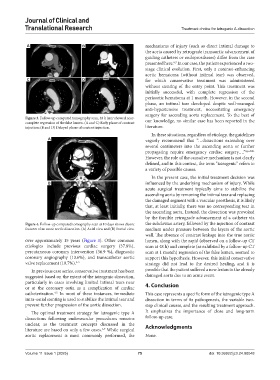
            Figure 4. Follow-up computed tomography scan at 10 days shows classic   the subclavian artery, followed by the injection of contrast
            features of an acute aortic dissection. (A) Axial view and (B) frontal view.  medium under pressure between the layers of the aortic
                                                               wall. The absence of contrast leakage into the true aortic
            over approximately 15  years (Figure  3). Other common   lumen, along with the rapid (observed on a follow-up CT
            etiologies include previous cardiac surgery (37.8%),   scan at 48 h) and complete (as exhibited by a follow-up CT
            percutaneous coronary intervention (36.9 %), diagnostic   scan at 1 month) regression of the false lumen, seemed to
            coronary angiography (13.6%), and transcatheter aortic   support this hypothesis. However, this initial conservative
            valve replacement (10.7%). 1-3                     strategy did not lead to the desired healing, and it is
              In previous case series, conservative treatment has been   possible that the patient suffered a new lesion in the already
            suggested based on the extent of the iatrogenic dissection,   damaged aorta due to an acute event.
            particularly in cases involving limited intimal tears near
            or at the coronary ostia as a complication of cardiac   4. Conclusion
            catheterization.  In most of these instances, immediate   This case represents a specific form of the iatrogenic type A
                        4,5
            intra-ostial stenting is used to stabilize the intimal tear and   dissection in terms of its pathogenesis, the variable two-
            prevent further progression of the aortic dissection.  step clinical course, and the resulting treatment approach.
              The optimal treatment strategy for iatrogenic type  A   It emphasizes the importance of close and long-term
            dissections following endovascular procedures remains   follow-up care.
            unclear, as the treatment concepts discussed in the   Acknowledgments
            literature are based on only a few cases.  While surgical
                                            6,7
            aortic replacement is most commonly performed, the   None.


            Volume 11 Issue 1 (2025)                        75                            doi: 10.36922/jctr.24.00048

