


Page 80 - JCTR-11-1
P. 80
Journal of Clinical and
            Translational Research                                            Treatment choice for iatrogenic A-dissection


            2. Case presentation                                 Given the mechanism of injury and the likely absence
                                                               of an intra-aortic intimal tear (evidenced by contrast
            A 79-year-old patient, who had undergone exclusion of a   stagnation in the  false  lumen),  conservative  treatment
            degenerative abdominal aortic aneurysm 5 years earlier using   was initially chosen. Antihypertensive treatment with
            a bifurcated bi-iliac endovascular prosthesis, was admitted   metoprolol (75 mg/day) and amlodipine (10 mg/day) was
            for  elective  complementary  endovascular  treatment  of   initiated.
            a  progressively  developing  aneurysm  in  the  distal  right
            iliac artery (Figure  1). After the successful retrograde   A follow-up CT scan 48 h later showed near-complete
            advancement of a catheter through the right femoral artery,   regression of the false lumen. The patient was extubated
            several attempts to insert a percutaneous guiding catheter   and transferred to rehabilitation 14 days after admission,
            antegrade through the left axillary artery failed to reach the   with an unremarkable clinical course (Figure  3A).
            descending thoracic aorta. Subsequent contrast injection   A subsequent CT scan after 1 month confirmed the near-
            revealed stagnation of the contrast medium at the aortic arch   complete regression of the false lumen (Figure 3B).
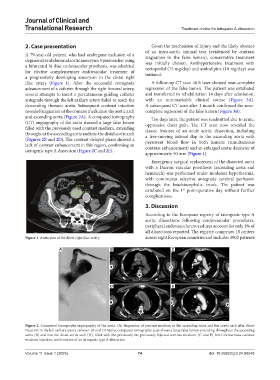
            and ascending aorta (Figure 2A). A computed tomography   Ten days later, the patient was readmitted due to acute,
            (CT) angiography of the aorta showed a large false lumen   oppressive chest pain. The CT scan now revealed the
            filled with the previously used contrast medium, extending   classic features of an acute aortic dissection, including
            throughout the ascending aorta and into the distal aortic arch   a free-moving intimal flap in the ascending aorta with
            (Figures 2B and 2D). The contrast-delayed phase showed a   persistent blood flow in both lumens (simultaneous
            lack of contrast enhancement in this region, confirming an   contrast enhancement) and an enlarged aortic diameter of
            iatrogenic type A dissection (Figure 2C and 2E).
                                                               approximately 50 mm (Figure 4).
                                                                 Emergency surgical replacement of the dissected aorta
                                                               with a Dacron vascular prosthesis (ascending aorta and
                                                               hemiarch) was performed under moderate hypothermia,
                                                               with continuous selective antegrade cerebral perfusion
                                                               through the brachiocephalic trunk. The patient was
                                                               extubated on the 1   post-operative day without further
                                                                               st
                                                               complications.
                                                               3. Discussion
                                                               According to the European registry of iatrogenic type A
                                                               aortic dissections following cardiovascular procedures,
                                                               peripheral endovascular procedures account for only 1% of
                                                               all dissections reported. The registry comprises 18 centers
            Figure 1. Aneurysm of the distal right iliac artery  across eight European countries and includes 3902 patients


                          A                     B                         C


                                                D                         E


            Figure 2. Computed tomography angiography of the aorta. (A) Stagnation of contrast medium in the ascending aorta and the aortic arch after direct
            injection in the left axillary artery catheter. (B and D) Native computed tomography scan shows a large false lumen extending throughout the ascending
            aorta (B) and into the distal aortic arch (D), filled with the previously the previously injected contrast medium. (C and E) After intravenous contrast
            medium injection, confirmation of an iatrogenic type A dissection.

            Volume 11 Issue 1 (2025)                        74                            doi: 10.36922/jctr.24.00048

