


Page 38 - JCTR-11-2
P. 38
Journal of Clinical and
            Translational Research                                            miRNA in pneumonia and pulmonary fibrosis


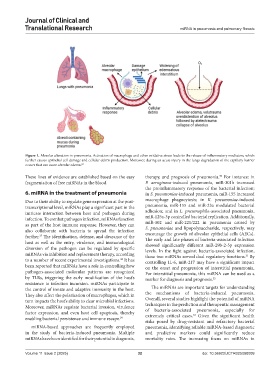
            Figure 1. Alveolar alteration in pneumonia. Activation of macrophage and other oxidative stress leads to the release of inflammatory mediators, which
            further causes epithelial cell damage and cellular debris production. Moreover, during an acute injury in the lungs degradation of the capillary barrier
            occurs that can cause alveolar edema. 69

            These lines of evidence are established based on the easy   therapy, and prognosis of pneumonia.  For instance: in
                                                                                              30
            fragmentation of free miRNAs in the blood.         P. aeruginosa-induced pneumonia, miR-301b increased
                                                               the proinflammatory response of the bacterial infection;
            6. miRNA in the treatment of pneumonia             in S. pneumoniae-induced pneumonia, miR-155 increased

            Due to their ability to regulate gene expression at the post-  macrophage phagocytosis; in  K. pneumoniae-induced
            transcriptional level, miRNAs play a significant part in the   pneumonia, miR-155 and miR-23a modulated bacterial
            intricate interaction between host and pathogen during   adhesion; and in  L. pneumophila-associated pneumonia,
            infection. To combat pathogen infection, miRNAs function   miR-125a-3p controlled bacterial replication. Additionally,
            as part of the host immune response. However, they can   miR-302 and miR-221/222 in pneumonia caused by
            also collaborate with bacteria to spread the infection   S. pneumoniae and lipopolysaccharide, respectively, may
                                                               encourage the growth of alveolar epithelial cells (AECs).
            further.  The identification, defense, and clearance of the   The early and late phases of bacteria-associated infection
                  27
            host as well as the entry, virulence, and immunological   showed significantly different miR-29b-2-5p expression
            diversion  of  the pathogen can be  regulated by  specific   levels. In the  fight against bacteria-associated infection,
            miRNAs via inhibition and replacement therapy, according   these two miRNAs served dual regulatory functions.  By
                                                                                                         31
            to a number of recent experimental investigations.  It has   controlling IL-6, miR-217 may have a significant impact
                                                    28
            been reported that miRNAs have a role in controlling how   on  the  onset  and  progression  of  interstitial  pneumonia.
            pathogen-associated molecular patterns are recognized   For interstitial pneumonia, this miRNA can be used as a
            by  TLRs, triggering the  early  modification of  the  host’s   marker for diagnosis and prognosis. 32
            resistance to infection incursion. miRNAs participate in
            the control of innate and adaptive immunity in the host.   The miRNAs are important targets for understanding
            They also affect the polarization of macrophages, which in   the mechanisms of bacteria-induced pneumonia.
            turn impacts the host’s ability to clear microbial infections.   Overall, several studies highlight the potential of miRNA
            Moreover, miRNAs regulate bacterial invasion, virulence   techniques in the prediction and therapeutic management
                                                               of bacteria-associated pneumonia, especially for
            factor expression, and even host cell apoptosis, thereby   extremely critical cases.  Given the significant health
                                                                                   33
            enabling bacterial persistence and immune escape. 29
                                                               risks posed by  drug-resistant and refractory bacterial
              miRNA-based approaches are frequently employed   pneumonia, identifying reliable miRNA-based diagnostic
            in the study of bacteria-induced pneumonia. Multiple   and predictive markers could significantly reduce
            miRNAs have been identified for their potential in diagnosis,   mortality rates. The increasing focus on miRNAs in


            Volume 11 Issue 2 (2025)                        32                         doi: 10.36922/JCTR025080009

