


Page 61 - JCTR-11-2
P. 61
Journal of Clinical and
            Translational Research                                              CT-guided needle versus glue localization


                         A                       B                       C


                         D                  E                 F                G


                         H                       I                       J


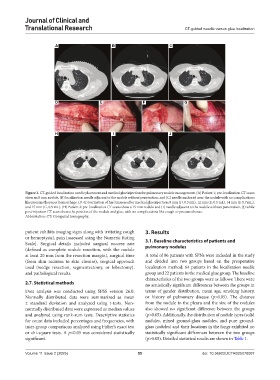
            Figure 1. CT-guided localization needle placement and medical glue injection for pulmonary nodule management. (A) Patient 1; pre-localization CT scans
            show an 8 mm nodule, (B) localization needle adjacent to the nodule without penetration, and (C) needle anchored near the nodule with no complications
            like pneumothorax or hemorrhage. (D-G) Formation of hard masses after medical glue injection; 9 mm (D, 0.3 mL), 12 mm (E, 0.5 mL), 14 mm (F, 0.7 mL),
            and 15 mm (G, 0.9 mL). (H) Patient 2; pre-localization CT scans show a 15 mm nodule and (I) needle adjacent to the nodule without penetration, (J) while
            post-injection CT scan shows the position of the nodule and glue, with no complications like cough or pneumothorax.
            Abbreviation: CT: Computed tomography.


            patient exhibits imaging signs along with irritating cough   3. Results
            or hemoptysis), pain [assessed using the Numeric Rating
            Scale]. Surgical details included surgical  success rate   3.1. Baseline characteristics of patients and
            (defined as complete nodule resection, with the nodule   pulmonary nodules
            at least 20 mm from the resection margin), surgical time   A total of 86 patients with SPNs were included in the study
            (from skin incision to skin closure), surgical approach   and divided into two groups based on the preoperative
            used  (wedge  resection,  segmentectomy,  or  lobectomy),   localization method: 64 patients in the localization needle
            and pathological results.                          group and 22 patients in the medical glue group. The baseline
                                                               characteristics of the two groups were as follows: There were
            2.7. Statistical methods                           no statistically significant differences between the groups in
            Data analysis was conducted using SPSS version  26.0.   terms of gender distribution, mean age, smoking history,
            Normally distributed data were summarized as mean   or  history  of  pulmonary  disease  (p>0.05).  The  distance
            ±  standard  deviation  and  analyzed  using  t-tests.  Non-  from the nodule to the pleura and the size of the nodules
            normally distributed data were expressed as median values   also showed no significant difference between the groups
            and analyzed using rank-sum tests. Descriptive statistics   (p>0.05). Additionally, the distribution of nodule types (solid
            for count data included percentages and frequencies, with   nodules, mixed ground-glass nodules, and pure ground-
            inter-group comparisons analyzed using Fisher’s exact test   glass nodules) and their locations in the lungs exhibited no
            or chi-square tests. A p<0.05 was considered statistically   statistically significant differences between the two groups
            significant.                                       (p>0.05). Detailed statistical results are shown in Table 1.


            Volume 11 Issue 2 (2025)                        55                         doi: 10.36922/JCTR025070007

