


Page 63 - JCTR-11-2
P. 63
Journal of Clinical and
            Translational Research                                              CT-guided needle versus glue localization


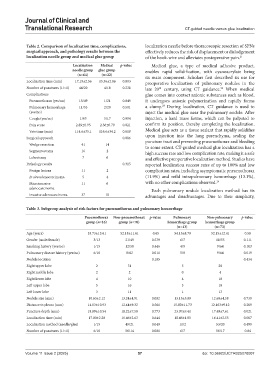
            Table 2. Comparison of localization time, complications,   localization needle before thoracoscopic resection of SPNs
            surgical approach, and pathology results between the   effectively reduces the risk of displacement or dislodgement
            localization needle group and medical glue group   of the hook-wire and alleviates postoperative pain. 21

                                Localization   Medical   p‑value  Medical glue, a type of medical adhesive product,
                                needle group   glue group      enables rapid solidification, with cyanoacrylate being
                                  (n=64)    (n=22)             its main component. Scholars first described its use for
            Localization time (min)  17.19±2.56  15.36±2.06  0.003  preoperative localization of pulmonary nodules in the
            Number of punctures (1/>1)  44/20  4/18  0.238     late 20   century, using CT guidance.  When medical
                                                                     th
                                                                                               22
            Complications                                      glue comes into contact anionic substances such as blood,
             Pneumothorax (yes/no)  15/49    1/21    0.049     it undergoes anionic polymerization and rapidly forms
                                                                      23
             Pulmonary hemorrhage   11/53    2/20    0.501     a clump.  During localization, CT guidance is used to
             (yes/no)                                          inject the medical glue near the pulmonary nodule. After
             Cough (yes/no)        1/63      5/17    0.004     injection, a hard mass forms, which can be palpated to
             Pain score          2.89±0.95  2.36±0.79  0.021   confirm its position, thereby completing the localization.
             Vats time (min)     114.6±35.1  116.6±34.2  0.819  Medical glue acts as a tissue sealant that rapidly solidifies
            Surgical approach                        0.086     upon  injection  into  the  lung  parenchyma,  sealing  the
                                                               puncture tract and preventing pneumothorax and bleeding
             Wedge resection        41        14               to some extent. CT-guided medical glue localization has a
             Segmentectomy          16        2                high success rate and low complication rate, making it a safe
             Lobectomy              7         6                and effective preoperative localization method. Studies have
            Pathology results                        0.315     reported localization success rates of up to 100% and low
             Benign lesions         11        2                complication rates, including asymptomatic pneumothorax
             In situ adenocarcinoma  5        4                (11.9%) and mild intrapulmonary hemorrhage (13.1%),
             Microinvasive          11        6                with no other complications observed. 24
             adenocarcinoma                                      Each pulmonary nodule localization method has its
             Invasive adenocarcinoma  37      10               advantages and disadvantages. Due to their simplicity,


            Table 3. Subgroup analysis of risk factors for pneumothorax and pulmonary hemorrhage
                                     Pneumothorax   Non‑pneumothorax   p‑value  Pulmonary   Non‑pulmonary   p‑value
                                      group (n=16)  group (n=70)        hemorrhage group   hemorrhage group
                                                                            (n=13)          (n=73)
            Age (years)               53.73±13.61   52.18±11.61   0.65     54.15±8.79      52.15±12.41   0.58
            Gender (male/female)         3/13         21/49       0.539       6/7            18/55       0.111
            Smoking history (yes/no)     1/15         12/58       0.446       4/9            9/64        0.103
            Pulmonary disease history (yes/no)  6/10   8/62       0.011       5/8            9/64        0.019
            Nodule location                                       0.105                                  0.434
            Right upper lobe              2            31                     5               28
            Right middle lobe             2             2                     0               4
            Right lower lobe              4            10                     4               10
            Left upper lobe               5            16                     3               18
            Left lower lobe               3            11                     1               13
            Nodule size (mm)           10.63±2.12    13.24±4.91   0.002    13.15±5.09      12.68±4.58    0.739
            Distance to pleura (mm)   14.03±10.93    12.44±9.32   0.561    15.80±11.73     12.163±9.12   0.209
            Puncture depth (mm)       18.89±10.54    18.22±7.58   0.773    23.07±9.41      17.49±7.61    0.021
            Localization time (min)    17.00±2.20    16.66±2.63   0.644    18.46±1.85      16.41±2.55    0.007
            Localization method (needle/glue)  1/15   49/21       0.049      11/2            53/20       0.499
            Number of punctures (1/>1)   6/10         56/14       0.001       6/7            56/17       0.04


            Volume 11 Issue 2 (2025)                        57                         doi: 10.36922/JCTR025070007

