


Page 62 - JCTR-11-2
P. 62
Journal of Clinical and
            Translational Research                                              CT-guided needle versus glue localization


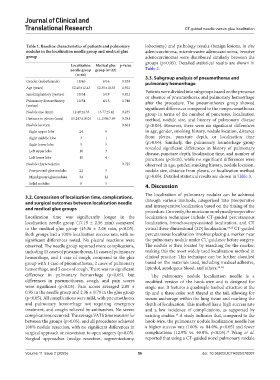
            Table 1. Baseline characteristics of patients and pulmonary   lobectomy) and pathology results (benign lesions, in situ
            nodules in the localization needle group and medical glue   adenocarcinoma, microinvasive adenocarcinoma, invasive
            group                                              adenocarcinoma) were distributed similarly between the
                                                               groups (p>0.05). Detailed statistical results are shown in
                               Localization   Medical glue  p‑value
                               needle group  group (n=22)      Table 2.
                                 (n=64)
            Gender (male/female)  18/46      6/16    0.939     3.3. Subgroup analysis of pneumothorax and
                                                               pulmonary hemorrhage
            Age (years)         52.45±12.43  52.35±10.55  0.922
            Smoking history (yes/no)  10/54  3/19    0.822     Patients were divided into subgroups based on the presence
                                                               or absence of pneumothorax and pulmonary hemorrhage
            Pulmonary disease history   10/54  4/18  0.748     after the procedure. The pneumothorax group showed
            (yes/no)                                           significant differences compared to the nonpneumothorax
            Nodule size (mm)    12.40±4.33  13.77±5.41  0.235  group in terms of the number of punctures, localization
            Distance to pleura (mm)  13.247±10.01  11.159±7.89  0.381  method, nodule size, and history of pulmonary disease
            Nodule location                          0.661     (p<0.05).  However,  there  were  no  significant  differences
             Right upper lobe      24         9                in age, gender, smoking history, nodule location, distance
             Right middle lobe     3          1                from pleura, puncture depth, or localization time
             Right lower lobe      9          5                (p>0.05). Similarly, the pulmonary hemorrhage group
             Left upper lobe       18         3                revealed significant  differences  in history of  pulmonary
                                                               disease, puncture depth, localization time, and number of
             Left lower lobe       10         4                punctures (p<0.05), while no significant differences were
            Nodule characteristics                   0.725     observed in age, gender, smoking history, nodule location,
             Pure ground-glass nodules  22    5                nodule size, distance from pleura, or localization method
             Mixed ground-glass nodules  34  12                (p>0.05). Detailed statistical results are shown in Table 3.
             Solid nodules         8          5
                                                               4. Discussion

            3.2. Comparison of localization time, complications,   The  localization  of  pulmonary  nodules  can  be  achieved
            and surgical outcomes between localization needle   through various methods, categorized into preoperative
                                                               and intraoperative localization based on the timing of the
            and medical glue groups
                                                               procedure. Currently, the most commonly used preoperative
            Localization time was significantly longer in the   localization techniques include CT-guided percutaneous
            localization needle group (17.19 ± 2.56  min) compared   localization, bronchoscopy-assisted localization, and CT
            to the medical glue group (15.36 ± 2.06  min,  p<0.05).   virtual three-dimensional (3D) localization. 14,15  CT-guided
            Both groups had a 100% localization success rate, with no   percutaneous localization involves placing a marker near
            significant differences noted. No  pleural  reactions  were   the pulmonary nodule under CT guidance before surgery.
            observed. The needle group reported more complications,   The nodule is then located by searching for the marker,
            including 15 cases of pneumothorax, 11 cases of pulmonary   making this the most widely used localization method in
            hemorrhage, and 1 case of cough, compared to the glue   clinical practice. This technique can be further classified
            group with 1 case of pneumothorax, 2 cases of pulmonary   based on the materials used, including medical adhesive,
            hemorrhage, and 5 cases of cough. There was no significant   lipiodol, autologous blood, and others. 16-18
            difference in pulmonary hemorrhage (p>0.05), but     The pulmonary nodule localization needle is a
            differences in pneumothorax, cough, and pain scores   modified version of the hook-wire and is designed for
            were significant (p<0.05). Pain scores averaged 2.89 ±   single use. It features a quadruple-barbed structure at the
            0.95 in the needle group and 2.36 ± 0.79 in the glue group   tip and a three-color soft thread at the tail, allowing for
            (p<0.05). All complications were mild, with pneumothorax   secure anchorage within the lung tissue and marking the
            and pulmonary hemorrhage not requiring emergency   depth of localization. This method has a high success rate
            treatment, and coughs relieved by antitussives. No severe   and a low incidence of complications, as supported by
            complications occurred. The average VATS time was similar   existing studies.  A study indicates that, compared to the
                                                                            19
            between the groups (p>0.05), and all procedures achieved   hook-wire, the pulmonary nodule localization needle has
            100% nodule resection, with no significant differences in   a higher success rate (100% vs. 84.0%, p<0.05) and fewer
                                                                                                 20
            surgical approach or conversion to open surgery (p>0.05).   complications (12.9% vs. 40.0%,  p<0.05).  Wang  et al.
            Surgical approaches (wedge resection, segmentectomy,   reported that using a CT-guided novel pulmonary nodule

            Volume 11 Issue 2 (2025)                        56                         doi: 10.36922/JCTR025070007

