


Page 25 - JCTR-11-3
P. 25
Journal of Clinical and
            Translational Research                                              Immunogenicity and safety of flu vaccines


                                                               the non-adjuvanted IV, and 365.51 (257.96 – 473.07) for
                          References  44  45  46  13           the split IV. Notably, the GMTs of the two subunit  IVs
                                                               were higher than that of the split vaccine. For H3N2, the
                                                               adjuvanted subunit  IV and the split IV demonstrated
                          Type of   virus   strain  IIV4  IIV3  IIV3  IIV4  higher GMTs. For the influenza B strains, the GMTs of the
                                                               non-adjuvanted subunit vaccine and the split vaccine were
                                                               similar but significantly lower than that of the adjuvanted
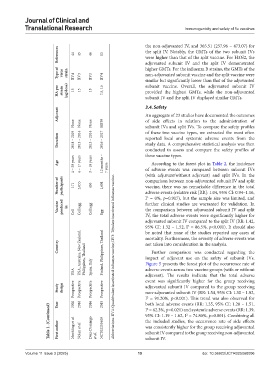
                          HA per   strain   (μg/dose)  15  15  15  7.5, 15  subunit  vaccine.  Overall, the  adjuvanted  subunit  IV
                                                               provided the highest GMTs, while the non-adjuvanted
                                                               subunit IV and the split IV displayed similar GMTs.

                                                               3.4. Safety
                          Adjuvant                             An aggregate of 23 studies have documented the outcomes

                                None  None  None  MF59         of side effects in relation to the administration of
                                                               subunit IVs and split IVs. To compare the safety profiles
                                                               of  these  two  vaccine  types,  we  extracted  the  most  often
                          Duration  2018 – 2019  2013 – 2014  2013 – 2014  2016 – 2017  reported local and systemic adverse events from the

                                                               study data. A comprehensive statistical analysis was then
                                                               conducted to assess and compare the safety profiles of
                                                               these vaccine types.
                                4 – 20 years  4 – 17 years  3 – 18 years  7 years  of adverse events was compared between subunit  IVs
                          Age                12 months –         According to the forest plot in Table 2, the incidence


                                                               (with adjuvant/without adjuvant) and split IVs.  In the
                          Number of   participants  171  2,055  430  1,601  comparison between non-adjuvanted subunit IV and split
                                                               vaccine, there was no remarkable difference in the total
                                                               adverse events (relative risk [RR]: 1.04, 95% CI: 0.94–1.16,
                                                                2
                                                               I  = 0%,  p=0.917), but the sample size was limited, and
                          Vaccine   produced   in  Cell  Cell/egg  Cell/egg  Egg  further clinical studies are warranted for validation. In
                                                               the comparison between adjuvanted subunit IV and split
                                                               IV, the total adverse events were significantly higher for
                                                               adjuvanted subunit IV compared to the split IV (RR: 1.42,
                                                               95% CI: 1.32 – 1.52, I  = 86.5%, p<0.001). It should also
                                                                                 2
                                                               be noted that none of the studies reported any cases of
                                   USA, Australia, New Zealand,   Philippines, Thailand  Finland, Philippines, Thailand Abbreviations: IIV4: Quadrivalent inactivated influenza vaccine; IIV3: Trivalent inactivated influenza vaccine.  impact of adjuvant use on the safety of subunit  IVs.
                          Country                              mortality. Furthermore, the severity of adverse events was
                                                               not taken into consideration in the analysis.
                                                                 Further comparison was conducted regarding the


                                                               adverse events across two vaccine groups (with or without
                                USA     Spain, Italy           Figure 5 presents the forest plot of the occurrence rate of
                                                               adjuvant). The results indicate that the total adverse
                          Study   design  Prospective  Prospective  Prospective  Prospective  event  was  significantly  higher  for  the  group  receiving
                                                               adjuvanted subunit  IV compared to the group receiving
                                                               non-adjuvanted subunit IV (RR: 1.54, 95% CI: 1.30 – 1.82,
                                                               I  = 91.20%,  p<0.001). This trend was also observed for
                                                                2
                                                               both local adverse events (RR: 1.35, 95% CI: 1.20 – 1.51,
                      Table 1. (Continued)  Year First author  2020 Moehling et al.  2016  Nolan et al.  2016 Diez-Domingo   et al.  2015 NCT02255409   I  = 62.3%, p=0.021) and systemic adverse events (RR: 1.39,
                                                                2
                                                               95% CI: 1.19 – 1.62, I  = 74.80%, p=0.001). Combining all
                                                                                2
                                                               the included studies, the occurrence rate of side effects
                                                               was consistently higher for the group receiving adjuvanted
                                                               subunit IV compared to the group receiving non-adjuvanted


            Volume 11 Issue 3 (2025)                        19  subunit IV.            doi: 10.36922/JCTR025060006

