


Page 48 - JCTR-11-3
P. 48
Journal of Clinical and
            Translational Research                                          Greek propolis use in COVID-19: Trial protocol


            will  be  analyzed  through  spectrophotometry and  high-  Table 1. Strata, stratification variables, and sample size
            performance liquid chromatography, with complementary
            gas chromatography-mass spectrometry or liquid     Strata  Age   Sample’s age  Vaccination status  Stratum (%)
                                                                             group (%)
            chromatography-mass spectrometry employed to confirm
            compound identity and enhance resolution, particularly   Stratum 1 18 – 49  29  Vaccinated  20% of 29%
            for minor flavonoids like 3-methyl pinobanksin. 61-65  Stratum 2 18 – 49  29  Unvaccinated  80% of 29%
                                                               Stratum 3 50 – 64  29     Vaccinated  20% of 29%
              All procedures will adhere to the WHO and International
            Council for Harmonization of Technical Requirements   Stratum 4 50 – 64  29  Unvaccinated  80% of 29%
            for Pharmaceuticals for Human Use (ICH) guidelines on   Stratum 5 65 – 85  42  Vaccinated  20% of 42%
            investigational product quality and reproducibility. 66-68  Stratum 6 65 – 85  42  Unvaccinated  80% of 42%
            7.3. Quality control and assurance
            The investigational product will comply with Good   reported hospitalization distributions (29%, 29%, and 42%
            Manufacturing Practice standards, following guidelines set   per age group, respectively, with ~80% unvaccinated). 76,77
            by the WHO and the ICH. 66,68  To ensure product quality,   Random assignment within each stratum will be
            consistency, and reproducibility, independent laboratory   conducted using computer-generated sequences (Table 2).
            analyses will be performed on both the raw material and   This approach mitigates confounding and strengthens the
            the final formulation.                             internal validity of treatment comparisons across groups.
              As  no  authorized  pharmaceutical  or  nutraceutical   9. Statistical analysis
            product is being used, chemical characterization results   Statistical analysis will be performed in accordance with the
            –  including  chromatography  and  mass  spectrometry   intention-to-treat principle. All randomized participants
            data – will be provided as supplementary documentation,   who receive at least one dose of the assigned intervention
            in alignment  with best  practices  for investigational   or placebo will be included in the final analysis. Descriptive
            compounds.  Moreover, the study will follow the    statistics will be used to summarize baseline demographic
                      68
            CONSORT  guidelines  to ensure methodological      and clinical characteristics, with continuous variables
            transparency and data integrity throughout the trial.  expressed as means and standard deviations or medians
            8. Sample size and randomization strategy          and  interquartile ranges,  depending on  the  distribution,
                                                               and categorical variables as frequencies and percentages.
            A priori  power  calculations  based  on Schoenfeld’s   Comparisons  between  the  intervention  and  control
            formula (Figure A2)  indicated that approximately 330   groups will be performed using appropriate inferential
                             69
            events are required to achieve 80% statistical power at a   tests based on data type and distribution. For continuous
            5% significance level, assuming a hazard ratio of 0.7 and   outcomes such as time to viral clearance, length of
            adjusting for multiple comparisons using Bonferroni   hospitalization, and biomarker changes (e.g., C-reactive
            correction. 70,71  Allowing for a 25% censoring rate of the   protein,  interleukin-6),  the  independent  samples  t-test
            primary endpoint (hospitalization duration ≤20  days),    will be used for normally distributed data, while the
                                                         72
            the total sample size was determined to be 441 participants.  Mann–Whitney U test will be applied for non-normally
              Participants will be equally randomized to three arms   distributed variables. For categorical variables such
            – intervention, placebo, and control – in a 1:1:1 ratio (147   as the need for oxygen therapy and the occurrence of
            per group). Stratified randomization will be employed to   adverse events, Chi-square or Fisher’s exact tests will be
            control for two key prognostic factors: age and vaccination   employed.
            status,  both of  which  significantly  influence  COVID-19   Kaplan–Meier survival analysis will be used to evaluate
            progression and outcomes. 38,73-75  For instance, unvaccinated   time-to-event outcomes, including time to viral clearance,
            individuals over 65 are approximately 4.5  times more   with log-rank tests used to compare curves between
            likely to die from COVID-19 than their vaccinated   groups. Multivariable Cox proportional hazards models
            counterparts,  while vaccinated individuals have shown   may be considered to adjust for potential confounders
                      74
            shorter viral clearance times. 75                  such as age, comorbidities, and baseline severity scores.
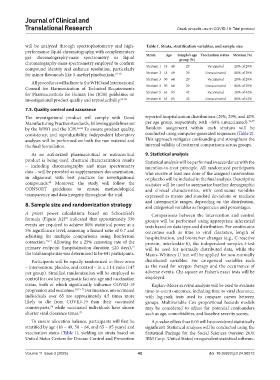
              To ensure allocation balance, participants will first be   A p-value of less than 0.05 will be considered statistically
            stratified by age (18 – 49, 50 – 64, and 65 – 85 years) and   significant. Statistical analyses will be conducted using the
            vaccination status (Table 1), yielding six strata based on   Statistical Package for the Social Sciences (version  26.0;
            United States Centers for Disease Control and Prevention   IBM Corp., United States) or equivalent statistical software.


            Volume 11 Issue 3 (2025)                        42                            doi: 10.36922/jctr.24.00073

