


Page 49 - JCTR-11-3
P. 49
Journal of Clinical and
            Translational Research                                          Greek propolis use in COVID-19: Trial protocol


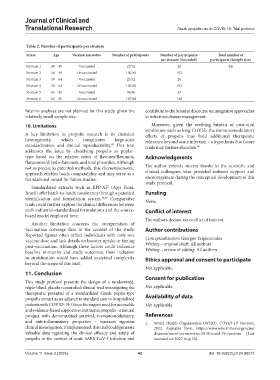
            Table 2. Number of participants per stratum
            Strata      Age     Vaccination status  Number of participants  Number of participants   Total number of
                                                                     per stratum (Rounded)  participants (Sample size)
            Stratum 1  18 – 49     Vaccinated          25.52                 26                   441
            Stratum 2  18 – 49    Unvaccinated         102.08               102
            Stratum 3  50 – 64     Vaccinated          25.52                 26
            Stratum 4  50 – 64    Unvaccinated         102.08               102
            Stratum 5  65 – 85     Vaccinated          36.96                 37
            Stratum 6  65 – 85    Unvaccinated         147.84               148

            Interim analyses are not planned for this study, given the   contribute to the broader discourse on integrative approaches
            relatively small sample size.                      to infectious disease management.

            10. Limitations                                      Moreover, given the evolving burden of post-viral
                                                               syndromes such as long COVID, the immunomodulatory
            A key limitation in propolis research is its chemical   effects of propolis may hold additional therapeutic
            heterogeneity,  which   complicates   large-scale  relevance beyond acute infection – a hypothesis that future
            standardization and clinical reproducibility.  This trial   trials may further elucidate. 80
                                                60
            addresses the issue by classifying propolis as poplar-
            type based on the relative ratios of flavones/flavonols,   Acknowledgments
            flavanones/dihydroflavonols, and total phenolics. Although
            not as precise as patented methods, this chemotaxonomic   The  author  extends  sincere  thanks  to the scientific  and
            approach enables batch comparability and may serve as a   clinical colleagues who provided indirect support and
            foundational model for future studies.             encouragement during the conceptual development of this
                                                               study protocol.
                                               ®
              Standardized extracts such as EPP-AF  (Apis Flora,
            Brazil) offer batch-to-batch consistency through a patented   Funding
            identification and formulation system. 78,79  Comparative   None.
            trials could further explore the clinical differences between
            such industrial-standardized formulations and the source-  Conflict of interest
            based model employed here.
                                                               The authors declare no conflict of interest.
              Another limitation concerns the interpretation of
            vaccination coverage data in the context of the study.   Author contributions
            Reported figures often reflect individuals with only one
            vaccine dose and lack details on booster uptake or timing   Conceptualization: Giorgos Tzigkounakis
            post-vaccination. Although these factors could influence   Writing – original draft: All authors
            baseline immunity and study outcomes, their inclusion   Writing – review & editing: All authors
            in stratification would have added analytical complexity   Ethics approval and consent to participate
            beyond the scope of this trial.
                                                               Not applicable.
            11. Conclusion
            This  study  protocol  presents  the design of  a randomized,   Consent for publication
            triple-blind, placebo-controlled clinical trial investigating the   Not applicable.
            therapeutic potential of a standardized Greek poplar-type
            propolis extract as an adjunct to standard care in hospitalized   Availability of data
            patients with COVID-19. Given the urgent need for accessible   Not applicable.
            and evidence-based supportive treatments, propolis – a natural
            product with  demonstrated antiviral, immunomodulatory,   References
            and anti-inflammatory properties – warrants rigorous   1.   World Health Organisation (WHO).  COVID-19 Vaccines;
            clinical investigation. If implemented, this trial could generate   2022. Available from: https://www.who.int/emergencies/
            valuable data regarding the clinical efficacy and safety of   diseases/novel-coronavirus-2019/covid-19-vaccines [Last
            propolis in the context of acute SARS-CoV-2 infection and   accessed on 2022 Aug 18].


            Volume 11 Issue 3 (2025)                        43                            doi: 10.36922/jctr.24.00073

