


Page 89 - JCTR-11-3
P. 89
Journal of Clinical and
            Translational Research                                         Remdesivir outcomes in hospitalized COVID-19


            Table 1. (Continued)                               Table 4. Complications and clinical outcomes among study
                                                               population
            Patients’ demographics and baseline   n (%) or
            characteristics                     mean±SD (%)    Variables                              n (%) or
             C-reactive protein (µg/mL)          106.4±326.2                                         mean±SD
             Ferritin (ng/mL)                   641.8±1054.3   Complications
             <60                                  82 (39)       Bacterial pneumonia                   14 (6.67)
             ≥60                                  118 (56.2)    Fungal pneumonia                      2 (0.95)
                                                                Bacteremia                             4 (1.9)
                                                                Acute respiratory distress syndrome   14 (6.67)
            Table 2. Concomitant medications received with remdesivir
                                                                Septic shock                          9 (4.29)
            Concomitant medications                  n (%)     Clinical outcomes
            Remdesivir+dexamethasone               101 (48.1)   Admitted to ICU                      41 (19.52)
            Remdesivir+tocilizumab                 22 (10.48)   Duration of ICU stay (days)*         10.5±11.05
                                                                Extracorporeal membrane oxygenation   1 (0.48)
            Table 3. Oxygen therapy among the study population  Vasopressor support                   11 (5.24)

            Characteristics of oxygen therapy #   n (%) or      Length of hospital stay (days)**     14.9±46.29
                                                Mean±SD (%)     Death #                               26 (12.4)
            Administration of oxygen therapy during hospitalization  96 (45.71)  Notes: * Indicates duration of ICU stay=Date of ICU discharge – Date
            Room air                              129 (61)     of ICU admission; ** Indicates length of hospital stay=Date of hospital
                                                               discharge – Date of hospital admission; # Indicates total number of
            Low-flow nasal cannula                86 (40.95)   deaths=26; There is one case with no classification pneumonia or not
            Duration of low-flow nasal cannula (days)*  4.87±5.42  pneumonia.
                                                               Abbreviations: SD: Standard deviation; ICU: Intensive care unit.
            High-flow nasal cannula               22 (10.48)
            Duration of high-flow nasal cannula (days)*  2.95±4.37
            Mechanical ventilation                 21 (10)
            Duration of mechanical ventilation (days)*  15.15±16.46
            Notes:   Indicates patient may receive more than one type of oxygen
                 #
            therapy; * Indicates duration of oxygen therapy=End date-Start date.

              In addition, patients on mechanical ventilation were
            more  likely  to  have  longer  periods  of hospital stays
            (mean = 44.461  days) compared to patients with no
            mechanical ventilation (mean = 19.179 days) with p<0.001
            (Figure 2).
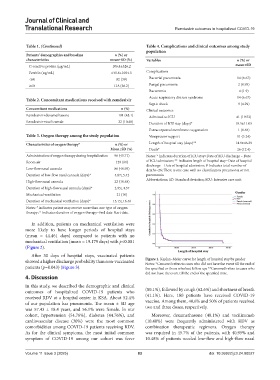
              After 30  days of hospital stays, vaccinated patients
            showed a higher discharge probability than non-vaccinated   Figure 1. Kaplan–Meier curve for length of hospital stay by gender
                                                               Notes: *Censored refers to cases who did not have the event till the end of
            patients (p=0.043) (Figure 3).                     the specified or those who lost follow-up; **Censored refers to cases who
                                                               did not have the event till the end of the specified time.
            4. Discussion
            In this study, we described the demographic and clinical
            outcomes of hospitalized COVID-19  patients who    (80.1%), followed by cough (62.6%) and shortness of breath
            received RDV at a hospital center in KSA. About 52.4%   (41.1%). Here, 180  patients have received COVID-19
            of our population has pneumonia. The mean ± SD age   vaccine. Among them, 40.6% and 50% of patients received
            was 57.43 ± 18.4  years, and 56.1% were female. In our   two and three doses, respectively.
            cohort, hypertension (54.76%), diabetes (44.76%), and   Moreover, dexamethasone (48.1%) and tocilizumab
            cardiovascular disease (30%) were the most common   (10.48%) were frequently administered with RDV as
            comorbidities among COVID-19 patients receiving RDV.   combination therapeutic regimens. Oxygen therapy
            As for the clinical symptoms, the most initial common   was required in 45.7% of the patients, with 40.95% and
            symptom of COVID-19 among our cohort was fever     10.48% of patients needed low-flow and high-flow nasal


            Volume 11 Issue 3 (2025)                        83                            doi: 10.36922/jctr.24.00027

