


Page 88 - JCTR-11-3
P. 88
Journal of Clinical and
            Translational Research                                         Remdesivir outcomes in hospitalized COVID-19


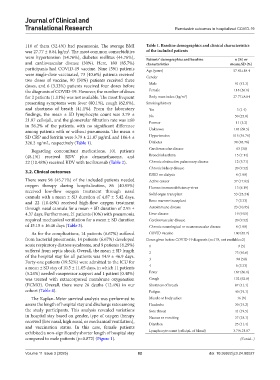
            110 of them (52.4%) had pneumonia. The average BMI   Table 1. Baseline demographics and clinical characteristics
            was 27.77 ± 8.84 kg/m . The most common comorbidities   of the included patients
                              2
            were hypertension (54.76%), diabetes mellitus (44.76%),   Patients’ demographics and baseline   n (%) or
            and cardiovascular disease (30%). Here, 180  (85.7%)   characteristics                 mean±SD (%)
            participants had COVID-19 vaccine. Nine (5%) patients   Age (years)                     57.43±18.4
            were single-dose vaccinated, 73 (40.6%) patients received   Gender
            two doses of vaccine, 90  (50%) patients received three
            doses, and 6 (3.33%) patients received four doses before   Male                          91 (43.3)
            the diagnosis of COVID-19. However, the number of doses   Female                         118 (56.1)
            for 2 patients (1.11%) was not available. The most frequent   Body mass index (kg/m )   27.77±8.84
                                                                                2
            presenting symptoms were fever (80.1%), cough (62.6%),   Smoking history
            and shortness of breath (41.1%). From the laboratory   Yes                                3 (1.4)
            findings, the mean ± SD lymphocyte count was 3.79 ±   No                                 50 (23.8)
            21.87 cells/µL, and the glomerular filtration rate was ≥60   Former                      11 (5.2)
            in 56.2% of the patients, with no significant difference
            among patients with or without pneumonia. The mean ±   Unknown                           144 (68.5)
            SD CRP and ferritin were 3.79 ± 21.87 µg/mL and 106.4 ±   Hypertension                  115 (54.76)
            326.2 ng/mL, respectively (Table 1).                Diabetes                             94 (44.76)
              Regarding concomitant medications, 101  patients   Cardiovascular disease               63 (30)
            (48.1%) received RDV plus dexamethasone, and        Bronchial asthma                     15 (7.14)
            22 (10.48%) received RDV with tocilizumab (Table 2).  Chronic obstructive pulmonary disease  12 (5.71)
                                                                Chronic kidney disease               20 (9.52)
            3.2. Clinical outcomes
                                                                ESRD on dialysis                     4 (1.90)
            There were 96 (45.71%) of the included patients needed   Active cancer                   37 (17.62)
            oxygen  therapy  during  hospitalization,  86  (40.95%)   Human immunodeficiency virus   13 (6.19)
            received low-flow oxygen treatment through nasal    Solid organ transplant               53 (25.24)
            cannula with a mean ± SD duration of 4.87 ± 5.42 days,
            and 22  (10.48%) received high-flow oxygen treatment   Bone marrow transplant            7 (3.33)
            through nasal cannula for a mean ± SD duration of 2.95 ±   Autoimmune disease            23 (10.95)
            4.37 days. Furthermore, 21 patients (10%) with pneumonia   Liver disease                 19 (9.05)
            required mechanical ventilation for a mean ± SD duration   Cerebrovascular disease       20 (9.52)
            of 15.15 ± 16.46 days (Table 3).                    Chronic neurological or neuromuscular disease  4 (1.90)
              As for the complications, 14 patients (6.67%) suffered   COVID vaccine                 180 (85.7)
            from bacterial pneumonia, 14 patients (6.67%) developed   Doses given before COVID-19 diagnosis (n=178, not available=2)
            acute respiratory distress syndrome, and 9 patients (4.29%)   1                           9 (5)
            suffered from septic shock. Overall, the mean ± SD length   2                            73 (40.6)
            of the hospital stay for all patients was 14.9 ± 46.9 days.   3                           90 (50)
            Forty-one patients (19.52%) were admitted to the ICU for
            a mean ± SD stay of 10.5 ± 11.05 days, in which 11 patients   4                          6 (3.33)
            (5.24%) needed vasopressor support and 1 patient (0.48%)   Fever                         167 (80.1)
            was treated with extracorporeal membrane oxygenation   Cough                             132 (62.6)
            (ECMO). Overall, there were 26 deaths (12.4%) in our   Shortness of breath               87 (41.1)
            cohort (Table 4).                                   Fatigue                              40 (19.1)
              The Kaplan–Meier survival analysis was performed to   Muscle or body aches              16 (9)
            assess the length of hospital stay and discharge rates among   Headache                  30 (15.2)
            the study participants. This analysis revealed variations   Sore throat                  41 (19.5)
            in hospital stay based on gender, type of oxygen therapy   Nausea or vomiting            37 (18.1)
            received (low nasal, high nasal, or mechanical ventilation),   Diarrhea                  25 (11.4)
            and vaccination status. In this case, female patients
            exhibited a non-significantly shorter length of hospital stay   Lymphocyte count (cells/µL of blood)  3.79±21.87
            compared to male patients (p=0.872) (Figure 1).                                            (Contd...)


            Volume 11 Issue 3 (2025)                        82                            doi: 10.36922/jctr.24.00027

