


Page 73 - JCTR-11-4
P. 73
Journal of Clinical and
            Translational Research                                              Adherence and psoriasis severity in Brazil


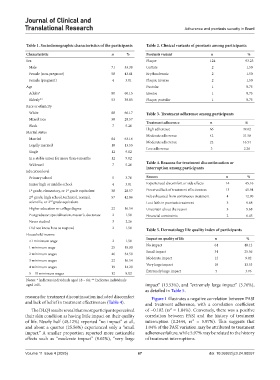
            Table 1. Sociodemographic characteristics of the participants  Table 2. Clinical variants of psoriasis among participants

            Characteristic                       n     %       Psoriasis variant           n              %
            Sex                                                Plaque                     124            93.23
             Male                               71    53.38    Guttate                     2              1.50
             Female (non-pregnant)              58    43.61    Erythrodermic               2              1.50
             Female (pregnant)                   4    3.01     Plaque, inverse             2              1.50
            Age                                                Pustular                    1              0.75
             Adults*                            80    60.15    Inverse                     1              0.75
             Elderly**                          53    39.85    Plaque, pustular            1              0.75
            Race or ethnicity
             White                              88    66.17    Table 3. Treatment adherence among participants
             Mixed race                         38    28.57
                                                               Treatment adherence        n              %
             Black                               7    5.26
                                                               High adherence             66            49.62
            Marital status
             Married                            84    63.16    Moderate adherence         42            31.58
                                                               Moderate adherence         22            16.54
             Legally married                    18    13.53
                                                               Low adherence               3             2.26
             Single                             12    9.02
             In a stable union for more than 6 months  12  9.02
             Widowed                             7    5.26     Table 4. Reasons for treatment discontinuation or
                                                               interruption among participants
            Education level
             Primary school                      5    3.76     Reason                            n        %
             Junior high or middle school        4    3.01     Experienced discomfort or side effects  14  45.16
             1  grade, elementary, or 1  grade equivalent  38  28.57  Perceived lack of treatment effectiveness  13  41.94
                              st
              st
             2  grade, high school, technical, normal,   57  42.86  Felt exhausted from continuous treatment  4  12.90
              nd
             scientific, or 2  grade equivalent                Lost faith in psoriasis treatment  3       9.68
                      nd
             Higher education or college degree  22   16.54    Uncertain about the reason        3        9.68
             Postgraduate: specialization, master’s, doctorate  2  1.50  Financial constraints   2        6.45
             Never studied                       3    2.26
             Did not know how to respond         2    1.50     Table 5. Dermatology life quality index of participants
            Household income
                                                               Impact on quality of life    n             %
             <1 minimum wage                     2    1.50
                                                               No impact                    64           48.12
             1 minimum wage                     25    18.80
                                                               Small impact                 34           25.56
             2 minimum wages                    46    34.59
                                                               Moderate impact              12           9.02
             3 minimum wages                    22    16.54
                                                               Very large impact            18           13.53
             4 minimum wages                    19    14.29
                                                               Extremely large impact        5           3.76
             5 – 10 minimum wages               12    9.02
            Notes: * Indicates individuals aged 18 – 64; ** Indicates individuals
            aged ≥65.                                          impact” (13.53%), and “extremely large impact” (3.76%),
                                                               as detailed in Table 5.
            reasons for treatment discontinuation included discomfort   Figure 1 illustrates a negative correlation between PASI
            and lack of belief in treatment effectiveness (Table 4).  and treatment adherence, with a correlation coefficient
              The DLQI results reveal that most participants perceived   of −0.102 (rs² = 1.04%). Conversely, there was a positive
            their skin condition as having little impact on their quality   correlation between  PASI and the history of treatment
            of life. Nearly half (48.12%) reported “no impact“ at all,   interruption (0.2444, rs² = 5.97%). This suggests that
            and about a quarter (25.56%) experienced only a “small   1.04% of the PASI variation may be attributed to treatment
            impact.” A smaller proportion reported more noticeable   adherence failure, while 5.97% may be related to the history
            effects such as “moderate impact” (9.02%), “very large   of treatment interruptions.


            Volume 11 Issue 4 (2025)                        67                            doi: 10.36922/jctr.24.00057

