


Page 74 - JCTR-11-4
P. 74
Journal of Clinical and
            Translational Research                                              Adherence and psoriasis severity in Brazil


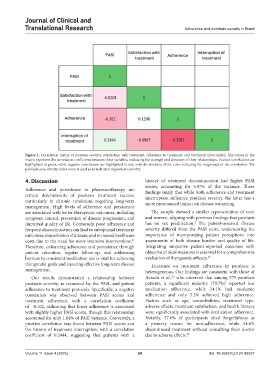
            Figure 1. Correlation matrix of psoriasis severity, satisfaction with treatment, adherence to treatment, and treatment interruption. The values in the
            matrix represent the correlation coefficients between these variables, indicating the strength and direction of their relationships. Positive correlations are
            highlighted in green, while negative correlations are highlighted in red, with the intensity of the color reflecting the magnitude of the correlation. The
            psoriasis area severity index score is used as an indicator of psoriasis severity.

            4. Discussion                                      history of treatment discontinuation had higher PASI
                                                               scores,  accounting  for  5.97%  of  the  variance.  These
            Adherence  and  persistence  to  pharmacotherapy  are   findings imply that while both adherence and treatment
            critical determinants of psoriasis treatment success,   interruption influence psoriasis severity, the latter has a
            particularly in chronic conditions requiring long-term   more pronounced impact on disease worsening.
            management. High levels of adherence and persistence
            are associated with better therapeutic outcomes, including   The sample showed a similar representation of men
            symptom control, prevention of disease progression, and   and women, aligning with previous findings that psoriasis
                                                                                    3
            improved quality of life. Conversely, poor adherence and   has no sex predilection.  The patient-assessed disease
            frequent discontinuation can lead to suboptimal treatment   severity differed from the PASI score, underscoring the
            outcomes, exacerbation of disease, and increased healthcare   importance of incorporating patient perceptions into
            costs due to the need for more intensive interventions.    assessments of  both  disease burden  and  quality  of  life.
                                                         21
            Therefore, enhancing adherence and persistence through   Integrating subjective patient-reported outcomes with
            patient education, regular follow-up, and addressing   objective clinical measures is essential for a comprehensive
            barriers to consistent medication use is vital for achieving   evaluation of therapeutic efficacy. 22
            therapeutic goals and ensuring effective long-term disease   Literature on treatment adherence in psoriasis is
            management.                                        heterogeneous. Our findings are consistent with those of
              Our  results  demonstrated  a  relationship  between   Avazeh  et  al.,  who observed that among 575 psoriasis
                                                                          23
            psoriasis severity, as measured by the PASI, and patient   patients, a significant majority (70.7%) reported low
            adherence to treatment protocols. Specifically, a negative   medication adherence, while 24.1% had moderate
            correlation was observed between PASI  scores  and   adherence and only 5.2% achieved high adherence.
            treatment  adherence,  with  a  correlation  coefficient   Factors such as  age, comorbidities,  treatment type,
            of  −0.102, indicating that lower adherence is associated   adverse effects, treatment satisfaction, and health literacy
            with slightly higher PASI scores, though this relationship   were significantly associated with medication adherence.
            accounted for only 1.04% of PASI variance. Conversely, a   Notably, 57.6% of participants cited forgetfulness as
            positive correlation was found between PASI scores and   a primary reason for non-adherence, while 54.6%
            the history of treatment interruption, with a correlation   discontinued treatment without consulting their doctor
            coefficient of 0.2444, suggesting that patients with a   due to adverse effects. 23


            Volume 11 Issue 4 (2025)                        68                            doi: 10.36922/jctr.24.00057

