


Page 106 - JCTR-11-5
P. 106
Journal of Clinical and
            Translational Research                                          Uric acid, CTGF genotype, and prostate cancer


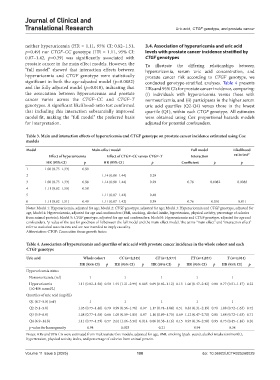
            neither hyperuricemia (HR = 1.11, 95% CI: 0.82–1.51,   3.4. Association of hyperuricemia and uric acid
            p=0.49) nor CTGF–CC genotype (HR = 1.11, 95% CI:   levels with prostate cancer incidence stratified by
            0.87–1.42,  p=0.39) was significantly associated with   CTGF genotypes
            prostate cancer in the main effect models. However, the   To illustrate the differing relationships between
            “full model” showed that interaction effects between   hyperuricemia, serum uric acid concentration, and
            hyperuricemia and  CTGF genotype were statistically   prostate cancer risk according to  CTGF genotype, we
            significant in both the age-adjusted model (p=0.0082)   conducted  genotype-stratified  analyses.  Table  4  presents
            and the fully adjusted model (p=0.010), indicating that   HRs and 95% CIs for prostate cancer incidence, comparing:
            the association between hyperuricemia and prostate   (i) individuals with hyperuricemia versus those with
            cancer varies across the  CTGF–CC  and  CTGF–T     normouricemia, and (ii) participants in the higher serum
            genotypes. A significant likelihood-ratio test confirmed   uric acid quartiles (Q2-Q4) versus those in the lowest
            that including this interaction substantially improved   quartile (Q1), within each CTGF genotype. All estimates
            model fit, making the “full model” the preferred basis   were obtained using Cox proportional hazards models
            for interpretation.                                adjusted for potential confounders.

            Table 3. Main and interaction effects of hyperuricemia and CTGF genotype on prostate cancer incidence estimated using Cox
            models
            Model                       Main‑effect model                         Full model        Likelihood
                      Effect of hyperuricemia  Effect of CTGF–CC versus CTGF–T    Interaction        ratio test*
                     HR (95% CI)     p       HR (95% CI)         p            Coefficient   p          p
            1       1.00 (0.75–1.33)  0.99       –                –               –         –           –
            2            –           –      1.14 (0.90–1.44)     0.29             –         –           –
            3       1.00 (0.75–1.33)  0.98  1.14 (0.90–1.44)     0.29            0.78     0.0082      0.0083
            4       1.11 (0.82–1.50)  0.50       –                –               –         –           –
            5            –           –      1.11 (0.87–1.42)     0.40             –         –           –
            6       1.11 (0.82–1.51)  0.49  1.11 (0.87–1.42)     0.39            0.76      0.010      0.011
            Notes: Model 1: Hyperuricemia, adjusted for age; Model 2: CTGF genotype, adjusted for age; Model 3: Hyperuricemia and CTGF genotype, adjusted for
            age; Model 4: Hyperuricemia, adjusted for age and confounders (BMI, smoking, alcohol intake, hypertension, physical activity, percentage of calories
            from animal protein); Model 5: CTGF genotype, adjusted for age and confounders; Model 6: Hyperuricemia and CTGF genotype, adjusted for age and
            confounders. *p-value of the test for goodness of fit between the full model and the main-effect model. The terms “main effect” and “interaction effect”
            refer to statistical associations and are not intended to imply causality.
            Abbreviation: CTGF: Connective tissue growth factor.

            Table 4. Association of hyperuricemia and quartiles of uric acid with prostate cancer incidence in the whole cohort and each
            CTGF genotype
            Uric acid               Whole cohort    CC (n=2,245)   CT (n=2,977)   TT (n=1,037)    T (n=4,014)
                                   HR (95% CI)  p  HR (95% CI)  p  HR (95% CI)  p  HR (95% CI)  p  HR (95% CI)  p
            Hyperuricemia status
             Normouricemia (ref)       1              1              1              1              1
             Hyperuricemia        1.11 (0.82–1.50) 0.50 1.91 (1.21–2.99) 0.005 0.69 (0.42–1.12) 0.13 1.06 (0.47–2.42) 0.88 0.77 (0.51–1.17) 0.22
             (≥0.416 mmol/L)
            Quartiles of uric acid (mg/dL)
             Q1 (0.7–5.0) (ref)        1              1              1              1              1
             Q2 (5.1–5.8)         1.05 (0.75–1.46) 0.79 0.99 (0.56–1.76) 0.97 1.17 (0.74–1.84) 0.51 0.83 (0.31–2.19) 0.70 1.08 (0.72–1.63) 0.72
             Q3 (5.9–6.8)         1.08 (0.77–1.50) 0.66 1.05 (0.59–1.85) 0.87 1.10 (0.69–1.75) 0.69 1.12 (0.47–2.70) 0.80 1.08 (0.72–1.63) 0.71
             Q4 (6.9–14.8)        1.11 (0.77–1.59) 0.57 2.01 (1.16–3.50) 0.014 0.66 (0.38–1.16) 0.15 0.97 (0.36–2.58) 0.95 0.73 (0.45–1.18) 0.20
             p-value for homogeneity  0.94           0.025           0.21           0.94           0.34
            Notes: HRs and 95% CIs were estimated from multivariate Cox models, adjusted for age, BMI, smoking (pack-years), alcohol intake (oz/month),
            hypertension, physical activity index, and percentage of calories from animal protein.


            Volume 11 Issue 5 (2025)                       100                         doi: 10.36922/JCTR025260029

