


Page 108 - JCTR-11-5
P. 108
Journal of Clinical and
            Translational Research                                          Uric acid, CTGF genotype, and prostate cancer


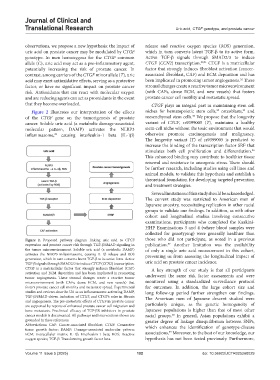
            observations, we propose a new hypothesis: the impact of   release  and reactive  oxygen species  (ROS)  generation,
            uric acid on prostate cancer may be modulated by CTGF   which  in  turn  converts  latent  TGF-β  to  its  active  form.
            genotype. In men homozygous for the  CTGF  common   Active TGF-β signals through SMAD2/3 to induce
            allele (C), uric acid may act as a pro-inflammatory agent,   CTGF (CCN2) transcription. 30,31  CTGF is a matricellular
            potentially  increasing  the  risk  of  prostate  cancer.  In   factor that strongly induces fibroblast activation (cancer-
            contrast, among carriers of the CTGF minor allele (T), uric   associated fibroblast, CAF) and ECM deposition and has
                                                                                                       32
            acid may exert antioxidative effects, serving as a protective   been implicated in promoting tumor angiogenesis.  These
            factor, or have no significant impact on prostate cancer   stromal changes create a reactive tumor microenvironment
            risk. Antioxidants that can react with molecular oxygen   (with CAFs, dense ECM, and new vessels) that fosters
            and are reducing agents can act as prooxidants in the event   prostate cancer cell motility and metastatic spread.
            that they become overloaded.                         CTGF plays an integral part in maintaining stem cell
                                                                                                        34
                                                                                             33
              Figure  2 illustrates our interpretation of the effects   niches  for  hematopoietic  stem  cells,   osteoblasts,   and
                                                                                   35
            of the  CTGF gene on the tumorigenesis of prostate   mesenchymal stem cells.  We propose that the longevity
            cancer. Soluble uric acid (a metabolic damage-associated   variant of  CTGF, rs9399005 (T), maintains a healthy
            molecular pattern, DAMP) activates the NLRP3       stem-cell niche without the toxic environment that would
                        29
            inflammasome,  causing interleukin-1 beta (IL-1β)   otherwise promote carcinogenesis and malignancy.
                                                               The longevity variant (T) of rs9399005 is predicted to
                                                               increase the binding of the transcription factor SRF that
                                                               stimulates both cell proliferation and differentiation.
                                                                                                            36
                                                               This enhanced binding may contribute to healthier tissue
                                                               renewal and resistance to oncogenic stress. There should
                                                               be further research, including studies using cell lines and
                                                               animal models, to validate this hypothesis and establish a
                                                               theoretical foundation for developing targeted prevention
                                                               and treatment strategies.
                                                                 Several limitations of this study should be acknowledged.
                                                               The current study was restricted to American men of
                                                               Japanese ancestry, necessitating replication in other racial
                                                               groups to validate our findings. In addition, as with other
                                                               cohort and longitudinal studies involving consecutive
                                                               examinations, participants who completed the Kuakini-
                                                               HHP Examinations 3 and 4 (where blood samples were
                                                               collected for  genotyping)  were  generally  healthier  than
            Figure  2. Proposed pathway diagram linking uric acid to  CTGF   those  who  did  not  participate,  as  noted  in  a  previous
                                                                        37
            expression and prostate cancer risk through TGF-β/SMAD signaling in   publication.  Another limitation was the availability
            the tumor microenvironment. Soluble uric acid (a metabolic DAMP)   of only a single uric acid measurement in this cohort,
            activates  the  NLRP3 inflammasome, causing IL-1β release and ROS   preventing  us  from  assessing  the  longitudinal  impact  of
            generation, which in turn converts latent TGF-β to its active form. Active
            TGF-β signals through SMAD2/3 to induce CTGF (CCN2) transcription.   uric acid on prostate cancer incidence.
            CTGF is a matricellular factor that strongly induces fibroblast (CAF)   A  key  strength  of  our  study  is  that  all  participants
            activation and ECM deposition and has been implicated in promoting   underwent the same risk factor assessments and were
            tumor angiogenesis. These stromal changes create a reactive tumor
            microenvironment (with CAFs, dense ECM, and new vessels) that   monitored using a standardized surveillance protocol
            fosters prostate cancer cell motility and metastatic spread. Experimental   for outcomes. In addition, the large cohort size and
            studies and reviews describe UA as an inflammasome-activating DAMP,   long follow-up period further strengthen our findings.
            TGF-β/SMAD-driven induction of CTGF, and CTGF’s roles in fibrosis   The American men of Japanese descent studied were
            and angiogenesis. The pro-metastatic effects of CTGF in prostate cancer
            are supported by reports of enhanced prostate cancer cell migration and   particularly unique, as the genetic homogeneity of
            bone  metastasis.  Preclinical  efficacy  of  TGF-βR  inhibitors  in  prostate   Japanese populations is higher than that of most other
                                                                          38
            cancer models is documented. All pathways and interventions shown are   racial groups.  In general, Asian populations exhibit a
            grounded in these references.                      greater  degree  of linkage disequilibrium  between  SNPs,
            Abbreviations:  CAF:  Cancer-associated  fibroblast;  CTGF:  Connective   which enhances the identification of genotype-disease
            tissue growth factor; DAMP: Damage-associated molecular pattern;   39
            ECM: Extracellular matrix; IL-1β: Interleukin-1 beta; ROS: Reactive   associations.  Moreover, to the best of our knowledge, our
            oxygen species; TGF-β: Transforming growth factor beta.  hypothesis has not been tested previously. Furthermore,


            Volume 11 Issue 5 (2025)                       102                         doi: 10.36922/JCTR025260029

