


Page 105 - JCTR-11-5
P. 105
Journal of Clinical and
            Translational Research                                          Uric acid, CTGF genotype, and prostate cancer


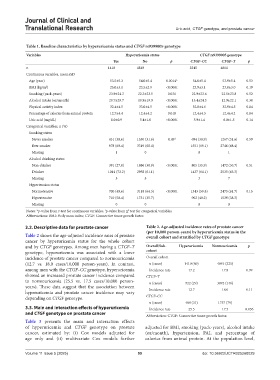
            Table 1. Baseline characteristics by hyperuricemia status and CTGF rs9399005 genotype
            Variables                                 Hyperuricemia status            CTGF rs9399005 genotype
                                                 Yes          No          p       CTGF–CC      CTGF–T      p
            n                                  1410        4849                   2245         4014
            Continuous variables, mean±SD
             Age (year)                         53.5±5.3    54.0±5.4    0.0014*    54.0±5.4     53.9±5.4  0.53
             BMI (kg/m )                        25.0±3.1    23.5±2.9    <0.0001    23.9±3.1     23.8±3.0  0.19
                     2
             Smoking (pack-years)              23.9±24.3    22.3±23.5   0.031      22.9±23.6   22.5±23.8  0.52
             Alcohol intake (oz/month)         20.7±29.7    10.9±19.9   <0.0001    13.4±24.3   12.9±22.1  0.38
             Physical activity index            32.4±4.5    33.0±4.5    <0.0001    32.8±4.6     32.9±4.5  0.84
             Percentage of calories from animal protein  12.7±4.4  12.4±4.2  0.018  12.4±4.3    12.4±4.2  0.84
             Uric acid (mg/dL)                  8.0±0.9      5.4±1.0    <0.0001    5.9±1.4      6.0±1.5   0.14
            Categorical variables, n (%)
             Smoking status
               Never smoker                    431 (30.6)  1530 (31.6)   0.49 †    694 (30.9)  1267 (31.6)  0.59
               Ever smoker                     978 (69.4)  3319 (68.4)            1551 (69.1)  2746 (68.4)
               Missing                            1            0                     0            1
             Alcohol drinking status
               Non-drinker                     391 (27.8)  1886 (38.9)  <0.0001    805 (35.9)  1472 (36.7)  0.51
               Drinker                         1014 (72.2)  2958 (61.1)           1437 (64.1)  2535 (63.3)
               Missing                            5            5                     3            7
             Hypertension status
               Normotensive                    700 (49.6)  3118 (64.3)  <0.0001   1343 (59.8)  2475 (61.7)  0.15
               Hypertensive                    710 (50.4)  1731 (35.7)             902 (40.2)  1539 (38.3)
               Missing                            0            0                     0            0
            Notes: *p-value from t-test for continuous variables;  p-value from χ  test for categorical variables.
                                                        2
                                              †
            Abbreviations: BMI: Body mass index; CTGF: Connective tissue growth factor.
            3.2. Descriptive data for prostate cancer          Table 2. Age‑adjusted incidence rates of prostate cancer
                                                               (per 10,000 person‑years) by hyperuricemia status in the
            Table 2 shows the age-adjusted incidence rates of prostate   overall cohort and stratified by CTGF genotype
            cancer by hyperuricemia status for the whole cohort
            and by CTGF genotypes. Among men having a CTGF–T   Overall/Sub‑  Hyperuricemia  Normouricemia  p
            genotype, hyperuricemia was associated with a lower   cohort
            incidence of prostate cancer compared to normouricemia   Overall cohort
            (12.7  vs. 18.0  cases/10,000 person-years). In contrast,   n (cases)  1410 (60)  4849 (225)
            among men with the CTGF–CC genotype, hyperuricemia   Incidence rate  17.2          17.8       0.99
            showed an increased prostate cancer incidence compared   CTGF–T
            to normouricemia (25.5  vs. 17.5  cases/10,000 person-  n (cases)   922 (29)     3092 (146)
            years). These data suggest that the association between   Incidence rate  12.7     18.0       0.11
            hyperuricemia and prostate cancer incidence may vary
            depending on CTGF genotype.                        CTGF–CC
                                                                n (cases)       488 (31)      1757 (79)
            3.3. Main and interaction effects of hyperuricemia   Incidence rate  25.5          17.5      0.036
            and CTGF genotype on prostate cancer
                                                               Abbreviation: CTGF: Connective tissue growth factor.
            Table 3 presents the main and interaction effects
            of  hyperuricemia  and  CTGF  genotype  on  prostate   adjusted for BMI, smoking (pack-years), alcohol intake
            cancer,  estimated  by:  (i)  Cox  models  adjusted  for   (oz/month), hypertension, PAI, and percentage of
            age only and (ii) multivariate Cox models further   calories from animal protein. At the population level,


            Volume 11 Issue 5 (2025)                        99                         doi: 10.36922/JCTR025260029

