


Page 13 - JCTR-11-5
P. 13
Journal of Clinical and
            Translational Research                                                AI and LLMs in iPSC cardiac research


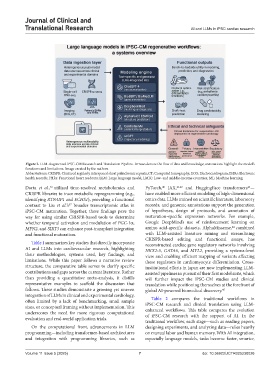
            Figure 2. LLM-Augmented iPSC-CM Research and Translation Pipeline. Arrows denote the flow of data and knowledge; annotations highlight the model’s
            functions and limitations. Image created by the authors.
            Abbreviations: CRISPR: Clustered regularly interspaced short palindromic repeats; CT: Computed tomography; ECG: Electrocardiogram; EHRs: Electronic
            health records; FHRs: Functional heart readouts; LLM: Large language model; LMIC: Low- and middle-income countries; ML: Machine learning.
            Dorta  et al., utilized time-resolved metabolomics and   PyTorch,  JAX, 41,42  and HuggingFace transformers —
                                                                      40
                      36
                                                                                                          43
            CRISPR libraries to trace metabolic reprogramming (e.g.,   have enabled more efficient modeling of high-dimensional
            identifying RTN4IP1 and ECHS1), providing a functional   omics data. LLMs trained on scientific literature, laboratory
                              37
            contrast to Liu  et al.’s  broader transcriptomic atlas in   records, and genomic annotations support the generation
            iPSC-CM maturation. Together, these findings pave the   of hypotheses, design  of protocols, and annotation of
            way for using similar CRISPR-based tools to determine   maturation-specific expression networks. For example,
            whether temporal activation and modulation of PGC-1α,   Google DeepMind’s use of reinforcement learning on
                                                                                                    44
            MFN2, and SIRT3 can enhance post-transplant integration   amino acid-specific datasets, AlphaMissense, combined
            and functional maturation.                         with LLM-assisted literature mining and streamlining
                                                               CRISPR-based editing and functional assays, has
              Table 1 summarizes key studies that directly incorporate   reconstructed cardiac gene regulatory networks involving
            AI and LLMs into cardiovascular research, highlighting   NKX2-5,  GATA6, and  MYL2, providing a systems-level
            their methodologies, systems used, key findings, and   view and enabling efficient mapping of variants affecting
            limitations. While this paper follows a narrative review   these  regulators  in  cardiomyocyte  differentiation.  Cross-
            structure, the comparative table serves to clarify specific   institutional efforts in Japan are now implementing LLM-
            contributions and gaps across the current literature. Rather   assisted pipelines in pursuit of their first model suite, which
            than providing a quantitative meta-analysis, it distills   will  further  impact  the  iPSC-CM  studies  and  clinical
            representative examples to scaffold the discussion that   translation while positioning themselves at the forefront of
            follows. These studies demonstrate a growing yet uneven   global AI-powered biomedical discovery. 45
            integration of LLMs in clinical and experimental cardiology,
            often limited by a lack of benchmarking, small sample   Table  2 compares the traditional workflows in
            sizes, or conceptual framing without implementation. This   iPSC-CM research and clinical translation using LLM-
                                                               enhanced workflows. This table compares the evolution
            underscores the need for more rigorous computational   of iPSC-CM research with the support of AI. In the
            evaluation and real-world application trials.
                                                               traditional workflow, each stage—such as reading papers,
              On the computational front, advancements in LLM   designing experiments, and analyzing data—relies heavily
            programming—including transformer-based architectures   on manual labor and human memory. With AI integration,
            and integration with programming libraries, such as   especially language models, tasks become faster, smarter,


            Volume 11 Issue 5 (2025)                        7                          doi: 10.36922/JCTR025230026

