


Page 41 - JCTR-9-4
P. 41
Sondore et al. | Journal of Clinical and Translational Research 2023; 9(4): 253-260   257
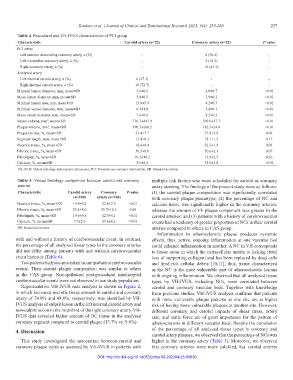
        Table 4. Procedural and VH-IVUS characteristics of PCI group
        Characteristic                               Carotid artery (n=22)       Coronary artery (n=22)        P‑value
        PCI artery
         Left anterior descending coronary artery, n (%)    -                          8 (36.4)                  -
         Left circumflex coronary artery, n (%)             -                          4 (18.2)                  -
         Right coronary artery, n (%)                       -                         10 (45.5)                  -
        Analyzed artery
         Left internal carotid artery, n (%)              6 (27.3)                       -                       -
         Right internal carotid artery, n (%)             16 (72.7)                      -                       -
        Minimal lumen diameter, mm, mean±SD               3.6±0.6                      2.0±0.7                  <0.01
        Mean lumen diameter, mm, mean±SD                  5.0±0.5                      2.9±0.1                  <0.01
        Minimal lumen area, mm, mean±SD                   13.8±3.9                     4.2±0.3                  <0.01
        Minimal vessel diameter, mm, mean±SD              6.3±1.0                      3.8±0.1                  <0.01
        Mean vessel diameter, mm, mean±SD                 7.4±0.8                      4.5±0.2                  <0.01
        Vessel volume, mm , mean±SD                     716.7±447.9                   309.6±37.7                <0.01
                     3
        Plaque volume, mm , mean±SD                     390.3±268.5                   182.3±24.0                <0.01
                     3
        Plaque burden, %, mean±SD                         53.4±7.7                    57.8±5.8                  0.03
        Segment length, mm, mean±SD                       15.4±8.3                    18.1±1.5                  0.17
        Necrotic tissue, %, mean±SD                       18.6±9.4                    22.5±1.9                  0.05
        Fibrotic tissue, %, mean±SD                       56.5±8.0                    50.6±2.1                  0.07
        Fibrolipids, %, mean±SD                          19.3±10.2                    13.9±2.7                  0.36
        Calcium, %, mean±SD                               5.6±4.4                     13.6±1.8                  <0.01
        VH-IVUS: Virtual histology intravascular ultrasound, PCI: Percutaneous coronary intervention, SD: Standard deviation

        Table 5. Virtual histology comparison between carotid and coronary   multiple risk factors who were scheduled for carotid or coronary
        arteries                                                artery stenting. The findings of the present study were as follows:
        Characteristic       Carotid artery   Coronary   P‑value  (1)  the  carotid  plaque  composition  was  significantly  correlated
                                (n=100)   artery (n=100)        with coronary plaque phenotype; (2) the percentage of NC and
        Necrotic tissue, %, mean±SD  19.8±9.4  22.6±7.3  <0.01  calcium tissue was significantly higher in the coronary arteries,
        Fibrotic tissue, %, mean±SD  53.4±8.0  51.7±10.3  0.09  whereas the amount of FF plaque component was greater in the
        Fibrolipids, %, mean±SD  19.6±9.6   12.5±9.1   <0.01    carotid arteries; and (3) patients with a history of cerebrovascular
        Calcium, %, mean±SD     7.7±5.6     13.6±8.2   <0.01    events had a tendency of greater proportion of NCs in their carotid
        SD: Standard deviation                                  arteries compared to others in CAS group.
                                                                   Inflammation  in  atherosclerotic  plaque  produces  systemic
        with and without a history of cerebrovascular event. In contrast,   effects,  thus,  active,  ongoing  inflammation  at  one  vascular  bed
        the percentage of all analyzed tissue types in the coronary arteries   could enhance inflammation in another. A NC in VH corresponds
        did not differ among patients with and without cerebrovascular   to tissue areas in which the extracellular matrix is lacking (total
        event histories (Table 6).                              loss of supporting collagen) and has been replaced by dead cells
          Two patients had post-procedural acute ipsilateral cerebrovascular   and lipid-rich cellular  debris  [10,11], thus, tissue characterized
        events.  Their carotid plaque composition was similar to others   as the NC is the most vulnerable part of atherosclerotic lesions
        in the CAS group. Non-ipsilateral post-procedural intrahospital   with ongoing inflammation. We observed that all analyzed tissue
        cerebrovascular events were not observed in our study population.  types by  VH-IVUS, including NCs,  were correlated  between
          Representative VH-IVUS case analysis is shown in Figure 2,   carotid  and coronary vascular  beds.  Together  with knowledge
        in which increased necrotic tissue amount in carotid and coronary   from previous studies, VH-IVUS analysis confirms that patients
        artery of 74.0% and 48.8%, respectively, was identified by VH-  with  more  vulnerable  plaque  patterns  at  one  site  are  at  higher
        IVUS analysis of culprit lesion in the left internal carotid artery and   risk of having more vulnerable plaques at another site. However,
        non-culprit lesion in the mid-third of the right coronary artery. VH-  different  coronary  and  carotid  impacts  of  shear  stress,  artery
        IVUS data revealed higher amount of DC tissue in the analyzed   size, and static force are of great importance for the pattern of
        coronary segment compared to carotid plaque (13.7% vs. 9.0%).   atherosclerosis in different vascular beds. Despite the correlation
        4. Discussion                                           of  the  percentage  of  all  analyzed  tissue  types  in  coronary  and
                                                                carotid artery plaques, we observed that the percentage of NCs was
          This study investigated  the association  between  carotid  and   higher in the coronary artery (Table 3). Moreover, we observed
        coronary plaque types as assessed by VH-IVUS in patients with   that  coronary  arteries  were  more  calcified,  but  carotid  arteries
                                          DOI: http://dx.doi.org/10.18053/jctres.09.202304.23-00030

