


Page 46 - JCTR-9-4
P. 46
262                       Ali et al. | Journal of Clinical and Translational Research 2023; 9(4): 261-264
        visit for elective cholecystectomy. She was referred to the medical
        department  for further workup after she was found to have
        isolated elevated ALP levels of up to 1537 IU/L (reference range
        40–150  IU/L). According to the patient  she only had a history
        of mild, non-radiating, non-pulsatile, bilateral  headache that
        occurred on and off several times during the day and that receded
        without intervention.  The patient  had no history of deafness,
        tinnitus,  dental  malocclusion,  fractures,  fatigue,  or  generalized
        body weakness. She gave no associated history of any abnormal
        bone enlargement, including her head, with no increase in hat size
        in recent years.
          On  inquiring further, she reported a history of dark-colored
        urine for the past 20 days with no history of pruritis, clay-colored
        stool, or weight loss. Examination revealed mild frontal bossing,
        whereas the rest of her general physical and systemic examination
        were within  normal  limits.  Biochemical  tests revealed  an ALP   Figure 1. X-ray (lateral view) of the skull showing widening of diploid
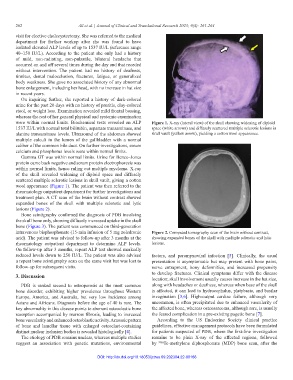
        1537 IU/L with normal total bilirubin, aspartate transaminase, and   space (white arrows) and diffusely scattered multiple sclerotic lesions in
        alanine transaminase levels. Ultrasound of the abdomen showed   skull vault (yellow arrow), yielding a cotton wool appearance.
        multiple  calculi  in  the  lumen  of the  gallbladder  with  a  normal
        caliber of the common bile duct. On further investigations, serum
        calcium and phosphorus levels were within normal limits.
          Gamma GT was within normal limits. Urine for Bence–Jones
        protein came back negative and serum protein electrophoresis was
        within normal limits, hence ruling out multiple myeloma. X-ray
        of the skull revealed widening of diploid space and diffusely
        scattered multiple sclerotic lesions in skull vault, giving a cotton
        wool appearance (Figure 1). The patient was then referred to the
        rheumatology outpatient department for further investigations and
        treatment plan. A CT scan of the brain without contrast showed
        expanded  bones of the  skull  with  multiple  sclerotic  and  lytic
        lesions (Figure 2).
          Bone scintigraphy confirmed the diagnosis of PDB involving
        the skull bone only, showing diffusely increased uptake in the skull
        bone (Figure 3). The patient was commenced on third-generation
        intravenous bisphosphonate (15-min infusion of 5 mg zoledronic   Figure 2. Computed tomography scan of the brain without contrast,
        acid). The patient was advised to follow-up after 3 months at the   showing expanded bones of the skull with multiple sclerotic and lytic
        rheumatology  outpatient  department  to determine  ALP levels.   lesions.
        On follow-up after 3 months, repeat ALP test showed markedly
        reduced levels down to 250 IU/L. The patient was also advised   factors, and paramyxoviral  infection  [5]. Clinically, the usual
        a repeat bone scintigraphy scan on the same visit but was lost to   presentation is asymptomatic but may present with bone pains,
        follow-up for subsequent visits.                        nerve  entrapment,  bony deformities,  and  increased  propensity
                                                                to develop fractures. Clinical symptoms differ with the disease
        3. Discussion
                                                                location; skull involvement usually causes increase in the hat size,
          PDB is ranked second to osteoporosis as the most common   along with headaches or deafness, whereas when base of the skull
        bone disorder, exhibiting  higher  prevalence  throughout  Western   is affected, it can lead to hydrocephalus, platybasia, and basilar
        Europe, America, and Australia, but very low incidence among   invagination  [3,6]. High-output  cardiac  failure,  although  very
        Asians and Africans. Diagnosis before the age of 40 is rare. The   uncommon, is often precipitated due to enhanced vascularity of
        key abnormality in this disease points to aberrant osteoclastic bone   the affected bone, whereas osteosarcoma, although rare, is usually
        resorption accompanied by marrow fibrosis, leading to increased   the feared complication in a pre-existing pagetic bone [7].
        bone vascularity and enhanced osteoblastic activity. A mosaic pattern   According  to  the US Endocrine  Society  clinical  practice
        of bone and lamellar tissue with enlarged osteoclast-containing   guidelines, effective management protocols have been formulated
        distinct nuclear inclusion bodies is revealed histologically [4].  for patients suspected of PDB, where the first-line investigation
          The etiology of PDB remains unclear, whereas multiple studies   remains  to be plain  X-ray of the affected  regions, followed
        suggest an  association  with  genetic  mutations,  environmental   by  99m Tc-methylene diphosphonate (MDP) bone scan, after the


                                          DOI: http://dx.doi.org/10.18053/jctres.09.202304.22-00186

