


Page 50 - JCTR-9-4
P. 50
266                       Seetharam et al. | Journal of Clinical and Translational Research 2023; 9(4):265-271
        ACS impact on the physical and mental health status of ACS   Further,  not  many  studies  have  looked  into  the  effect  of
        survivors.                                              comorbidities  on the quality  of life  (QoL) measured  post-PCI.
          A self-administered generic tool short-form health survey   Therefore, this study aimed to evaluate  the QoL among  ACS
        (SF-36) has been used in angina, acute myocardial infarction   patients post-PCI using the SF-12 health survey questionnaire and
        (AMI), and heart failure. The SF-36 has been demonstrated to   to explore the effect of comorbidities on QoL.
        be a sensitive measure for identifying improvements in HRQoL
        following active intervention in individuals with recent AMI.   2. Materials and Methods
        The SF-12 and SF-8 are condensed forms of the questionnaire
        which are accessible for use and are quicker to complete [3].  2.1. Study setting
          Multiple studies have shown that QoL is better after PCI than   This cohort study was conducted at the Cardiology outpatient
        it was before. Complete angina resolution was better with PCI,   department,  R.L. Jalappa Hospital,  in association  with the
        according to a meta-analysis of 14 randomized controlled trials   Department of Physiology, attached to Sri Devaraj Urs Medical
        comparing PCI to medical therapy in 7818  patients enrolled   College, Kolar, Karnataka, India.
        from 1987 to 2005. Furthermore, it has been observed that the
        SF-12, or condensed version of the SF-36, correlates favorably   2.2. Ethical consideration
        with the SF-36 summary scores in a variety of illnesses,
        including angina [4].                                      Central Ethics Committee clearance was obtained (CEC No.
          The reason for using the SF-12 health survey questionnaire was   SDUAHER/KLR/R & I/91/2021-22). Each participant provided
        with only 12 items, health status could be assessed aptly when   written informed consent to participate in the study.
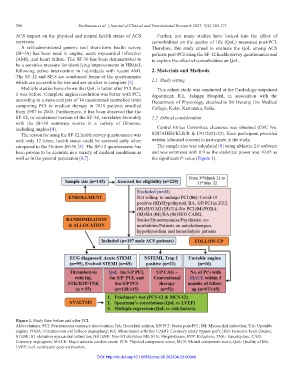
        compared to the 36-item SF-36 [5]. The SF-12 questionnaire has   The sample size was calculated [8] using nMaster 2.0 software
        been proven to be accurate in a variety of medical conditions as   and was estimated with 0.9 as the statistical power and <0.05 as
        well as in the general population [6,7].                the significant P-value (Figure 1).


        Figure 1. Study flow before and after PCI.
        Abbreviations: PCI: Percutaneous coronary intervention; BA: Bronchial asthma; S/P PCI: Status post-PCI; MI: Myocardial infarction; UA: Unstable
        angina; POBA: Percutaneous old balloon angioplasty; RA: Rheumatoid arthritis; CABG: Coronary artery bypass graft; IHD: Ischemic heart disease;
        STEMI: ST elevation myocardial infarction; NSTEMI: Non-ST elevation MI; STK: Streptokinase; RTP: Reteplase; TNK: Tenecteplase; CAG:
        Coronary angiogram; MACE: Major adverse cardiac event; PCS: Physical component score; MCS: Mental component score; QoL: Quality of life;
        LVEF: Left ventricular ejection fraction.
                                          DOI: http://dx.doi.org/10.18053/jctres.09.202304.23-00049

