


Page 68 - JCTR-9-4
P. 68
284                       Al-Qahtani et al. | Journal of Clinical and Translational Research 2023; 9(4): 282-289
        thrive  (two  males  and  six  females).  There  was  no  significant   Marsh–Oberhuber  classification.  Interestingly,  most  of  these
        association between gender and the different clinical presentations   patients were females (74.6%), while only 18 were males.
        (P = 0.97).                                                The second most notable  histopathological  finding  was  an
          Table 2 illustrates the histopathological findings of duodenal   increased frequency of intraepithelial lymphocytes without villous
        biopsies, grades of celiac  disease according to Corazza and   atrophy, which was found in 56 biopsies (37.3%) and classified as
        Villanaci  criteria,  and  histopathological  classification  according   Grade A according to Corazza and Villanaci criteria, and Type 1/
        to Marsh–Oberhuber criteria. Almost half of duodenal biopsies   Type 2 lesions according to the Marsh–Oberhuber classification.
        (71  cases, 47.3%) showed shortened villi caused by partial   In 23 patients (15.3%), there was severe subtotal villous atrophy,
        atrophy, which is consistent with Grade B1 according to Corazza   assigned as Grade  B2 according  to Corazza  and  Villanaci
        and  Villanaci  criteria,  and  Type  3A/3B lesions according  to   criteria and Type 3C lesions according to the Marsh–Oberhuber
                                                                classification. This group comprised 13 males (56.5%), compared
                               Number of cases per year         to  only  10  females.  Finally,  there  was  a  significant  association
                  70                                            (P =  0.01)  between  gender and histopathological  observations,
                  60
                  50                                            grading, and classification of celiac disease lesions.
                  40                                            4. Discussion
                  30
                  20                                               This 5-year retrospective  study aimed  to investigate
                  10                                            histopathological features in duodenal biopsies from celiac disease
                   0
                       2015   2016   2017    2018   2019        patients enrolled in different hospitals in Najran, Saudi Arabia.
            No. of patients  8  18    12      51     61         This work is a continuation of other previously published studies
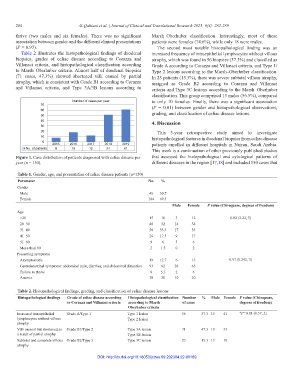
        Figure 1. Case distribution of patients diagnosed with celiac disease per   that  assessed the histopathological  and cytological  patterns  of
        year (n = 150).                                         different diseases in the region [17,18] and included 150 cases that

        Table 1. Gender, age, and presentation of celiac disease patients (n=150)
        Parameter                                              No.  %
        Gender
         Male                                                  46   30.7
         Female                                                104  69.3
                                                                         Male  Female   P value (Chi‑square, degrees of freedom)
        Age
         <20                                                   15   10    3      12              0.82 (2.22, 5)
         20–30                                                 48   32    14     34
         31–40                                                 50   33.3  17     33
         41–50                                                 26   17.3  9      17
         51–60                                                  9    6    3      6
         More than 60                                           2   1.3   0      2
        Presenting symptoms
         Asymptomatic                                          19   12.7  6      13              0.97 (0.242, 3)
         Gastrointestinal symptoms: abdominal pain, diarrhea, and abdominal distention   93  62  28  65
         Failure to thrive                                      8   5.3   2      6
         Anemia                                                30   20    10     20

        Table 2. Histopathological findings, grading, and classification of celiac disease lesions
        Histopathological findings  Grade of celiac disease according   Histopathological classification  Number   %  Male  Female  P value (Chi‑square,
                             to Corazza and Villanaci criteria  according to Marsh–  of cases        degrees of freedom)
                                                       Oberhuber criteria
        Increased intraepithelial   Grade A/Type 1    Type 1 lesion          56      37.3 15  41     *P=0.01 (8.57, 2)
        lymphocytes without villous                   Type 2 lesion
        atrophy
        Villi present but shortened as   Grade B1/Type 2   Type 3A lesion    71      47.3 18  53
        a result of partial atrophy                   Type 3B lesion
        Subtotal and complete villous  Grade B2/Type 3   Type 3C lesion      23      15.3 13  10
        atrophy

                                          DOI: http://dx.doi.org/10.18053/jctres.09.202304.22-00189

