


Page 63 - JCTR-9-4
P. 63
Li et al. | Journal of Clinical and Translational Research 2023; 9(4): 272-281  279
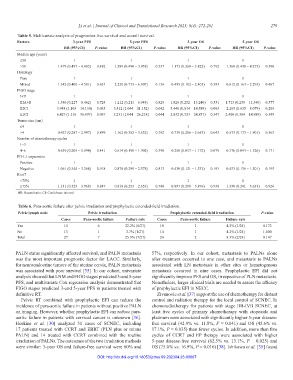
        Table 5. Multivariate analysis of progression-free survival and overall survival.
        Factors                3‑year PFS              5‑year PFS              3‑year OS              5‑year OS
                            HR (95%CI)   P‑value   HR (95%CI)    P‑value   HR (95%CI)   P‑value   HR (95%CI)   P‑value
        Median age (years)
         ≤50                    1                      1                       1                      1
         >50             1.479 (0.497 – 4.405)  0.482  1.389 (0.490 – 3.938)  0.537   1.173 (0.360 – 3.822)  0.792  1.368 (0.438 – 4.275)  0.590
        Histology
         Pure                   1                      1                       1                      1
         Mixed           1.342 (0.400 – 4.501)  0.633  2.250 (0.733 – 6.907)  0.156  0.495 (0.102 – 2.405)  0.383  0.612 (0.163 – 2.295)  0.467
        FIGO stage
         I+II                   1                      1                       1                      1
         IIIA+B          1.386 (0.227 – 8.462)  0.724  1.212 (0.211 – 6.948)  0.829  1.826 (0.252 – 13.240)  0.551   1.713 (0.259 – 11.340)  0.577
         IIIC1           3.948 (1.103 – 14.130)  0.035   3.412 (1.044 – 11.152)  0.042  3.446 (0.814 – 14.589)  0.093  2.265 (0.635 – 8.079)  0.208
         IIIC2           6.427 (1.116 – 36.997)  0.037   5.231 (1.044 – 26.218)  0.044  2.832 (0.323 – 24.837)  0.347  2.400 (0.384 – 14.989)  0.349
        Tumor size (cm)
         ≤4                     1                      1                       1                      1
         >4              0.927 (0.287 – 2.997)  0.899  1.162 (0.382 – 3.532)  0.792  0.739 (0.206 – 2.653)  0.643  0.573 (0.173 – 1.901)  0.363
        Number of chemotherapy cycles
         1–3                    1                      1                       1                      1
         4–6             0.639 (0.205 – 1.994)  0.441   0.614 (0.198 – 1.902)  0.398  0.258 (0.057 – 1.172)  0.079  0.376 (0.093 – 1.526)  0.171
        PD-L1 expression
         Positive               1                      1                       1                      1
         Negative        1.061 (0.344 – 3.268)  0.918  0.878 (0.299 – 2.578)  0.813   0.430 (0.121 – 1.532)  0.193  0.453 (0.136 – 1.501)  0.195
        Ki-67
         <75%                   1                      1                       1                      1
         ≥75%            1.131 (0.323 – 3.968)  0.847  0.819 (0.253 – 2.653)  0.740  0.897 (0.208 – 3.876)  0.938  1.330 (0.241 – 3.653)  0.926
        HR: Hazard ratio; CI: Confidence interval

        Table 6. Para-aortic failure after pelvic irradiation and prophylactic extended-field irradiation.
        Pelvic lymph node             Pelvic irradiation                Prophylactic extended‑field irradiation  P‑value
                           Cases    Para‑aortic failure  Failure rate  Cases  Para‑aortic failure  Failure rate
        Yes                 14            6          22.2% (6/27)   10            1             4.2% (1/24)    0.172
        No                  13            1           3.7% (1/27)   14            1             4.2% (1/24)    1.000
        Total               27            7          25.9% (7/27)   24            2             8.3% (2/24)    0.147


        PALN status significantly affected survival, and PALN metastasis   57%,  respectively.  In  our  cohort,  metastasis  to  PALNs  alone
        was the most important prognostic factor for LACC. Similarly,   after  treatment  occurred  in  one  case,  and  metastasis  to  PALNs
        for neuroendocrine tumors of the uterine cervix, PALN metastasis   associated  with  LN  metastasis  in  other  sites  or  hematogenous
        was associated with poor survival [35]. In our cohort, univariate   metastasis  occurred  in  nine  cases.  Prophylactic  EFI  did  not
        analysis showed that LNM and FIGO stages predicted 3-and 5-year   significantly improve PFS and OS, irrespective of PLN metastasis.
        PFS, and multivariate Cox regression analysis demonstrated that   Nonetheless, larger clinical trials are needed to assess the efficacy
        FIGO stages predicted 3-and 5-year PFS in patients treated with   of prophylactic EFI in NECC.
        definitive RT.                                             Zivanovic et al. [37] support the use of chemotherapy for distant
          Pelvic  RT  combined  with  prophylactic  EFI  can  reduce  the   control and radiation therapy for the local control of SCNEC. In
        incidence of para-aortic failure in patients without positive PALN   chemoradiotherapy for patients with stage IIB-IVB SCNEC, at
        on imaging. However, whether prophylactic EFI can reduce para-  least  five  cycles  of  primary  chemotherapy  with  etoposide  and
        aortic failure in patients with cervical cancer is unknown [36].   platinum were associated with significantly higher 5-year disease-
        Hoskins  et  al. [30]  analyzed  31  cases  of  SCNEC,  including   free survival (42.9% vs. 11.8%, P = 0.041) and OS (45.6% vs.
        17 patients treated with CCRT and EBRT (PLN plus or minus   17.1%, P = 0.035) than fewer cycles. In addition, more than five
        PALN)  and  14  treated  with  CCRT  combined  with  the  routine   cycles  of  CCRT  and  EP  therapy  were  associated  with  higher
        irradiation of PALNs. The outcomes of the two irradiation methods   5-year disease-free survival (62.5% vs. 13.1%, P = 0.025) and
        were similar: 3-year OS and failure-free survival were 60% and   OS (75.0% vs. 16.9%, P = 0.016) [38]. Ishikawa et al. [35] found
                                          DOI: http://dx.doi.org/10.18053/jctres.09.202304.23-00067

