


Page 58 - JCTR-9-4
P. 58
274                       Li et al. | Journal of Clinical and Translational Research 2023; 9(4): 272-281
        2.5. Ethnical statements                                3.2. Immunohistochemistry

        2.5.1. Ethical approval                                    Ki-67 protein expression levels were measured in 59 patients.
                                                                The number of Ki-67-positive cells in each patient ranged from
          This study was performed in accordance with the principles of the   20%  to  100%,  with  a  median  of  75%.  Immunohistochemistry
        Declaration of Helsinki and was approved by the Ethics Committee   showed that 92.2% (59/64), 41.9% (26/62), and 67.2% (41/61)
        of Clinical Oncology School of Fujian Medical University, Fujian   patients were positive for Syn, CgA, and CD56, respectively.PD-
        Cancer Hospital (Review Number K2022-208-01).           L1 expression was positive in 17 (37.8%) patients.
        2.5.2. Consent to participate                           3.3. OS

          Informed consent was obtained from all individual participants   The follow-up period ranged from 13 to 156 months, with a
        included in the study.                                  median of 33 months. The 3- and 5-year OS was 41.7% and 35.2%,

        2.5.3. Consent to publish                               and 3- and 5-year PFS was 35.6% and 30.6%, respectively. The
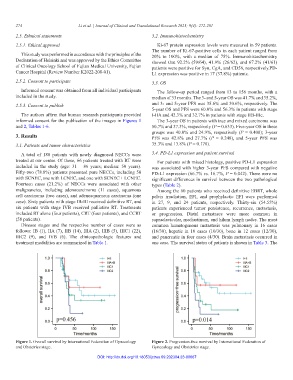
                                                                5-year OS and PFS were 60.0% and 56.3% in patients with stage
          The authors affirm that human research participants provided   I-IIA and 42.3% and 32.7% in patients with stage IIB-IIIc.
        informed consent for the publication of the images in Figures 1   The 3-year OS in patients with true and mixed carcinoma was
        and 2, Tables 1-6.                                      50.7% and 37.3%, respectively (P = 0.633). Five-year OS in these
                                                                groups was 40.0% and 24.9%, respectively (P = 0.400); 3-year
        3. Results                                              PFS  was  42.8%  and  27.7%  (P  =  0.248),  and  5-year  PFS  was
        3.1. Patients and tumor characteristics                 35.3% and 13.8% (P = 0.178).
          A  total  of  188  patients  with  newly  diagnosed  NECCs  were   3.4. PD-L1 expression and patient survival
        treated at our center. Of these, 66 patients treated with RT were   For patients with mixed histology, positive PD-L1 expression
        included  in  the  study  (age:  31  –  86  years;  median:  50  years).   was associated with higher 3-year PFS compared with negative
        Fifty-two (78.8%) patients presented pure NECCs, including 50   PD-L1 expression (66.7% vs. 16.7%, P = 0.042). There were no
        with SCNEC, one with LCNEC, and one with SCNEC + LCNEC.   significant differences in survival between the two pathological
        Fourteen  cases  (21.2%)  of  NECCs  were  associated  with  other   types (Table 2).
        malignancies,  including  adenocarcinoma  (11  cases),  squamous   Among the 60 patients who received definitive EBRT, whole
        cell carcinoma (two cases), and adenosquamous carcinoma (one   pelvis  irradiation,  EFI,  and  prophylactic  EFI  were  performed
        case). Sixty patients with stage IB-III received definitive RT, and   in  27,  9,  and  24  patients,  respectively.  Thirty-six  (54.55%)
        six  patients  with  stage  IVB  received  palliative  RT.  Treatments   patients  experienced  tumor  persistence,  recurrence,  metastasis,
        included RT alone (four patients), CRT (four patients), and CCRT   or  progression.  Distal  metastases  were  more  common  in
        (58 patients).                                          supraclavicular, mediastinum, and hilum lymph nodes. The most
          Disease  stages  and  the  respective  number  of  cases  were  as   common  hematogenous  metastasis  was  pulmonary  in  16  cases
        follows: IB (1), IIA (7), IIB (14), IIIA (2), IIIB (5), IIIC1 (22),   (16/30),  hepatic  in  10  cases  (10/30),  bone  in  12  cases  (12/30),
        IIIC2  (9),  and  IVB  (6).  The  clinicopathologic  features  and   and pancreatic in four cases (4/30). Brain metastasis occurred in
        treatment modalities are summarized in Table 1.         one case. The survival status of patients is shown in Table 3. The


        Figure 1. Overall survival by International Federation of Gynecology   Figure 2. Progression-free survival by International Federation of
        and Obstetrics stage.                                   Gynecology and Obstetrics stage.
                                          DOI: http://dx.doi.org/10.18053/jctres.09.202304.23-00067

